

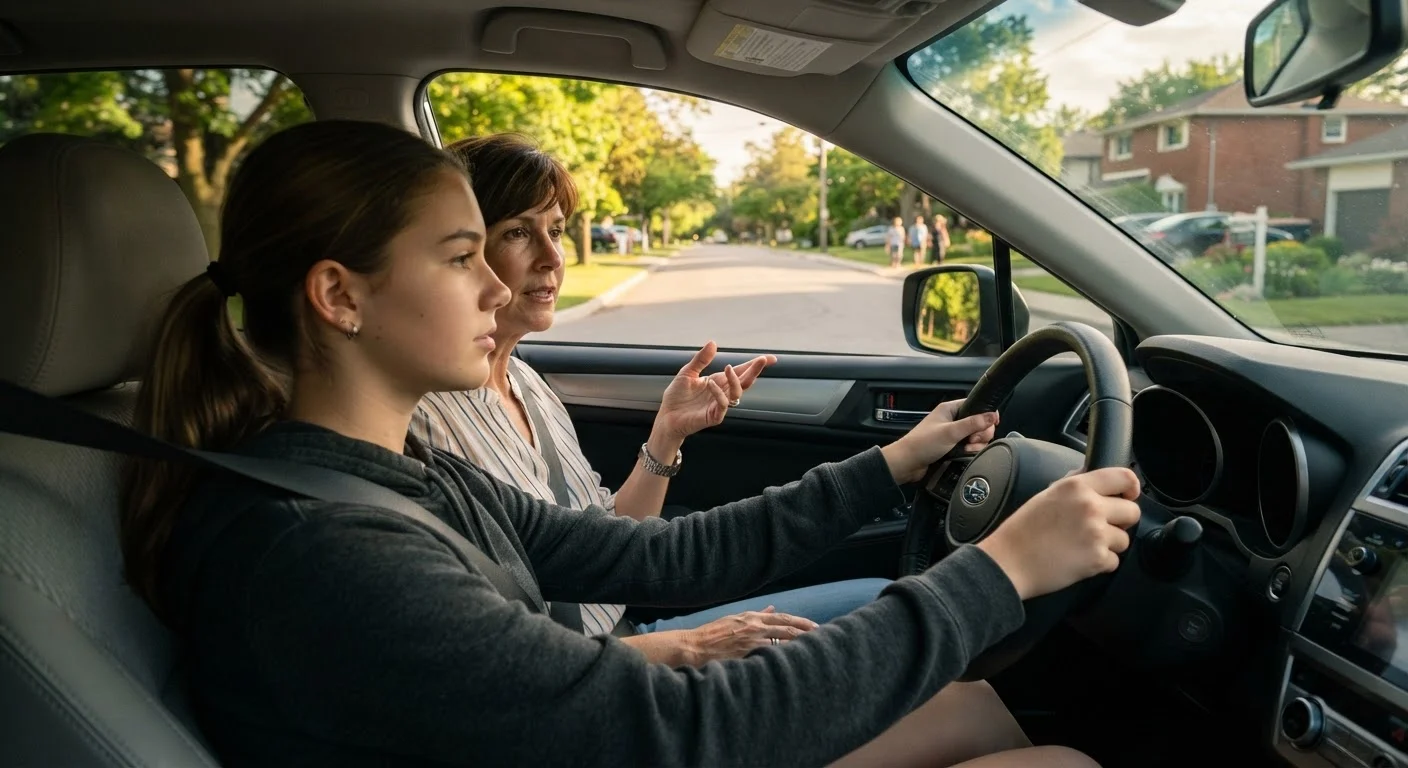
Why the First Year Is the Most Critical
New drivers don't lack effort - they lack accumulated experience. The human brain develops hazard-perception skills gradually, and that gap between license-in-hand and true road fluency is where most teen crashes occur. Understanding this frames supervised practice not as a formality but as a genuine safety intervention.
The First Year Carries the Highest Risk
Research consistently shows that newly licensed drivers are significantly more likely to be involved in a serious crash during their first year of independent driving than at any later point. This isn't about ability - it's about experience. The habits established during supervised practice are the primary buffer against that elevated risk. Treat every session as a deliberate investment in long-term safety.
For families thinking about the longer arc of driving risk, our article on how driving risks shift across a lifetime offers useful context on how the risk profile of a teen driver compares to other age groups.
Passenger Limits Matter More Than You Think
Every additional teen passenger in a vehicle driven by a newly licensed teen statistically increases crash risk. Most states restrict the number of non-family passengers a new driver may carry during the first months of licensure - know your state's graduated licensing rules and enforce them consistently at home, even when the law allows exceptions.
The goal of supervised practice is not to accumulate hours on a form - it's to build specific, transferable habits before the moment arrives when no adult is in the passenger seat.
What to Do: Step-by-Step Guidance for Supervising Adults
What you will need
Graduated Driver Licensing (GDL) State Summary
Identifies the specific permit hours, nighttime restrictions, and passenger limits that apply in your state.
Vehicle Owner's Manual
Helps the teen learn warning lights, mirror adjustment, and basic controls specific to the car they'll be driving.
Driving Log or Practice App
Tracks hours driven, conditions practiced, and skills completed so neither parent nor teen loses sight of progress.
Establish a pre-drive checklist ritual
Before every practice session, walk through the same brief sequence: adjust the seat and steering wheel, set all mirrors (including blind-spot checks), confirm seatbelts are fastened, and silence phones. Doing this verbally and visibly - every single time - wires the habit before solo driving begins.
Address phone and distraction rules before the engine starts
Set a non-negotiable expectation: the phone goes face-down or in a bag before the car moves. Research covered in our analysis of phone use and cognitive distraction shows that even hands-free calls meaningfully reduce a driver's attention - a risk that is amplified for inexperienced drivers whose working memory is already occupied with basic vehicle control.
Start in genuinely low-stakes environments
Empty parking lots and quiet residential streets are the appropriate starting point - not because the teen isn't capable, but because foundational skills (smooth braking, steering input, spatial awareness) require mental bandwidth that complex traffic consumes before it can be spared. Move to arterial roads only after parking-lot maneuvers feel automatic.
Introduce varied conditions deliberately
Once basic control is solid, deliberately include night driving, highway merging, rain, and high-traffic periods - while you are still in the passenger seat. Most states log supervised hours but don't require specific conditions. Fill that gap intentionally. Teens who've driven in rain with a coach respond more calmly to rain alone.
Teach scanning and following distance as active habits
Experienced drivers scan intersections and track multiple vehicles automatically. New drivers focus on the car directly ahead. Teach the three-second following distance rule explicitly, and practice narrating the road: 'What's happening two cars ahead? What's in your mirrors?' This active commentary transitions into internal habit over time.
Model the behavior you expect
Teens observe their parents driving for years before they sit behind the wheel themselves. Rolling stops, phone use at lights, and tailgating register and normalize. If your household rule is phone-away driving, it applies to every adult in the car, every time. Consistency between what you teach and what you model is the strongest reinforcement available. For a broader look at how driving risks evolve with age, see our guide to road safety across a lifetime.
Introduce basic vehicle care alongside driving skills
A driver who understands how to check tire pressure, read a fuel gauge, and recognize a dashboard warning light is safer and more confident. Pair driving practice with brief, practical under-the-hood moments. Our first-time owner's roadmap to routine car care covers the foundational checks every new driver should recognize.
Practice in Conditions You Hope Never to Face
Many families naturally avoid supervised sessions in rain, heavy traffic, or at night - but those are exactly the conditions that catch new drivers off guard when they're alone. Deliberately scheduling practice in varied conditions, while you're still in the car, builds far more adaptive skill than accumulated hours in ideal weather. For more on wet-road technique, see our rainy weather driving habits guide.
The content provided on our blog site traverses numerous categories, offering readers valuable and practical information. Readers can use the editorial team’s research and data to gain more insights into their topics of interest. However, they are requested not to treat the articles as conclusive. The website team cannot be held responsible for differences in data or inaccuracies found across other platforms. Please also note that the site might also miss out on various schemes and offers available that the readers may find more beneficial than the ones we cover.