

Option A
The 50/30/20 Rule
The flexible, percentage-based framework for busy households.
Best for: Families with steady monthly income who want a simple structure without micromanaging every purchase.
Option B
Envelope Budgeting
The hands-on, category-by-category spending control system.
Best for: Families who overspend in specific categories and need a hard stop to reinforce discipline.
How Each System Works
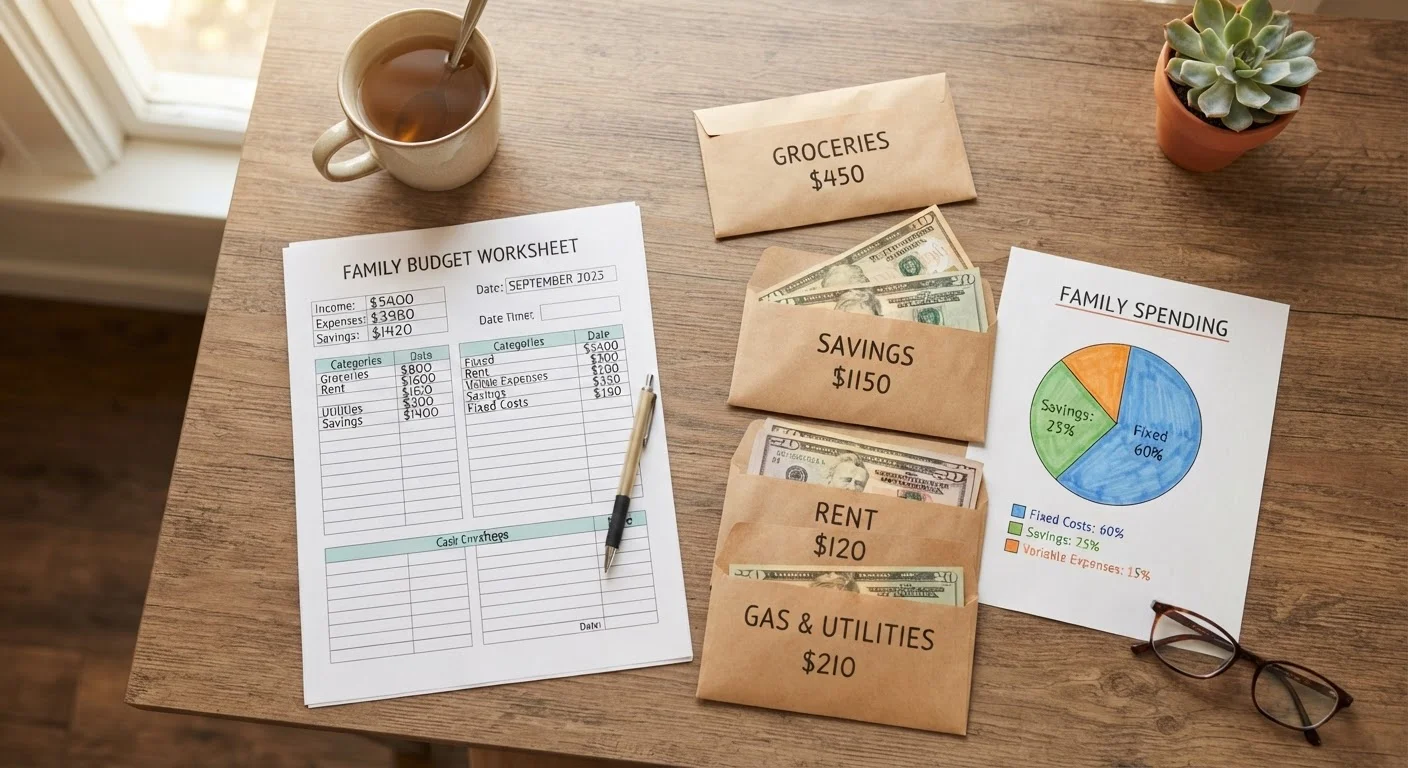
The 50/30/20 rule was popularized as a straightforward way to allocate after-tax household income: roughly 50% toward needs (housing, utilities, groceries, insurance), 30% toward wants (dining out, streaming, recreation), and 20% toward savings and debt repayment beyond minimums. The appeal is simplicity - you set the percentages once, check your spending against them monthly, and adjust course if a category runs hot.
Envelope budgeting operates differently. At the start of each pay period, you divide your income into labeled envelopes - one for groceries, one for gas, one for dining, and so on. Each envelope receives a fixed dollar amount. When the envelope empties, spending in that category stops until the next funding cycle. Originally a cash system, it's now widely practiced digitally through apps or spreadsheets that replicate the same hard-limit logic.
Both methods share a core premise: pre-committing where money goes before you spend it. The difference is granularity and enforcement. The 50/30/20 rule gives you wide lanes; envelope budgeting gives you narrow, numbered slots. See the spending categories most households need to account for for a sense of how detailed envelope systems can get.
Where Each Method Holds Up - and Where It Doesn't
The 50/30/20 rule's flexibility is its greatest strength and its most common weakness. For families with stable salaries and generally disciplined spending, three buckets are usually enough to stay on track. But the needs/wants distinction is harder to draw in practice than it sounds - a car payment is a need, but which car? A smartphone plan is a need, but which plan? The needs vs. wants line is blurrier than most budgeting advice admits, and that ambiguity gives plenty of room for spending to drift upward within the "needs" bucket.
Envelope budgeting eliminates most of that ambiguity by forcing category-level decisions upfront. If the grocery envelope holds $600, you know when you're at $580 and can course-correct before month-end. The limitation is setup time and maintenance - families typically need 10-15 or more active envelopes to cover common household categories, each requiring its own monthly funding decision.
| Criterion | 50/30/20 Rule | Envelope Budgeting |
|---|---|---|
| Setup complexity | Low - three categories only | Moderate - 10-15+ envelopes |
| Ongoing maintenance | Monthly review | Each pay period refunding |
| Handles variable income | Less predictable (% of unknown total) | More reliable (fixed dollar amounts) |
| Spending enforcement | Soft - category limits are broad | Hard - empty envelope = stop spending |
| Savings visibility | Built-in 20% target | Requires a dedicated savings envelope |
| Best for beginners | Yes - minimal learning curve | Moderate - requires category planning |
| Flexibility for lifestyle variation | High - broad buckets adapt easily | Lower - each change needs re-allocation |
Families managing irregular income - freelancers, hourly workers, households with seasonal earnings - often find envelope budgeting more reliable, since they're working with actual dollars rather than percentages of an uncertain total. By contrast, dual-income professional households with predictable paychecks tend to find the 50/30/20 rule sufficient without the overhead of granular tracking.
Practical Considerations for Families
Before choosing a framework, it helps to diagnose where your household money actually goes wrong. If your problem is that you simply don't save enough, the 50/30/20 rule's explicit 20% savings target may be the nudge you need. If your problem is that groceries or dining consistently blow past your mental budget, an envelope sets a boundary that percentages don't.
Neither System Requires Cash
Envelope budgeting no longer requires physical currency. Many families replicate the system using separate bank accounts, labeled spreadsheet columns, or dedicated budgeting apps that apply the same hard-limit logic digitally. Similarly, the 50/30/20 rule works equally well tracked through a bank's spending dashboard or a simple monthly tally. The framework matters more than the medium.
Implementation also matters. Both systems can be run on paper, in a spreadsheet, or through digital tools. If you're deciding between tracking methods rather than budgeting frameworks, the comparison of paper budgets vs. budgeting apps covers that tradeoff in detail. For families who want to apply either framework month by month, the month-by-month family budget checklist offers a structured review process that works with either system.
One hybrid approach many families use: start with the 50/30/20 rule to understand their broad spending patterns, then layer in envelope-style limits only for the two or three categories where they consistently overspend. This combines low maintenance with targeted enforcement where it counts most.
This article is for general informational and educational purposes only and does not constitute personalized financial advice. Consult a qualified financial professional for guidance specific to your household's situation.
The content provided on our blog site traverses numerous categories, offering readers valuable and practical information. Readers can use the editorial team’s research and data to gain more insights into their topics of interest. However, they are requested not to treat the articles as conclusive. The website team cannot be held responsible for differences in data or inaccuracies found across other platforms. Please also note that the site might also miss out on various schemes and offers available that the readers may find more beneficial than the ones we cover.