

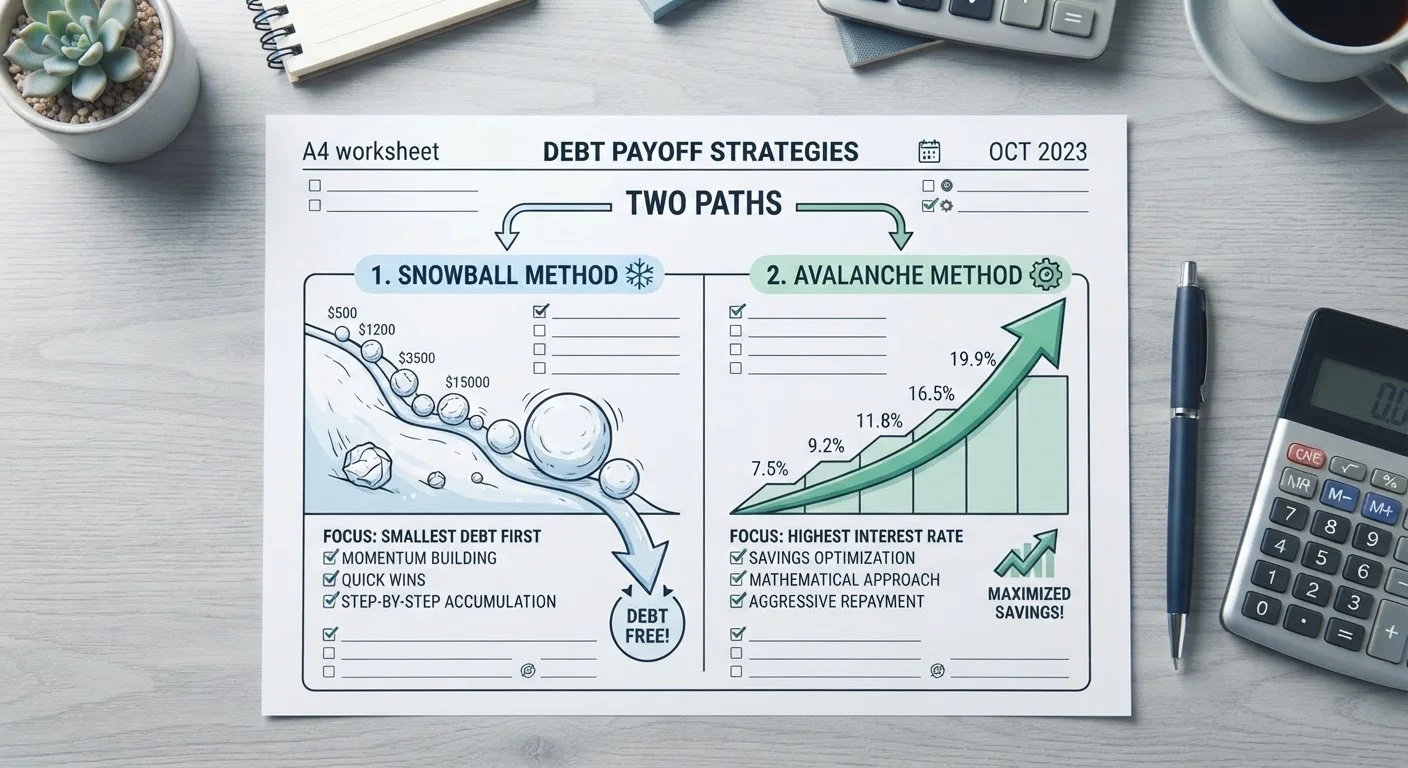
Option A
Debt Avalanche
The mathematically optimal, interest-minimizing approach.
Best for: Families who are highly motivated by numbers and want to minimize total interest paid over the life of their debts.
Option B
Debt Snowball
The behaviorally driven, momentum-building approach.
Best for: Families who need visible early wins to stay motivated and build consistent debt-payoff habits.
How Each Method Actually Works
Both strategies share the same mechanical foundation: you pay the monthly minimum on every debt you carry, then direct any additional dollars - your "payoff surplus" - toward one target account at a time. The difference is purely in how you rank that target.
Debt Avalanche: You rank debts by interest rate, highest to lowest. Your entire surplus goes to the top-rate account until it reaches a zero balance, then you roll that freed-up payment to the next account on the list - like an avalanche gathering speed as it descends.
Debt Snowball: You rank debts by outstanding balance, smallest to largest. Your surplus attacks the smallest account first, regardless of its interest rate. Once that account is cleared, the freed payment rolls to the next smallest balance - like a snowball picking up mass.
Before you can apply either method effectively, you need a clear picture of every debt you carry. The family debt inventory walks through exactly how to catalogue balances, rates, and minimum payments so nothing gets overlooked.
| Criterion | Debt Avalanche | Debt Snowball |
|---|---|---|
| Payoff order | Highest interest rate first | Smallest balance first |
| Total interest paid | Lower (mathematically optimal) | Potentially higher |
| Time to first zero balance | Longer (if high-rate debt is large) | Shorter (quick early wins) |
| Motivational structure | Driven by numbers and savings logic | Driven by visible progress milestones |
| Account complexity | Unchanged until high-rate debts clear | Reduces account count quickly |
| Best rate-spread scenario | Wide gap between rates (e.g. 5% vs. 24%) | Rates cluster closely together |
| Completion likelihood | Higher for analytically motivated households | Higher for households needing behavioral wins |
The Real Cost Difference - and Why It Varies
The avalanche method will almost always produce a lower total interest cost, sometimes meaningfully so. The exact gap depends on the spread between your highest and lowest interest rates, your balances, and how large a monthly surplus you can maintain.
Consider a simplified household scenario: three debts totaling $14,000 - a $1,000 medical bill at 0% interest, a $4,000 personal loan at 11%, and a $9,000 credit card balance at 22%. The snowball clears the medical bill first (quick win, but 0% interest - no savings). The avalanche attacks the credit card immediately. Over 24-36 months, that difference in sequencing can translate to hundreds of dollars in avoided interest charges, depending on the payoff timeline.
However, that math only holds if both households actually complete the plan. Research published in the Journal of Marketing Research has found that consumers who use the small-balance-first approach tend to pay off a greater share of their debt - suggesting that for some households, the behavioral edge of the snowball more than compensates for its mathematical inefficiency. This is why financial educators frequently present both options rather than declaring a single winner.
~$1,300
Median US household credit card interest paid annually
According to Federal Reserve and Consumer Financial Protection Bureau data on revolving credit balances, median annual interest costs for carrying households have exceeded $1,000 in recent years.
3 in 10
US adults carrying credit card debt month-to-month
Federal Reserve Survey of Consumer Finances data consistently shows a substantial share of US households carrying revolving balances that accrue interest each month.
Higher
Debt elimination rate for small-balance-first payers
Academic research published in the Journal of Marketing Research found that focusing on eliminating individual accounts - the snowball approach - was associated with greater overall debt reduction progress.
Choosing the Right Fit for Your Household
Think honestly about your household's track record with financial commitments. If you and your partner have started debt payoff plans before and abandoned them after a few months, the snowball's early wins may be worth the extra interest. If you are highly numbers-driven and find spreadsheets motivating, the avalanche's clear financial logic may sustain you through the longer stretch before your first account closes.
A few practical checkpoints worth considering:
- Your payoff surplus: The larger your monthly surplus above minimums, the smaller the behavioral gap between methods becomes. A significant surplus accelerates both strategies.
- Your rate spread: If your interest rates cluster closely together (say, 18% to 21%), the avalanche's mathematical advantage narrows considerably. If you have a mix of 0% promotional debt and 25% credit card debt, the avalanche advantage is much larger.
- Account count: Carrying six or more accounts often tips the scale toward the snowball - eliminating accounts simplifies your monthly management and reduces the chance of a missed payment.
It is also worth recognizing that debt payoff does not have to happen in a vacuum. The balance between debt payoff and savings is a separate but closely related decision - and one worth exploring alongside whichever sequencing method you choose.
Additionally, some families wonder whether consolidating multiple debts into a single loan changes the equation. It can - but consolidation carries its own trade-offs, covered in detail in our look at debt consolidation trade-offs.
Whichever path you choose, watch for the habits that quietly stall progress. Common missteps - from treating windfalls as spending money to making only minimums when cash flow improves - are explored in our article on how families unintentionally slow their debt payoff.
This article is for general informational and educational purposes only and does not constitute personalized financial advice. Consult a licensed financial professional for guidance tailored to your specific situation.
The content provided on our blog site traverses numerous categories, offering readers valuable and practical information. Readers can use the editorial team’s research and data to gain more insights into their topics of interest. However, they are requested not to treat the articles as conclusive. The website team cannot be held responsible for differences in data or inaccuracies found across other platforms. Please also note that the site might also miss out on various schemes and offers available that the readers may find more beneficial than the ones we cover.