

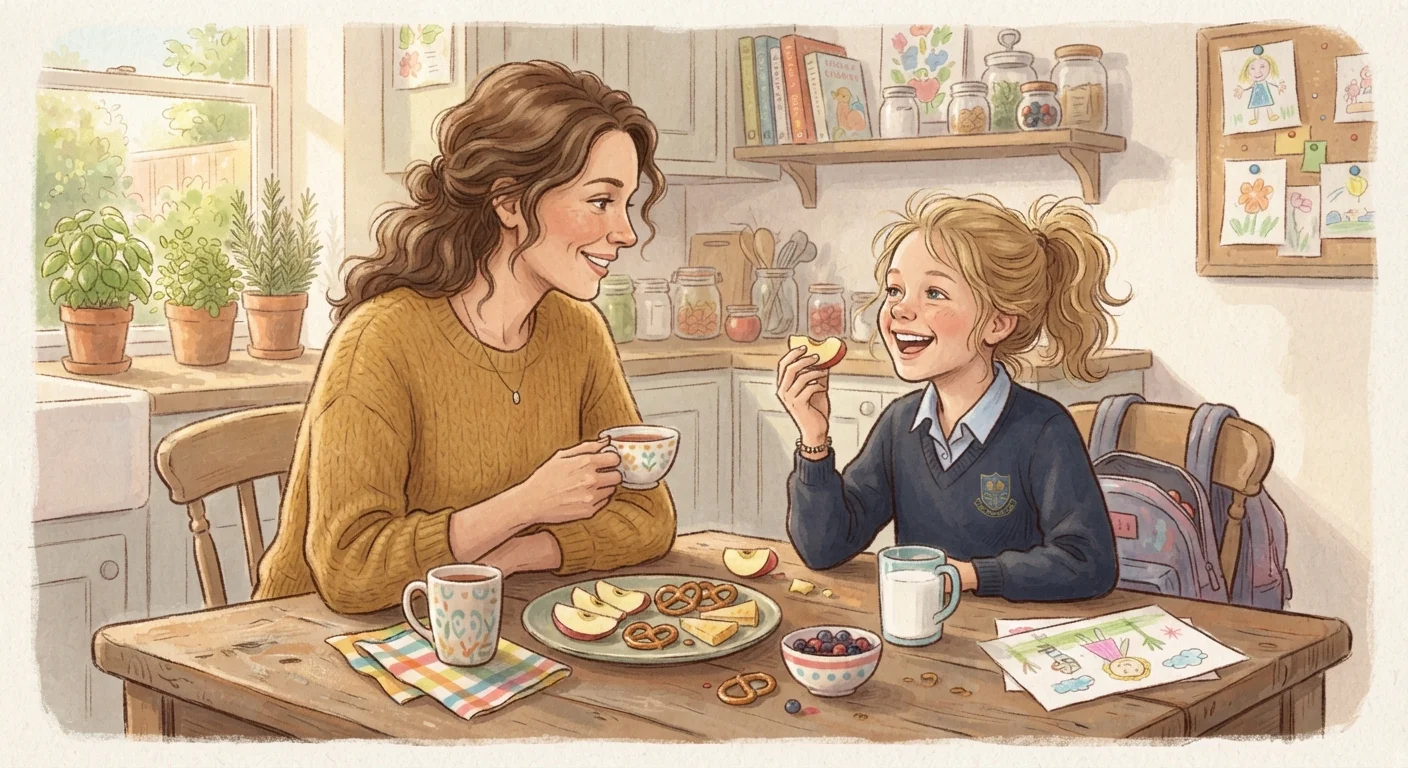
Why "Fine" Is a Perfectly Rational Answer
When children respond to "How was school?" with "fine" or "nothing," they're not being difficult. From their perspective, the question is genuinely hard to answer. A school day contains dozens of micro-events - most of which feel unremarkable in the moment - and a broad open-ended question offers no obvious entry point. Cognitive scientists sometimes describe this as the "retrieval cue" problem: without a specific prompt, the brain has trouble selecting which memory to surface.
Understanding this reframes the challenge entirely. The goal isn't to get your child to talk more - it's to ask better questions. As discussed in our overview of learning at home, the conversations that happen outside school can meaningfully reinforce what's happening inside it - but only if children are actually engaged in them.
Don't Turn Conversation Into an Interrogation
Children - especially older elementary and middle schoolers - are sensitive to feeling quizzed rather than heard. If every question feels like a test, they'll disengage. Aim for genuine curiosity, not an audit. The goal is connection first; learning naturally follows.
What You'll Need Before You Start
These conversations don't require special materials, but a little preparation makes a real difference. Think of this less as a formal activity and more as a daily habit you're intentionally cultivating.
What you will need
A quiet, comfortable space
Reduces distraction and signals to your child that this conversation is a genuine priority.
A light snack
Many children open up more readily when they're not hungry after a long school day.
A short list of specific questions prepared in advance
Prevents the parent from defaulting to vague questions when the moment arrives.
Step-by-Step: Making the Conversation Work
Follow these steps consistently over two to three weeks. Like any habit, the first few attempts may feel a little awkward - that's normal. The goal is a low-pressure daily ritual, not a perfect interview.
Give them a decompression buffer first
Most children need 15-20 minutes of low-demand time after school before they're emotionally ready to talk. Let them have a snack, move around, or decompress quietly. Jumping straight into questions the moment they walk in often produces the very one-word answers you're trying to avoid.
Lead with something specific, not open-ended
Replace "How was your day?" with a question anchored to something real. Try: "You had that science quiz today - how did that feel when you were actually doing it?" or "Did anything surprise you in math this week?" Specific questions signal that you're genuinely paying attention, and they give your child something concrete to respond to rather than a blank conversational canvas.
Share something from your own day first
Reciprocity works. When you model the kind of honest, slightly detailed sharing you're hoping for - including a moment that was frustrating or confusing - you normalize vulnerability and give your child a conversational template. Keep it brief and age-appropriate: "I had a meeting today where I completely forgot what I was going to say. It was embarrassing but also kind of funny."
Ask about feelings alongside facts
"What did you learn?" and "How did that make you feel?" are equally important. Emotions are memory anchors - children retain information more durably when they can connect it to how something felt. Asking "Was there anything that confused you today?" or "Did anything make you feel proud?" opens up both the emotional and cognitive layers of their school experience.
Follow their lead - then gently extend
When your child says something interesting, resist the urge to immediately evaluate or pivot. Instead, reflect it back and ask one more layer: "Oh, so the teacher said that? What did you think about it?" This technique - sometimes called "extending" in early childhood education - keeps the conversation going without pressure and signals that their perspective genuinely matters.
Close with a forward-looking question
End the check-in with something that looks ahead rather than reviewing what's already done: "Is there anything coming up this week you're nervous or excited about?" This shifts the conversation from retrospective to engaged anticipation, and gives you a natural opening for the next day's check-in.
Use the "Rose, Bud, Thorn" Ritual
Ask your child to share one good thing from their day (rose), one thing they're looking forward to (bud), and one difficult moment (thorn). This simple structure gives kids a manageable framework and often surfaces details parents would never hear from an open-ended question. It works especially well at dinner when the whole family participates.
When It's Still Not Working
Some children are naturally more private, and that's worth respecting. If a child consistently resists after-school conversations, consider shifting the context entirely. Side-by-side activities - cooking together, a short walk, or a car ride - often unlock more conversation than face-to-face formats, because the absence of direct eye contact removes social pressure. Unstructured time can be just as rich a learning and sharing opportunity as a planned discussion.
It's also worth considering whether the timing is wrong. Some children genuinely open up at bedtime rather than after school. If that's when your child tends to share, lean into it - a five-minute check-in before lights-out can be more valuable than a longer, earlier attempt that goes nowhere.
Finally, remember that not every conversation needs to be about school. Talking about what you made for dinner, a funny thing that happened, or something they're currently interested in builds the same conversational trust - and that trust is ultimately what makes the school-day conversations possible.
The content provided on our blog site traverses numerous categories, offering readers valuable and practical information. Readers can use the editorial team’s research and data to gain more insights into their topics of interest. However, they are requested not to treat the articles as conclusive. The website team cannot be held responsible for differences in data or inaccuracies found across other platforms. Please also note that the site might also miss out on various schemes and offers available that the readers may find more beneficial than the ones we cover.