

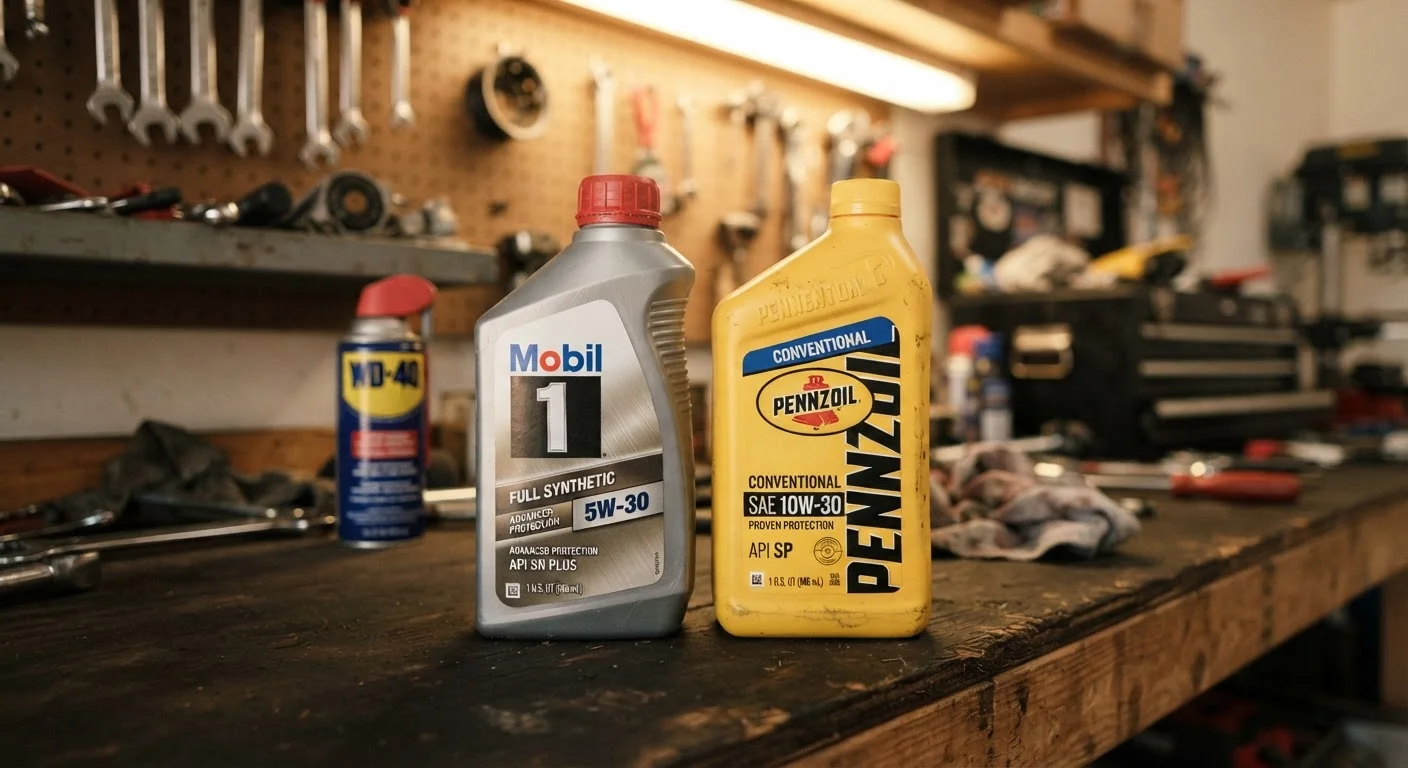
Option A
Synthetic Motor Oil
The engineered, high-performance option for modern engines.
Best for: Drivers with newer vehicles, those in extreme climates, or anyone seeking longer intervals between oil changes.
Option B
Conventional Motor Oil
The time-tested, widely available standard for everyday driving.
Best for: Owners of older vehicles with straightforward engines who follow regular maintenance schedules.
What Makes These Two Oils Different
Motor oil does two essential jobs: it lubricates moving engine parts to reduce friction, and it helps carry heat away from the engine. Both synthetic and conventional oils accomplish this, but they differ significantly in how they are made and how they behave under stress.
Conventional motor oil is refined directly from crude petroleum. The refining process removes many impurities, but natural variations in molecular size and structure remain. This means the oil's performance can fluctuate more as temperatures rise or fall.
Synthetic motor oil, by contrast, is chemically constructed - usually from a base of highly refined petroleum or other compounds - so that molecules are uniform in size and structure. This gives synthetic oil more predictable, stable behavior across a wider range of temperatures and engine conditions.
A middle-ground option also exists: synthetic-blend oil mixes conventional and synthetic base stocks. It offers some of synthetic's benefits at a cost closer to conventional, and is worth knowing about when you consult your vehicle's owner's manual. For a broader look at routine service intervals, see Your Family Car's Maintenance Schedule, Decoded.
| Criterion | Synthetic Motor Oil | Conventional Motor Oil |
|---|---|---|
| Origin | Chemically engineered base stocks | Refined from crude petroleum |
| Typical change interval | 7,500-10,000+ miles (varies by vehicle) | 3,000-5,000 miles (varies by vehicle) |
| Cost per quart | Higher upfront cost | Lower upfront cost |
| Temperature stability | Performs well in extreme heat and cold | More variable in extreme temperatures |
| Engine protection under stress | Strong - uniform molecular structure | Adequate for standard conditions |
| Compatibility with older engines | Generally safe; check manual | Traditional choice for older engines |
| Manufacturer requirement | Required by many modern vehicles | Sufficient for many older vehicles |
Cost, Intervals, and the Real Math for Families
One of the most common concerns families have is simple: which oil costs less? The answer requires looking beyond the sticker price per quart.
Conventional oil is typically less expensive upfront - often meaningfully so per quart. However, most manufacturers recommend changing conventional oil every 3,000 to 5,000 miles, while synthetic oil is commonly rated for 7,500 to 10,000 miles or more, depending on the vehicle and driving conditions. (Always defer to your owner's manual, as these figures vary by engine design.)
When you account for labor costs if you use a shop, plus oil and filter materials, the annual cost difference between the two options can narrow considerably - and in some cases, synthetic's longer intervals make it cost-competitive over a full year of driving.
~2x
Longer typical change interval for synthetic oil
Synthetic oil commonly supports roughly twice the mileage between changes compared to conventional oil, though exact intervals depend on vehicle specifications.
3-4
Average oil changes per year for most drivers
Based on typical US driving patterns of 12,000-15,000 miles annually and conventional oil change intervals; synthetic oil may reduce this to 1-2 changes per year.
Keep in mind that oil changes are just one piece of the ownership cost picture. If you're thinking broadly about managing car expenses, our guide to Auto Costs & Savings covers a range of practical approaches.
How to Decide What Your Family's Car Actually Needs
The most important resource for this decision is not marketing language on an oil bottle - it's your vehicle's owner's manual. Manufacturers specify oil type, viscosity grade (such as 5W-30 or 0W-20), and change intervals based on how the engine was designed. Using the wrong specification can, in some cases, affect engine performance or warranty coverage.
A few practical questions to guide your thinking:
- Does the manual specify full synthetic? If yes, use it. Many newer engines require it.
- Is your vehicle older or high-mileage? Some mechanics suggest that very old engines with worn seals may benefit from staying with conventional oil, though high-mileage formulas (a category of their own) also exist for this scenario.
- What are your driving conditions? Frequent short trips, extreme temperatures, towing, or stop-and-go commuting place more stress on oil. Synthetic's stability can be an advantage in these situations.
If you're new to routine car maintenance and want a solid foundation, Under the Hood: A First-Time Owner's Roadmap to Routine Car Care walks through the essentials clearly. And for those thinking about the bigger picture of vehicle ownership costs, the comparison in Leasing vs. Buying a Car is worth a read.
This article is for general informational purposes only. Always consult your vehicle's owner's manual and a qualified mechanic for guidance specific to your car's make, model, and condition.
The content provided on our blog site traverses numerous categories, offering readers valuable and practical information. Readers can use the editorial team’s research and data to gain more insights into their topics of interest. However, they are requested not to treat the articles as conclusive. The website team cannot be held responsible for differences in data or inaccuracies found across other platforms. Please also note that the site might also miss out on various schemes and offers available that the readers may find more beneficial than the ones we cover.