

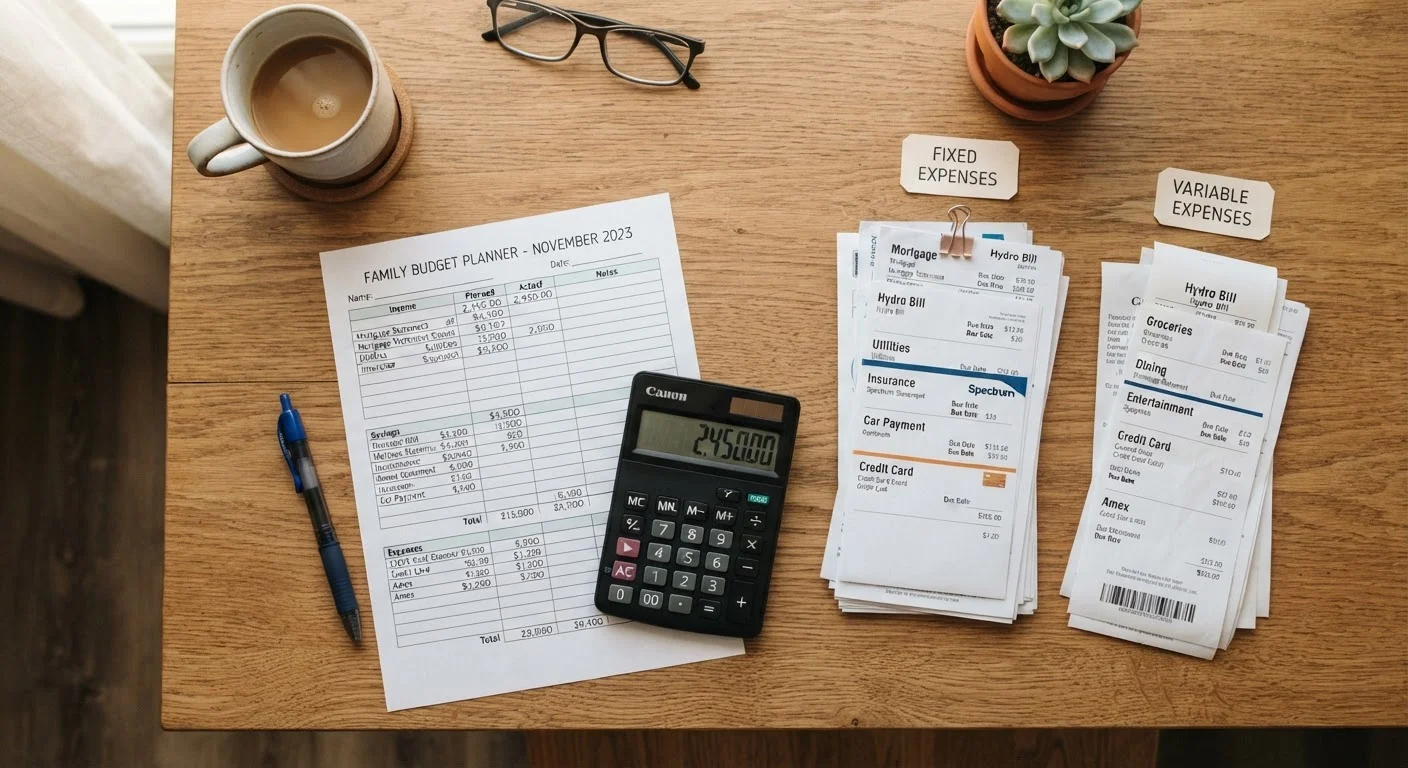
Why This Distinction Matters Before You Budget Anything
Most budgeting advice jumps straight to percentages and spending categories without addressing a more fundamental question: which of your expenses can you actually control right now, and which are locked in? That answer depends almost entirely on whether a cost is fixed or variable.
Fixed expenses are non-negotiable in the short term. You've made a contractual commitment - a lease, a loan, an insurance policy - and the dollar amount doesn't move. Variable expenses, by contrast, respond to decisions you make each week. Spend less at the grocery store, drive fewer miles, skip the takeout order - and that category shrinks.
This distinction shapes every budgeting decision you make. It tells you where to look when money is tight, and it prevents the frustration of trying to 'cut' a cost that simply isn't cuttable without a major life change. If you're building a family budget from scratch, mapping your expenses into these two buckets is the logical first step.
~33%
Of income spent on housing alone
The U.S. Bureau of Labor Statistics Consumer Expenditure Survey consistently shows housing accounts for roughly one-third of average household expenditures - making it the dominant fixed cost for most families.
57%
Of Americans living paycheck to paycheck
A widely cited LendingClub survey found a majority of US consumers report living paycheck to paycheck, underscoring how little buffer most households have when variable costs spike unexpectedly.
$9,343
Average household food expenditure annually
According to the BLS Consumer Expenditure Survey, food - including groceries and dining - represents one of the largest variable expense categories for US families.
Fixed Expenses: Predictable, but Not Always Small
Fixed expenses are stable, which makes them budget-friendly in one sense - you know exactly what's coming. But stable doesn't mean insignificant. For most US households, fixed costs consume the largest share of take-home pay, often 50% or more when housing, vehicle loans, and insurance are combined.
Common fixed expenses include:
- Mortgage or rent payments
- Auto loan installments
- Student loan payments
- Health, auto, and homeowners or renters insurance premiums
- Fixed-rate subscription services
- Minimum required debt payments
Because these amounts are set by contract, reducing them usually requires a structural change - refinancing a loan, moving to a less expensive home, or shopping your insurance at renewal. That's worth doing periodically, but it's not a quick lever. The practical implication: don't waste time trying to trim fixed expenses month to month. Focus your energy on the variable side.
Variable Expenses: Where Real Budget Flexibility Lives
Variable expenses are the working parts of your budget - the costs that respond to your choices. This is where budgeting actually becomes active management rather than passive accounting.
Common variable expenses include:
- Groceries and household supplies
- Gasoline and rideshare costs
- Utilities (electricity, water, gas)
- Dining out and entertainment
- Clothing and personal care
- Medical copays and out-of-pocket costs
Food is typically a family's largest flexible expense - and one of the most frequently underestimated. Grocery spending inside a family budget reveals patterns most families don't notice until they start tracking. The same logic applies across every variable category: actual spending data, not guesstimates, should anchor your budget numbers.
It also helps to think about needs vs. wants in your spending within the variable category. Some variable expenses are essential (food, medications); others are discretionary (streaming upgrades, restaurant meals). That secondary layer of analysis tells you where cuts are realistic without sacrificing quality of life.
Track Variable Spending for 90 Days First
Before assigning a number to any variable category, pull three months of actual bank and credit card statements. Calculate your real average spend per category - not what you think you spend. Most families find their actual variable spending runs 15-25% higher than their mental estimate, which is exactly why budgets built on guesswork fail in the first month.
The Third Category Families Often Miss: Periodic Fixed Costs
There's a type of expense that trips up even organized budgeters - costs that are fixed in amount but don't arrive monthly. Car registration, annual insurance premiums, back-to-school shopping, holiday gifts, and semi-annual property taxes all fall here. They're predictable, but families often treat them like surprises.
The standard solution is a sinking fund strategy: list every periodic cost, total them for the year, then divide by 12 and set that amount aside monthly. When the bill arrives, the money is already waiting. This technique transforms budget-busting lump sums into manageable monthly line items, and it's one of the most underused tools in household financial planning.
This article is for general informational purposes only and does not constitute personalized financial advice. Consult a qualified financial professional for guidance specific to your household situation.
Frequently Asked Questions
Fixed expenses are costs that remain the same each billing period, such as rent, mortgage payments, or loan installments. Variable expenses fluctuate based on usage or choices, like groceries, gas, or dining out. Knowing which is which helps you identify where you have flexibility in your budget.
Common fixed expenses include mortgage or rent payments, car loans, insurance premiums, subscription services at a set rate, and minimum debt payments. These amounts are predictable and contractually set, making them straightforward to plan for each month.
In practice, yes. For example, if you set a strict monthly grocery budget and consistently hit that number, it functions like a fixed cost in your planning. Budget apps sometimes allow you to 'lock in' a spending envelope, treating it as a fixed allocation even if the underlying spending varies.
Utilities are generally variable because the amount changes based on usage - heating bills spike in winter, cooling costs rise in summer. Some utilities offer budget billing programs that average your annual usage into equal monthly payments, making them behave more like fixed expenses.
Variable expenses are harder to predict and easier to underestimate. Families often budget an optimistic number for groceries or gas, then overspend without realizing it until the month is over. Tracking actual spending for two or three months gives a more honest baseline.
Divide the annual cost by 12 and set that amount aside each month into a dedicated savings bucket, often called a sinking fund. This prevents large, predictable expenses - like car registration or holiday gifts - from feeling like emergencies when they arrive.
The content provided on our blog site traverses numerous categories, offering readers valuable and practical information. Readers can use the editorial team’s research and data to gain more insights into their topics of interest. However, they are requested not to treat the articles as conclusive. The website team cannot be held responsible for differences in data or inaccuracies found across other platforms. Please also note that the site might also miss out on various schemes and offers available that the readers may find more beneficial than the ones we cover.