

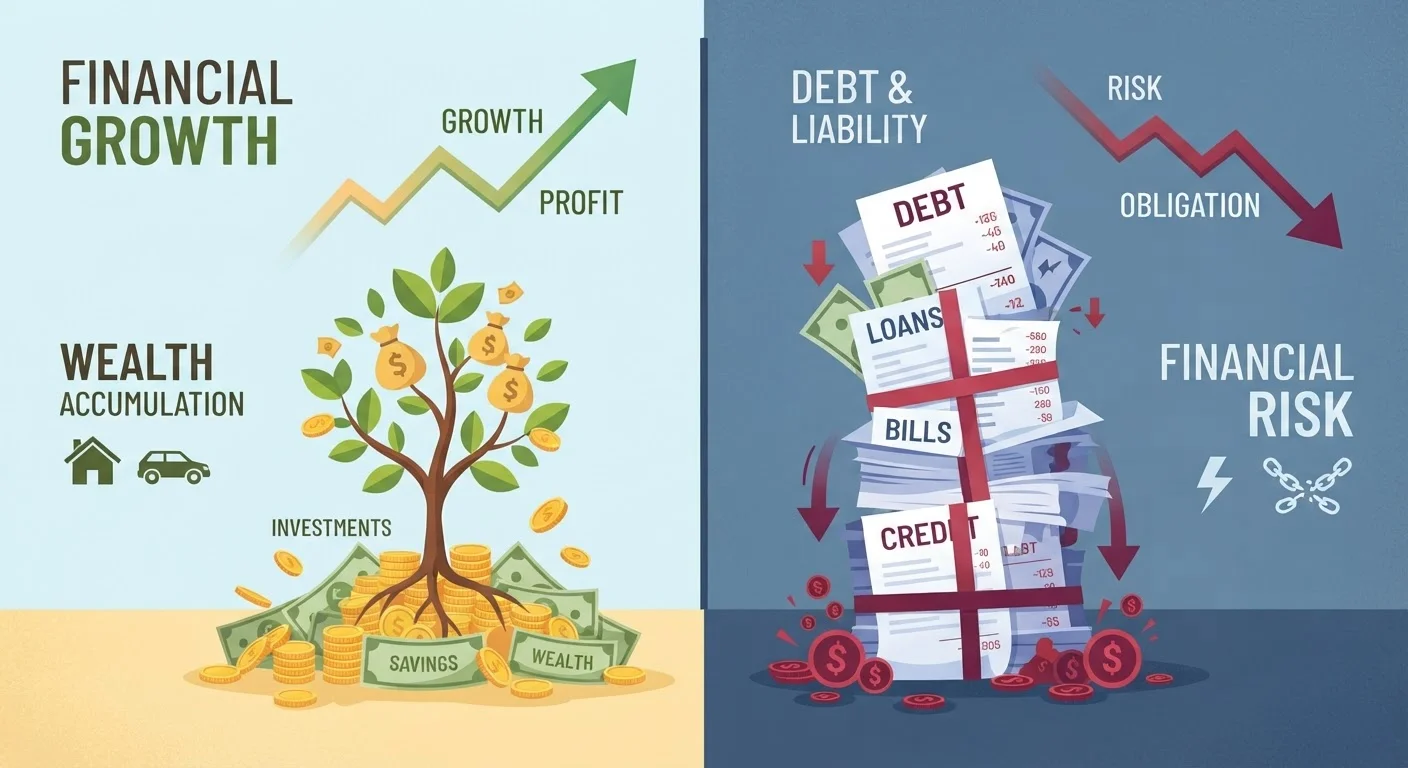
The Basic Mechanic: Interest on Top of Interest
At its core, compound interest is a loop. You earn (or owe) interest. That interest gets added to your balance. Then the next interest calculation uses the new, larger balance. Repeat indefinitely.
With a savings account, this loop is your friend. Suppose you deposit $5,000 into an account earning 4% APY, compounded monthly. After the first month, you've earned roughly $16.67 in interest, bringing your balance to $5,016.67. In the second month, interest is calculated on $5,016.67 - not the original $5,000. The difference feels small at first, but it accelerates meaningfully over years and decades.
With debt - particularly revolving credit card balances - the same loop works against you. If you carry a $3,000 balance on a card with a 22% APR compounded daily and make no payments, the balance grows by roughly $1.80 every single day from interest alone. After a year with no payments, you'd owe closer to $3,726. After two years, over $4,577. The debt doesn't wait.
Compounding Frequency Matters More Than It Looks
The difference between daily and monthly compounding seems trivial on small balances, but it scales significantly over large balances and long time horizons. On savings, more frequent compounding is slightly better for you. On debt, more frequent compounding is slightly worse. Always check the terms of any financial product before signing.
When Compounding Builds Wealth
The most powerful application of compound interest for families is long-term savings - retirement accounts, education funds, and emergency savings that stay invested over time.
Two factors amplify compounding on the savings side: time and consistency. The longer money stays invested, the more compounding cycles it goes through. Regular contributions - even modest ones - keep adding fresh principal for compounding to work on.
~$33,100
Value of $10,000 saved at 5% APY over 24 years
Illustrative calculation showing compounding more than triples the original deposit without any additional contributions over a 24-year horizon.
20%-29%+
Typical US credit card APR range
According to the Consumer Financial Protection Bureau, average credit card interest rates have risen sharply in recent years, making compounding on revolving balances increasingly costly for households.
Daily
How often most US credit cards compound interest
Most major US card issuers apply the daily periodic rate (APR ÷ 365) to the outstanding balance each day, meaning unpaid balances accumulate interest continuously.
This is why financial educators consistently emphasize starting early over starting large. A family that contributes $200 per month beginning when their child is born has dramatically different outcomes than one that begins contributing $400 per month twelve years later - even if the second family contributes more total dollars before the child turns 18. The math strongly rewards early action.
Automating savings contributions removes the temptation to skip a month and keeps compounding working consistently on your behalf.
When Compounding Accelerates Debt
On the debt side, compounding is most damaging when the interest rate is high and the balance lingers. Credit cards are the most common household example: US credit card APRs often range from 20% to 29% or higher, and most issuers compound daily. Carrying even a modest balance month to month means you're paying interest on interest almost immediately.
The minimum payment trap makes this worse. Minimum payments are typically calculated as a small percentage of the outstanding balance. In the early months, most of that payment goes toward interest, leaving the principal nearly intact - giving compounding even more time to do damage.
For a detailed look at exactly how credit card interest accumulates, see the real cost of carrying a credit card balance.
Mortgages and auto loans generally use amortization schedules (which are structured differently from revolving debt), but any loan where payments fall behind - triggering capitalization of unpaid interest - can turn a manageable balance into a growing one quickly.
Practical Steps for Families
Understanding compounding is only useful if it changes behavior. Here's how families can act on it:
- Attack high-rate debt first. Because high-interest debt compounds fastest, reducing that balance directly shrinks the interest load each cycle. The debt avalanche vs. debt snowball approaches both work - choose the one that fits your household's psychology and cash flow.
- Don't wait to start saving. Even $25 a month in a savings or retirement account begins compounding. Delaying a year costs you that year's compounding, plus every compounding cycle built on top of it for decades.
- Watch compounding frequency on debt products. A credit card compounding daily at 22% is materially more expensive than a personal loan compounding monthly at the same stated rate. APR vs. APY comparisons help surface this difference.
- Balance debt paydown with savings. Carrying high-interest debt while ignoring savings creates vulnerability. Balancing debt repayment and savings goals requires trade-offs, but even a small emergency fund prevents new high-interest debt when unexpected costs arise.
This article is for general informational and educational purposes only and does not constitute personalized financial advice. Consult a qualified financial professional for guidance specific to your household's situation.
Frequently Asked Questions
Simple interest is calculated only on the original principal. Compound interest is calculated on the principal plus any interest already earned or owed. Over time, compound interest produces much larger gains on savings - and much larger costs on debt - than simple interest would.
Most US credit cards compound interest daily. The daily periodic rate (your APR divided by 365) is applied to your balance each day, so even a few missed payments can cause your balance to grow noticeably faster than you might expect.
Not exactly, but they are closely related. APY (Annual Percentage Yield) reflects the real annual return on a savings account after compounding is factored in. The more frequently interest compounds, the higher the APY compared to the stated annual rate.
Pay down high-interest debt as aggressively as your budget allows, since that stops compounding from working against you. At the same time, contribute consistently to savings or retirement accounts so compounding begins building in your favor as early as possible.
It depends on the loan type. Federal student loans generally use simple daily interest while in repayment, but interest can capitalize (be added to principal) under certain conditions, which then compounds. Private student loans vary - always check your loan terms.
It matters enormously. Because compounding multiplies existing balances, contributions made earlier have far more time to grow. General financial education examples often illustrate that a decade's head start can produce a substantially larger final balance even with identical contribution amounts - though actual results depend on rates and market conditions.
The content provided on our blog site traverses numerous categories, offering readers valuable and practical information. Readers can use the editorial team’s research and data to gain more insights into their topics of interest. However, they are requested not to treat the articles as conclusive. The website team cannot be held responsible for differences in data or inaccuracies found across other platforms. Please also note that the site might also miss out on various schemes and offers available that the readers may find more beneficial than the ones we cover.