

Why Park Choice Matters More Than You Think
National parks are often sold as the ultimate family destination - affordable, educational, and spectacular. That's generally true. But "national park" covers everything from a flat lakeside meadow to a high-altitude backcountry wilderness. What works brilliantly for teenagers can be genuinely unsafe or exhausting for a four-year-old.
Before you book, the questions worth asking aren't just "Is it beautiful?" but "Can we get to the beautiful parts without a six-mile hike?" and "Are there clean restrooms within reach?" Families with kids under eight in particular benefit from choosing parks where the highlights are accessible, shade and water are available, and crowd levels don't create dangerous situations near cliffs or drop-offs.
For a broader comparison of how national parks stack up against other destination types on cost and logistics, see our destination type comparison guide. If you're just getting started with family travel planning altogether, this practical starting point covers the basics before you choose any destination.
Acadia National Park, Maine
Acadia is one of the most family-accessible parks in the country, largely because of its carriage roads - 45 miles of gravel, motor-free paths that are flat enough for strollers and small bikes. The park sits on Mount Desert Island, so the ocean is always close. Sand Beach is a manageable outing, and the tidal pools near Otter Cliff are endlessly interesting to young children at low tide.
The park has solid visitor infrastructure: clean facilities, a reliable shuttle system that reduces the need to find parking with a car full of tired kids, and a Junior Ranger program that gives children a clear sense of purpose. Shoulder seasons (late spring and early fall) offer cooler temps and thinner crowds than peak summer.
Acadia's carriage roads are flat, motor-free, and genuinely stroller-friendly.
Olympic National Park, Washington
Olympic is unusually diverse - it contains a temperate rainforest, a rugged Pacific coastline, and mountain terrain all within one park boundary. That variety is a practical advantage for families: if the weather turns in one zone, you can shift to another.
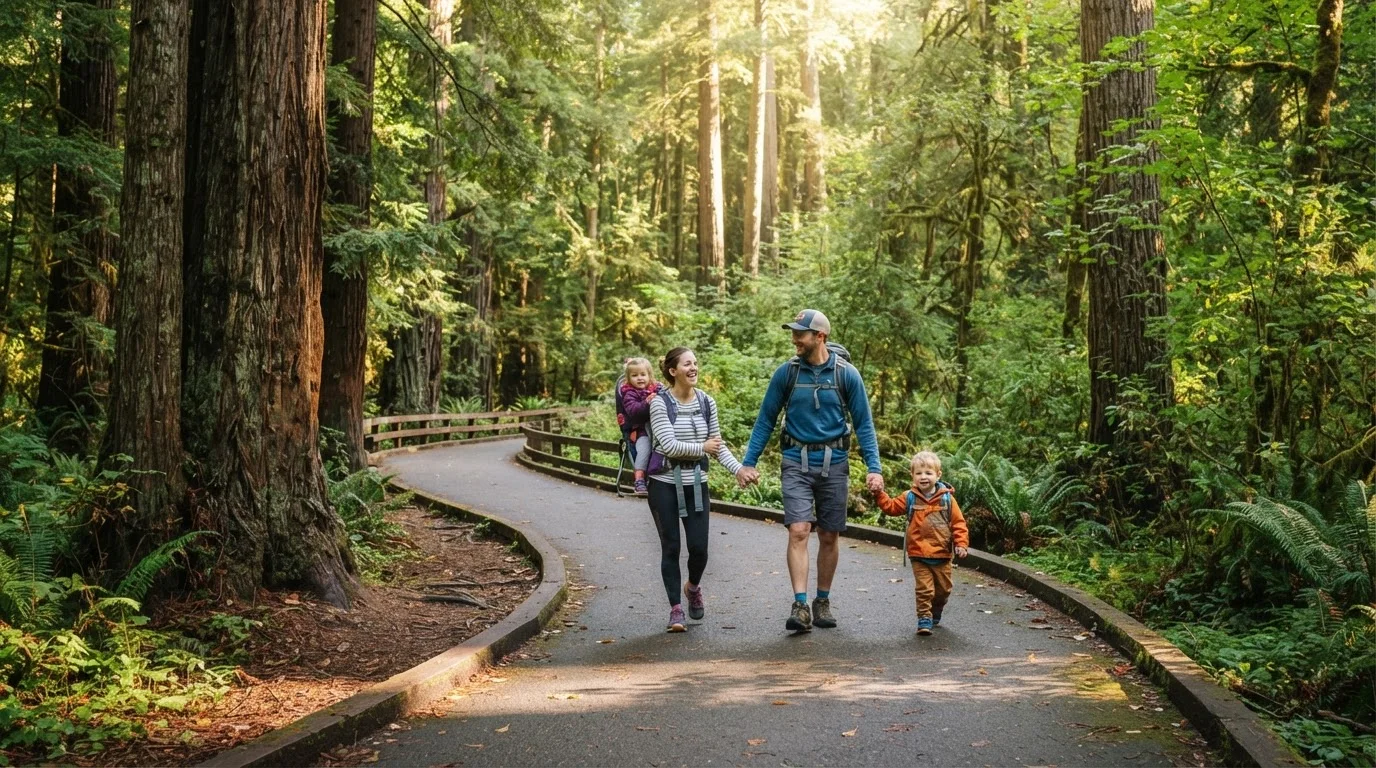
The Hoh Rain Forest has wide, relatively flat trails where young kids can walk among enormous old-growth trees. Rialto Beach is accessible by car and requires almost no hiking to reach genuinely dramatic scenery. Facilities at major visitor areas are well maintained, and the park's sheer size means there's usually a less crowded option nearby.
Olympic's multiple ecosystems give families a backup plan when one zone isn't cooperating.
Rocky Mountain National Park, Colorado
The caveat here is altitude: most of the park sits above 8,000 feet, and some key overlooks reach well over 11,000. Families should allow a day or two to acclimate before doing anything strenuous, and toddlers should be watched carefully for signs of altitude sickness (lethargy, headache, reduced appetite). Consult a healthcare provider if you have concerns about altitude and young children.
With that in mind, Rocky Mountain is spectacular and genuinely rewarding for families who pace themselves. Bear Lake is reachable by a free park shuttle and has easy loop trails that young children can complete. Wildlife sightings - elk, marmots, bighorn sheep - are common even from roadside pull-offs, which is a win with kids who can't hike far.
Allow altitude acclimation time before attempting trails with young children at Rocky Mountain.
Shenandoah National Park, Virginia
Shenandoah's location within a few hours of several major East Coast metro areas makes it one of the most practical options for families doing a weekend trip rather than a full vacation. Skyline Drive runs the length of the park, meaning families can access sweeping ridge-top views without leaving the car - a genuine advantage when naps are a factor.
Lower Hawksbill Summit Trail is among the park's more manageable hikes for older toddlers when conditions are dry. Dark Hollow Falls is also popular and accessible, though the return trip is uphill - worth factoring in. The park has multiple picnic areas with facilities, and campgrounds are reservable in advance through the National Park Service's reservation system.
Skyline Drive lets families access dramatic views without a single step of hiking.
Great Smoky Mountains National Park, Tennessee/North Carolina
The Smokies are the most visited national park in the country, which is a double-edged fact for families. On one hand, there's no entry fee, the infrastructure is excellent, and there's a huge range of trail difficulty. On the other hand, peak summer weekends can be very crowded, and traffic on the park road can be significant.
Laurel Falls is one of the most popular paved trails in the park and is manageable for young kids, though it draws crowds. Less-visited areas like Cades Cove offer open meadows, wildlife viewing, and a historic loop road that works well as a low-stress outing. The Smokies also connect to a number of gateway towns with additional family-friendly amenities.
The Smokies charge no entry fee and offer trails at every ability level, including young toddlers.
Zion National Park, Utah
Zion is breathtaking - and also genuinely hazardous in parts, which matters when you're traveling with young children. The Narrows and Angels Landing involve serious exposure to water crossings and steep drop-offs respectively, and are not appropriate for young kids. But the Pa'rus Trail is fully paved, follows the Virgin River, and is one of the most pleasant easy walks in the Southwest.
The park operates a mandatory shuttle system during peak season, which actually simplifies logistics for families - no hunting for parking. Shade is limited in summer and temperatures can be extreme; early morning visits and hydration discipline are non-negotiable. Consider visiting in spring or fall when temperatures are more forgiving for small children.
Zion's Pa'rus Trail is paved, flat, and follows a river - a reliable win for young kids.
Making the Most of Whichever Park You Choose
Regardless of which park you visit, a few habits consistently improve the experience with young kids. Arrive early - most parks are manageable at 8 a.m. and crowded by 11. Bring more snacks and water than you think you need. Keep days short and focused; two high-quality hours outdoors beats a five-hour death march. And always check current conditions, trail closures, and entry requirements through the National Park Service website before you go, since conditions change seasonally and access can be limited without advance reservations.
Use the Junior Ranger Program Strategically
Most national parks offer a Junior Ranger booklet that kids complete by completing activities, attending ranger talks, and observing nature. It gives young children a concrete goal for the visit and a badge or certificate at the end - surprisingly motivating even for five- and six-year-olds. Pick up the booklet as soon as you enter the visitor center, since completing it typically takes a few hours spread across your visit.
Beyond the parks themselves, national park towns often have free or low-cost attractions worth building into your itinerary. Our guide to free and low-cost activities for traveling families includes ideas that pair well with park visits. And if your family includes kids of different ages with competing interests, this guide to multi-age destination planning can help you find common ground.
This article provides general travel information only. Conditions, access, fees, and safety considerations at national parks change regularly. Always verify current details through the National Park Service and relevant official sources before traveling.
The content provided on our blog site traverses numerous categories, offering readers valuable and practical information. Readers can use the editorial team’s research and data to gain more insights into their topics of interest. However, they are requested not to treat the articles as conclusive. The website team cannot be held responsible for differences in data or inaccuracies found across other platforms. Please also note that the site might also miss out on various schemes and offers available that the readers may find more beneficial than the ones we cover.