

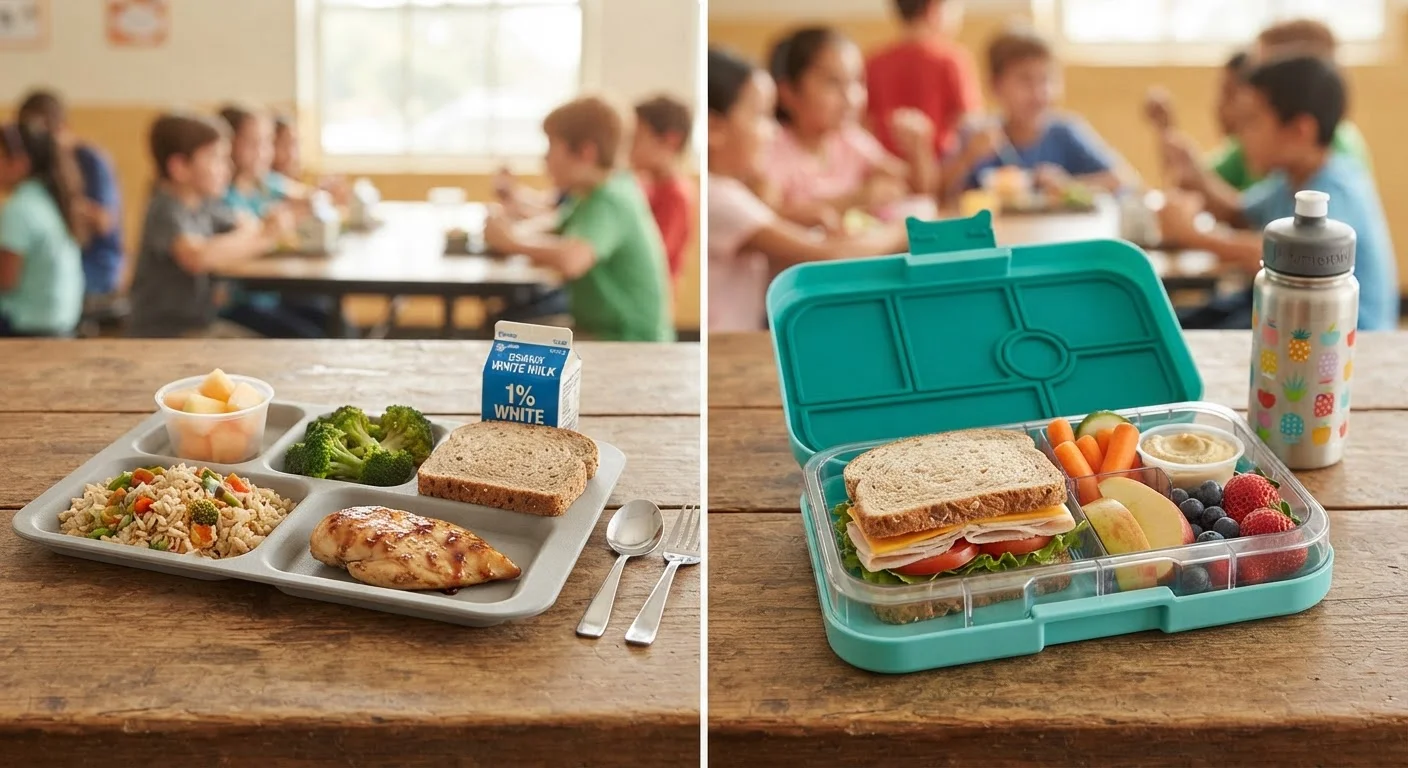
Our Verdict
School lunch and packed lunch each have genuine strengths that depend heavily on a family's budget, schedule, and children's nutritional needs. Families who qualify for free or reduced-price meals will generally find school lunch the stronger value, while those with time and planning capacity may prefer the control a packed lunch provides. Many families find that combining both approaches across the week offers a practical middle ground.
| Best for | Recommended |
|---|---|
| Families qualifying for free or reduced-price meal programs | School Lunch |
| Parents who want full control over ingredients and portions | Packed Lunch |
| Busy households with limited morning prep time | School Lunch |
| Children with allergies, dietary restrictions, or selective eating | Packed Lunch |
Understanding the Real Cost Difference
Cost is usually the first factor families consider, but the comparison is rarely straightforward. The price of a school lunch varies by district, typically ranging from around $2.50 to $5.00 per meal. However, household income determines whether that full price applies - the National School Lunch Program (NSLP) provides free meals to children from households at or below 130% of the federal poverty level, and reduced-price meals (capped at $0.40) to those up to 185%. For qualifying families, school lunch is almost always the more economical option.
For families paying full price, a packed lunch may cost less per day - but only with disciplined shopping. Staples like whole grain bread, peanut butter, cheese sticks, and fruit bought in bulk can bring the per-meal cost down, though convenience items and individually packaged snacks quickly close that gap. See our guide to feeding a family on a tight budget for strategies that keep packed lunch costs genuinely competitive. For broader household cost management, the family budgeting hub offers practical frameworks.
Nutrition: What Each Option Typically Provides
School lunches that participate in the NSLP must meet standards set by the U.S. Department of Agriculture (USDA), which require specific amounts of fruits, vegetables, whole grains, lean protein, and dairy, along with sodium and calorie limits by grade level. These standards provide a nutritional floor that many packed lunches don't always match in practice.
That said, what children actually eat from a school tray varies. Studies have found that plate waste - food thrown away - is common in cafeteria settings, meaning a nutritionally compliant meal isn't always a fully consumed one. Packed lunches offer parents the advantage of tailoring foods to a child's known preferences and dietary needs, which can improve the likelihood of actually eating the meal.
| School Lunch | Packed Lunch | |
|---|---|---|
| Typical daily cost (full price) | $2.50-$5.00 per meal | $2.00-$4.00 with planning |
| Cost for qualifying families | Free or $0.40 reduced | No discount available |
| Nutritional standards | USDA-regulated minimum standards | Depends entirely on parent choices |
| Morning prep time required | None | 10-20 minutes daily |
| Allergy/dietary control | Limited; varies by district | Full parental control |
| Food variety | Rotates weekly; set menu | Customizable but requires planning |
| Likelihood child finishes meal | Variable; plate waste common | Higher if tailored to preferences |
The challenge with packed lunches is consistency. Without deliberate planning, they can skew toward processed, high-sodium, or low-fiber items. Resources like the guide to frozen vs. fresh produce can help families make smarter ingredient choices without overcomplicating prep.
Time, Convenience, and the Morning Routine
For many families, the practical friction of morning routines is a deciding factor. School lunch eliminates the need to shop for, assemble, and pack a meal five days a week. That recovered time - even 10 to 15 minutes daily - can meaningfully reduce household stress, particularly for single-parent households or families with early start times.
Packed lunches require advance planning to avoid becoming a last-minute scramble. Weekend batch prep - portioning snacks, boiling eggs, slicing vegetables - can make weekday assembly faster. Families who build packing into their Sunday routine often find it becomes manageable habit rather than daily burden.
Make Batch Prep Work for You
Spending 20-30 minutes on Sunday preparing portable components - portioned fruit, cut vegetables, pre-made protein - makes weekday packed lunches significantly faster to assemble. Keeping a rotating list of four or five simple, accepted combinations removes decision fatigue during busy mornings. The everyday savings hub has additional strategies for cutting costs on routine household purchases like lunch staples.
A practical middle ground is a hybrid schedule: school lunch two or three days per week, packed lunch on remaining days. This reduces planning load while preserving some control over what children eat.
Special Dietary Needs and Allergies
For children with food allergies, religious dietary requirements, or medical conditions affecting diet, packed lunch often provides the only reliable path to safe, appropriate eating at school. While many schools accommodate common allergens and some offer alternative menu items, the degree of accommodation varies considerably by district and staffing capacity.
Parents managing these concerns should communicate directly with school nutrition staff to understand what safeguards are in place. In many cases, a packed lunch is the lower-risk option - not because school programs are careless, but because cross-contamination risks in high-volume cafeteria environments are real and difficult to fully eliminate.
This article is for general informational purposes only and does not constitute medical, nutritional, or dietary advice. Families managing health conditions or food allergies should consult a qualified healthcare provider or registered dietitian for guidance tailored to their child's needs.
The content provided on our blog site traverses numerous categories, offering readers valuable and practical information. Readers can use the editorial team’s research and data to gain more insights into their topics of interest. However, they are requested not to treat the articles as conclusive. The website team cannot be held responsible for differences in data or inaccuracies found across other platforms. Please also note that the site might also miss out on various schemes and offers available that the readers may find more beneficial than the ones we cover.