

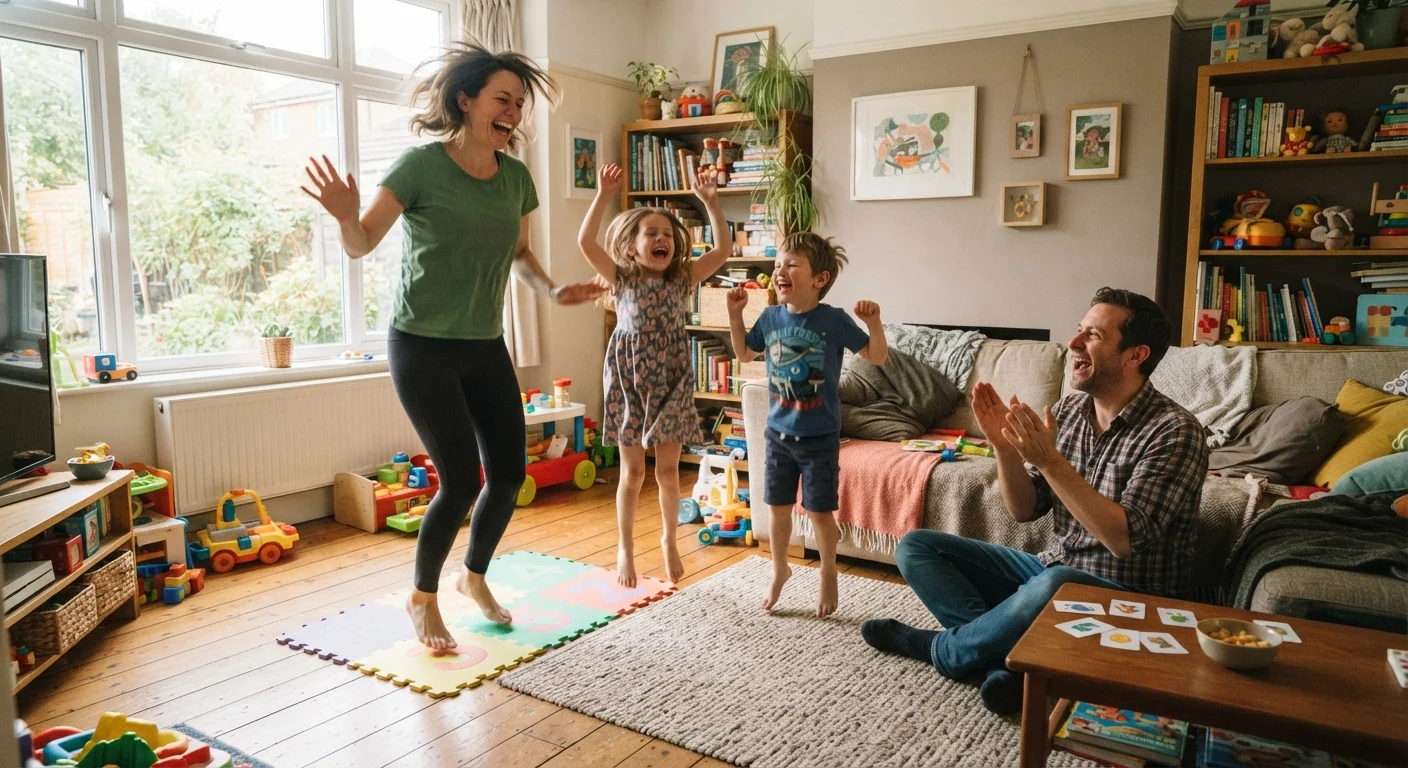
Why Family Movement Matters More Than Formal Exercise
Children don't need a structured fitness programme to be physically healthy - they need regular, joyful movement woven into daily life. When adults participate alongside kids, activity stops feeling like a chore and starts feeling like connection. The habits formed during family play in childhood are among the strongest predictors of active behaviour in adulthood, according to public health research. The good news: none of this requires a gym membership, expensive gear, or a large yard. Most of the ideas below work in a living room.
If you've ever told yourself the family needs more space or equipment before getting active, common exercise myths may be holding your family back - and most of them don't hold up under scrutiny.
Keep Sessions Short and Pressure-Free
Research on children's activity patterns shows they naturally move in short bursts rather than sustained sessions. Ten to fifteen minutes of enthusiastic play is more valuable than a reluctant half-hour. Ending the activity while everyone is still having fun makes the next session something to look forward to rather than something to resist.
Seven Active Games and Exercises the Whole Family Will Actually Do
Indoor obstacle courses
Cushions, rolled blankets, dining chairs, and hula hoops can transform any living room into a challenging obstacle course. Children as young as three can participate, and the setup itself becomes part of the fun. Take turns designing the course so every family member gets creative control. Vary the challenges - crawling under tables, hopping between cushions, balancing on a taped line - to work different muscle groups and coordination skills without anyone realising they're exercising.
Let each child design their own course for instant buy-in and creative pride.
Freeze dance
Put on a family playlist and dance until the music stops - then hold your position like a statue. Freeze dance is genuinely aerobic, requires zero equipment, and works for ages two to adult. Because the rules are simple, younger children aren't left behind. It's also a low-stakes way to introduce rhythm and body awareness. Studies on childhood physical activity consistently highlight unstructured play as highly effective at raising heart rate, and freeze dance sits squarely in that category.
Freeze dance raises heart rates and requires nothing beyond a music source and floor space.
Balloon keep-up
A single inflated balloon and a rule that it cannot touch the floor produces surprising levels of physical effort and laughter. Played as a team, it builds cooperation; played competitively, it sharpens reflexes and lateral movement. Because a balloon moves slowly, even young children can succeed, keeping frustration low and motivation high. Parents can add complexity for older kids - using only one hand, no hands, or calling out which body part must make the next contact.
One balloon, one rule - keep it off the floor - is enough to exhaust everyone happily.
Yoga and stretching sessions
Family yoga is more accessible than many parents assume. Animal-themed poses - downward dog, cobra, cat-cow - resonate with younger children, and the playfulness of naming poses after creatures removes any intimidating fitness framing. Even a ten-minute session improves flexibility, body awareness, and calm. Research supports regular flexibility and mobility work as an undervalued component of overall fitness. For guidance on weaving stretching into a busy week, see how to fit mobility work into family routines.
Animal-named yoga poses make stretching approachable and genuinely fun for young children.
Scavenger hunts
A well-designed scavenger hunt sends family members moving continuously across a home, yard, or neighbourhood park. The physical distance covered is often substantial - and entirely incidental to the game's perceived purpose. Clues can reinforce educational content for school-age children, or simply use picture cards for pre-readers. Rotate who creates the hunt each time, which builds anticipation and gives every family member ownership over the activity.
Scavenger hunts disguise sustained movement as pure adventure and problem-solving.
Fitness challenge cards
Write simple physical challenges on index cards - ten star jumps, five slow squats, a 20-second wall sit, a lap around the yard - shuffle them, and take turns drawing. This format works as a quiet-morning warm-up, a rainy-afternoon activity, or a post-dinner wind-down depending on which cards are drawn. The unpredictability keeps it fresh. Involving children in writing the cards gives them agency and often results in surprisingly creative (and tiring) challenge ideas. Pair this with a broader home routine using the principles outlined in building a family fitness routine that actually sticks.
Shuffled challenge cards add unpredictability that keeps children genuinely curious about what comes next.
Backyard or park relay races
Relay races scale to any outdoor space and any age gap between participants. Handicap distances or tasks so younger children remain competitive - a toddler hopping to a cone is racing on equal footing with a teenager doing the same distance as a bear crawl. Laughter levels tend to be high, competitive instincts are satisfied, and everyone gets meaningfully winded. Relays also teach turn-taking and cheering for others, reinforcing values beyond fitness.
Adjusting each runner's challenge means everyone stays competitive regardless of age or size.
A Note on Safety and Individual Needs
All families are different, and children's physical capabilities vary widely. Choose activities suited to your children's developmental stage and any existing health considerations. If your child has a chronic condition, mobility limitation, or has been advised by a clinician to limit certain movements, consult a qualified healthcare professional before introducing new physical activities. This article provides general educational information, not medical advice.
Turning Activity Into a Family Habit
The biggest obstacle to family fitness isn't motivation - it's consistency during the inevitably chaotic periods of family life. School runs, illness, shift work, and seasonal schedule changes all disrupt good intentions. Building small, flexible movement habits rather than rigid routines makes it far easier to stay on track. For practical strategies on protecting those habits when life gets unpredictable, see keeping exercise consistent when family life gets chaotic.
Active family time is also one of the most budget-friendly investments a household can make. There are no membership fees, no travel costs, and no equipment requirements for the majority of activities listed here - a genuine everyday win for families managing household budgets carefully.
This article is for general informational and educational purposes only. It is not a substitute for professional medical advice, diagnosis, or treatment. Always consult a qualified healthcare provider with questions about your family's physical health or activity needs.
The content provided on our blog site traverses numerous categories, offering readers valuable and practical information. Readers can use the editorial team’s research and data to gain more insights into their topics of interest. However, they are requested not to treat the articles as conclusive. The website team cannot be held responsible for differences in data or inaccuracies found across other platforms. Please also note that the site might also miss out on various schemes and offers available that the readers may find more beneficial than the ones we cover.