

Why These Myths Stick - And What They Cost Families
Exercise myths rarely survive scrutiny, but they're surprisingly durable because they tap into real anxieties: not having enough money, space, time, or knowledge. For families already juggling work schedules, school runs, and tight budgets, a belief that effective exercise requires a gym membership or a room full of equipment can feel like a permission slip to do nothing at all.
The cost isn't trivial. Physical inactivity is associated with a wide range of preventable health risks, and the habits children observe at home tend to shape their own relationship with movement for years. Clearing up these misconceptions isn't just about fitness - it's about removing unnecessary barriers so families can get moving with what they already have.
Myth
You need equipment - dumbbells, resistance bands, or at least a yoga mat - before a home workout is worth doing.
Fact
Bodyweight exercises alone can build strength, improve cardiovascular fitness, and increase flexibility without any equipment.
Push-ups, squats, lunges, planks, and jumping jacks require nothing but floor space. Research consistently supports bodyweight training as an effective approach to improving muscular strength and endurance. The perceived need for equipment is largely a marketing artifact, not a fitness reality. If you'd like to explore where gear does and doesn't add value, bodyweight training compared to weight machines covers the evidence clearly.
Myth
A workout has to last at least 30-45 minutes to count for anything.
Fact
Shorter bouts of movement - even 10 minutes - accumulate meaningful health benefits over the course of a day.
Major public health guidelines, including those from the U.S. Department of Health and Human Services, recognize that physical activity can be accumulated in shorter sessions throughout the day rather than one continuous block. For busy families, three 10-minute sessions can be just as practical and beneficial as a single longer one. The key variable is total weekly movement, not the length of any individual session.
Myth
Home workouts are fine for adults, but kids need structured sports or a PE class to get real exercise.
Fact
Unstructured active play and simple family movement routines at home fully count toward children's daily physical activity needs.
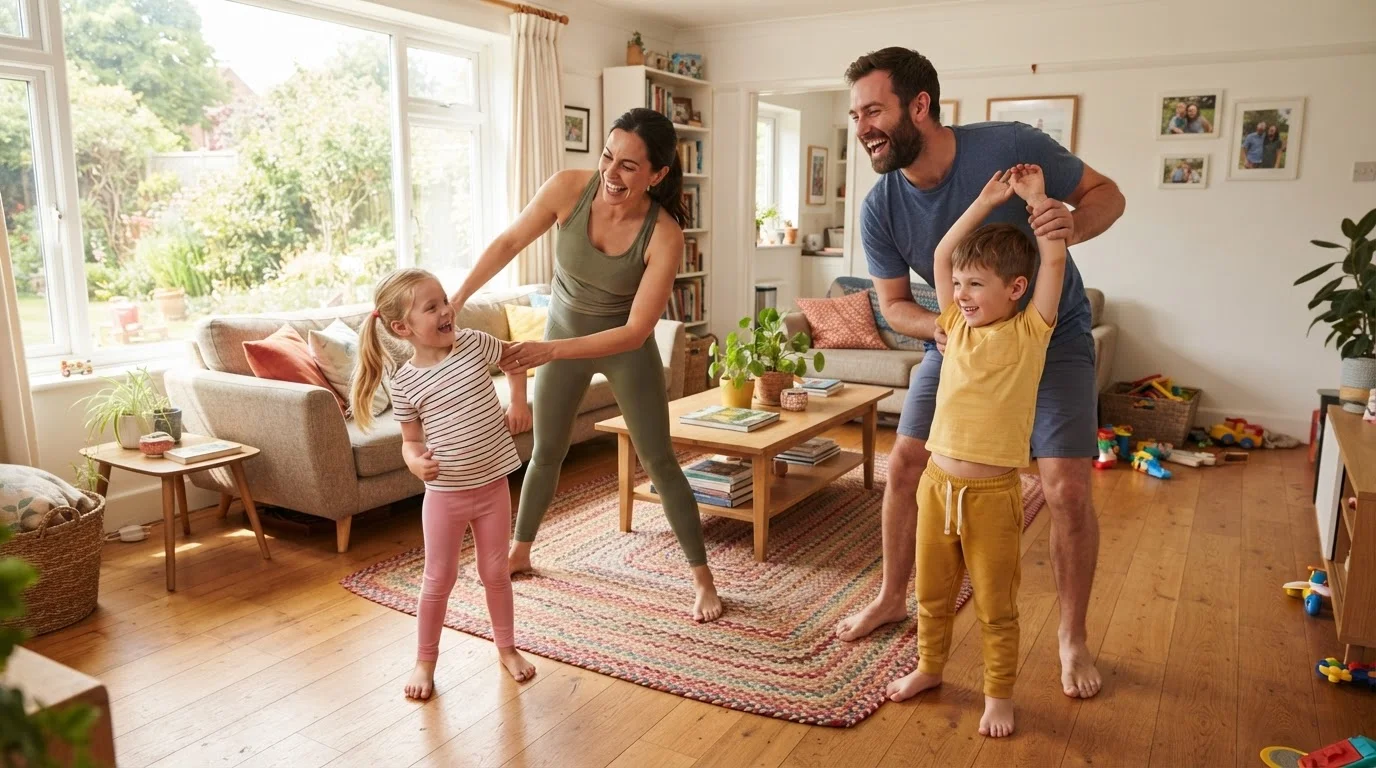
Children's physical activity guidelines focus on total daily movement - and active games, dancing, obstacle courses, and bodyweight circuits at home all contribute. Structured sport is valuable, but it isn't the only path to healthy movement habits. In fact, active games the whole family can enjoy together can build lasting habits more effectively than scheduled activities alone, because children associate movement with fun rather than obligation.
Myth
If you're not sweating heavily or feeling sore the next day, the workout wasn't effective.
Fact
Sweat is a cooling mechanism, and soreness is a sign of novelty - neither reliably indicates training quality or progress.
Soreness (formally called DOMS) peaks when you try unfamiliar movements, then diminishes as the body adapts - that adaptation is progress, not regression. Similarly, sweat rate depends heavily on temperature, humidity, and individual physiology, not workout quality. Meaningful progress is better tracked through improved endurance, strength, or consistency. See what's actually worth measuring in a home fitness routine for practical guidance.
Myth
You need a dedicated room or large open space to exercise at home.
Fact
Most effective bodyweight movements require only a few square feet - roughly the size of a yoga mat.
Squats, planks, push-ups, and seated core work all fit within a very small footprint. Even cardio moves like high knees or mountain climbers need minimal lateral space. exercising effectively in small or shared spaces is something many apartment-dwelling and smaller-home families do successfully every day with thoughtful exercise selection.
Myth
Once you stop seeing rapid progress, home workouts have stopped working and you need a gym.
Fact
Progress naturally plateaus as the body adapts; adjusting variables like tempo, volume, or exercise variation restores momentum.
Early gains in any new routine come quickly because the body is responding to an unfamiliar stimulus. When that stimulus becomes familiar, progress slows - this is normal physiology, not a failure of home exercise. Small adjustments - slowing a repetition down, adding a pause at the hardest point, or switching to a more challenging variation - reintroduce the stimulus. why home workout progress stalls and what to do about it explains this process in practical terms.
Putting the Facts Into Practice at Home
Debunking myths is useful only if it translates into action. Here's how each correction can reshape a realistic home routine:
- Start without buying anything. Push-ups, squats, and planks require zero investment. If you later want to add tools, setting up a home workout space on a tight budget outlines what genuinely helps versus what's marketing.
- Use short windows deliberately. A 10-minute session before breakfast, a 10-minute walk at lunch, and an evening stretch routine add up - and they fit around school and work schedules more easily than a single long block.
- Include the whole family. Movement doesn't need to be segregated by age. building a family fitness routine that actually sticks shows how shared activity builds both fitness and consistency.
- Don't neglect flexibility. Strength and cardio get most of the attention, but stretching and mobility work most families skip is an often-overlooked component that supports long-term comfort and injury resilience.
More Isn't Always Better
Pushing too hard too fast - particularly when returning to exercise after a long break - raises the risk of injury. Physical activity guidelines broadly recommend gradual progression. If anyone in the family experiences pain (not general fatigue) during exercise, stop and seek professional guidance before continuing.
This article is for general informational purposes only and does not constitute medical advice. Always consult a qualified healthcare professional before beginning a new exercise program, particularly for children, older adults, or individuals with existing health conditions.
Always Consult a Professional First
This article provides general health information, not medical advice. Before starting any new exercise routine - especially for children, older adults, or anyone managing a chronic condition - consult a qualified healthcare professional. They can help identify any modifications or precautions suited to your household's specific needs.
The content provided on our blog site traverses numerous categories, offering readers valuable and practical information. Readers can use the editorial team’s research and data to gain more insights into their topics of interest. However, they are requested not to treat the articles as conclusive. The website team cannot be held responsible for differences in data or inaccuracies found across other platforms. Please also note that the site might also miss out on various schemes and offers available that the readers may find more beneficial than the ones we cover.