

Why Flexibility and Mobility Get Left Behind
When families carve out time for exercise, strength and cardio tend to win. Stretching feels optional - the thing you skip when the kids need dinner or homework runs long. Yet this is precisely why so many adults find themselves stiff, achy, and more prone to strains as the years pass.
Mobility and flexibility training doesn't build muscle or burn significant calories, so it rarely feels urgent. But its absence has a slow, compounding cost: reduced range of motion, poorer posture from prolonged sitting, and joints that become less resilient under load. For families trying to stay active at home, mobility work is the quiet force multiplier that makes everything else work better. See how it fits into a broader home routine in our family fitness guide.
65%
Adults who report skipping post-workout stretching
Survey data from fitness behaviour studies broadly suggest the majority of recreational exercisers rarely include a structured cool-down or stretching phase.
5-10 min
Daily practice shown to improve flexibility
General physical therapy and exercise science literature indicates that short, consistent daily stretching sessions produce meaningful flexibility gains over four to eight weeks.
3×
More sedentary hours for school-age children vs. prior generations
Research on children's physical activity patterns highlights that increased screen time has significantly reduced incidental movement, making intentional mobility practice more important for younger family members.
What Mobility Training Actually Does for the Body
Static stretching targets muscle length, but mobility training goes a step further by strengthening a joint's ability to move actively through its full range. Think of the difference between being able to lift your leg high when someone holds it versus lifting it just as high under your own muscle control. The latter requires both flexibility and neuromuscular coordination.
Regular mobility practice has several well-documented general benefits:
- Reduced injury risk: Joints that move freely and with control are less likely to be strained during everyday tasks - lifting groceries, picking up a toddler, or reaching overhead.
- Better posture: Hip flexor and thoracic spine mobility work can counteract the effects of prolonged desk or couch sitting.
- Improved athletic performance: Greater usable range of motion means more efficient movement patterns in any sport or workout.
- Stress reduction: Slow, deliberate stretching activates the parasympathetic nervous system, which can lower perceived stress levels.
These benefits apply across age groups - from school-aged children whose screen time is rising, to parents managing the physical demands of family life.
“Mobility is the foundation of human movement. Without it, strength and endurance have nowhere to express themselves safely.”
— Kelly Starrett, Doctor of Physical Therapy and author on movement and mobility
Fitting It Into a Busy Family Schedule
The most effective mobility routine is one a family will actually do. That usually means short, consistent sessions rather than marathon stretching blocks that only happen occasionally. Consider these practical entry points:
- Morning reset (5 minutes): A few hip circles, cat-cow stretches, and shoulder rolls before breakfast costs almost no time and sets a mobile, energised tone for the day.
- TV-time stretching: Commercial breaks or the first ten minutes of a family show are ideal for floor-based mobility work. No extra time slot required.
- Post-activity cooldown: If the family has completed any other workout, tacking on five to eight minutes of static stretching while muscles are warm is highly efficient.
- Before-bed wind-down: Gentle stretching in a dimly lit room doubles as a calming bedtime ritual, particularly for children.
If your living space feels tight, keep in mind that stretching and mobility work require very little room - often just the length of a yoga mat. For broader ideas on exercising in limited spaces, see working out in small spaces.
Start With Just Two Moves
If introducing mobility work feels overwhelming, begin with just two exercises: a hip flexor stretch and a thoracic rotation. These two movements address the most common areas of stiffness in adults who spend time sitting. Once the habit is established, you can gradually add more variety.
Making It a Family Habit, Not a Solo Chore
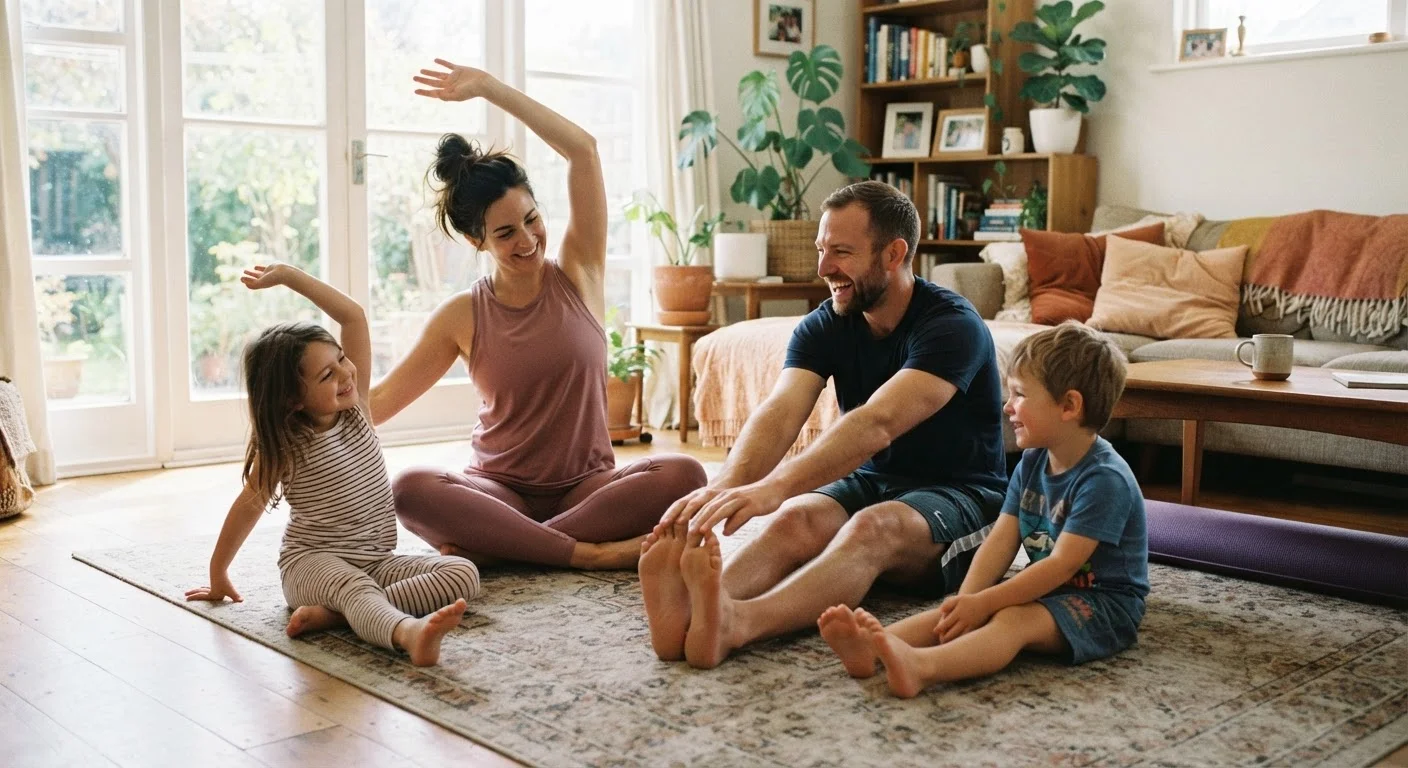
Children are naturally curious about movement, and involving them in stretching sessions removes the "exercise as obligation" framing. A five-minute morning stretch circle where everyone copies each other's favourite move builds the habit without pressure. For parents, modelling mobility practice sends a clear message: taking care of your body is a normal, everyday activity - not a punishment or a chore.
Families who connect mobility work to existing routines - morning wake-up, after school, before bed - tend to maintain it more reliably than those who treat it as a separate commitment. The same principle holds for broader fitness habits; our article on staying consistent with exercise during chaotic periods offers additional strategies.
This article is for general informational and educational purposes only and does not constitute medical advice. Consult a qualified healthcare professional before starting a new exercise programme, particularly if you or a family member has any existing health condition, injury, or concern.
Frequently Asked Questions
Stretching generally refers to passively lengthening a muscle, such as holding a hamstring stretch. Mobility work is active - it involves moving joints deliberately through their full range of motion. Both are valuable and complement each other well.
Most health and fitness authorities suggest daily or near-daily practice yields the best results, even if sessions are short. Five to ten minutes after a workout or before bed is a realistic and effective starting point for most families. Consult a healthcare provider for guidance specific to individual health conditions.
Gentle stretching is generally safe and beneficial for children. Focus on dynamic warm-ups before activity and light static stretches afterward. Avoid forcing any position and ensure movements feel comfortable. Always consult a paediatrician if a child has a known musculoskeletal condition.
Dynamic stretching (controlled leg swings, arm circles) is generally recommended before activity to warm up the muscles. Static stretching (holding positions) is better suited to after exercise, when muscles are already warm. This distinction is supported by general sports medicine guidance.
Regular mobility and flexibility work may support back health by addressing muscle tightness and improving postural control, according to general physical therapy principles. However, back pain has many causes, and anyone experiencing persistent or acute back pain should consult a qualified healthcare professional before starting a new routine.
The content provided on our blog site traverses numerous categories, offering readers valuable and practical information. Readers can use the editorial team’s research and data to gain more insights into their topics of interest. However, they are requested not to treat the articles as conclusive. The website team cannot be held responsible for differences in data or inaccuracies found across other platforms. Please also note that the site might also miss out on various schemes and offers available that the readers may find more beneficial than the ones we cover.