

Why Material Composition Matters Before You Decide
Flooring decisions affect daily comfort, maintenance workload, and long-term home value. Yet most families choose based on appearance alone - and then discover that a material's behavior under foot traffic, moisture, or temperature changes doesn't match their expectations. Knowing what a floor is actually made of tells you how it will expand, wear, absorb sound, and respond to cleaning - before you commit.
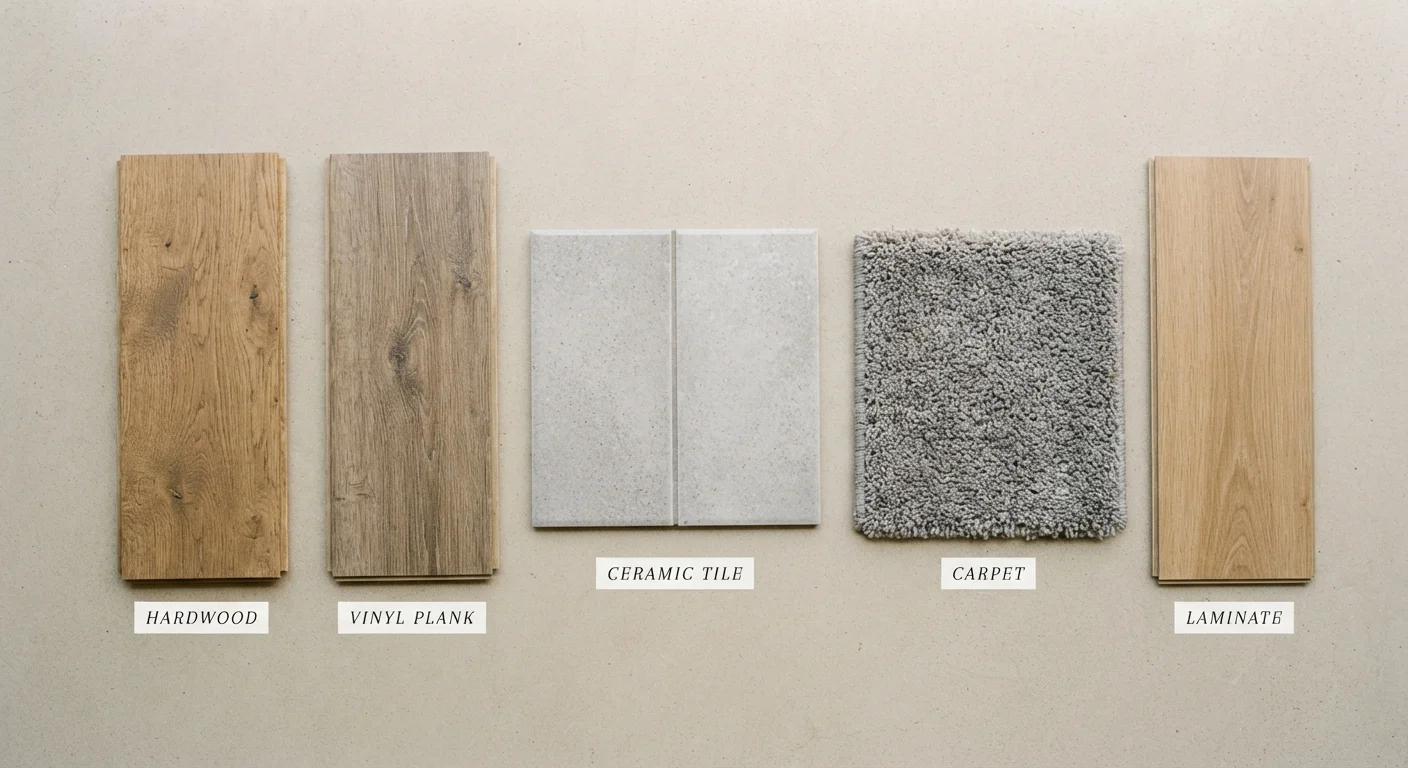
This reference covers the five most common residential flooring types: hardwood, luxury vinyl plank (LVP), ceramic or porcelain tile, carpet, and laminate. Each entry explains core composition, structural behavior, and maintenance requirements so you can evaluate options clearly.
| Most water-resistant option | Luxury Vinyl Plank (LVP) or porcelain tile |
| Only refinishable common flooring | Solid hardwood |
| Softest underfoot (synthetics) | Carpet, followed by LVP with underlayment |
| Hardest surface material | Porcelain tile (rated on Mohs hardness scale) |
| Most moisture-sensitive core | Laminate (HDF core swells with water exposure) |
| Typical carpet fiber types | Nylon, polyester, wool |
Hardwood, LVP, Tile, Carpet, and Laminate: A Material-by-Material Breakdown
Solid Hardwood
Solid hardwood is milled from a single piece of timber - typically oak, maple, hickory, or walnut. Each plank is genuine wood throughout, which allows it to be sanded and refinished multiple times over decades. However, wood is hygroscopic, meaning it absorbs and releases moisture, causing the planks to expand and contract seasonally. This makes solid hardwood poorly suited to basements or high-humidity rooms without careful climate control.
Luxury Vinyl Plank (LVP)
LVP is a multi-layer synthetic product. Its core is typically rigid PVC or a limestone-composite blend, topped with a photographic film that mimics wood or stone, then sealed with a protective wear layer. LVP is 100% waterproof at the plank level and dimensionally stable, meaning it resists the swelling and shrinking that affects real wood. It is softer underfoot than tile and warmer than stone, making it a practical choice for kitchens, bathrooms, and basements.
Ceramic and Porcelain Tile
Ceramic tile is made from clay fired at high temperatures; porcelain is a denser subtype fired at even higher temperatures, making it harder and less porous. Both are installed over a rigid subfloor with mortar and grout. Tile is impervious to water and highly resistant to scratching, but the grout lines between tiles are porous and require periodic sealing to resist staining and microbial growth. For a detailed look at ongoing tile and grout care, see what bathroom tile maintenance actually requires.
Carpet
Carpet consists of fiber tufts - most commonly nylon, polyester, or wool - anchored to a primary backing, then bonded to a secondary backing with adhesive. Nylon is the most durable synthetic option and resists crushing well. Polyester resists staining but can flatten under heavy traffic. Wool is a natural fiber with excellent resilience and natural fire resistance, though it costs considerably more. All carpet types trap airborne particles in their fibers, which can affect indoor air quality if not vacuumed regularly.
Laminate
Laminate is a composite product built from a high-density fiberboard (HDF) core, a photographic décor layer, and a hard melamine resin surface. The HDF core is wood-based and will swell if water penetrates the seams, so laminate is generally not recommended for wet areas without a highly water-resistant rating. Its hard surface resists surface scratches but cannot be refinished - once the wear layer is through, the floor must be replaced.
Wear Layer
A transparent protective coating on the surface of LVP and laminate flooring. Measured in mils (thousandths of an inch), a thicker wear layer generally indicates greater resistance to scratching and surface abrasion.
Hygroscopic
A material property describing the tendency to absorb moisture from the surrounding air. Solid hardwood and laminate's HDF core are hygroscopic, causing them to expand and contract as indoor humidity levels change.
HDF (High-Density Fiberboard)
A compressed wood-fiber panel used as the structural core of laminate flooring. It is denser than standard particleboard but susceptible to swelling when exposed to standing water.
Grout
A cement- or epoxy-based filler applied between tile pieces to seal joints. Standard cement grout is porous and requires periodic sealing to prevent staining and moisture infiltration.
Porosity
A measure of how much open space exists within a material's surface or structure. Lower porosity means less absorption of water and staining agents - porcelain tile is less porous than ceramic tile.
Subfloor
The structural layer of flooring beneath the finished surface, typically plywood or concrete. Its flatness, dryness, and rigidity directly affect how well any finished flooring material performs and lasts.
Durability Ranges and Maintenance Expectations
Durability is not absolute - it depends on traffic volume, subfloor preparation, and maintenance consistency. The table below summarizes typical performance characteristics across categories.
| Material | Water Resistance | Scratch Resistance | Refinishable? | Estimated Lifespan (with care) |
|---|---|---|---|---|
| Solid Hardwood | Low | Moderate | Yes | 50-100 years |
| LVP | High | Moderate-High | No | 15-25 years |
| Porcelain Tile | Very High | Very High | No | 50+ years |
| Carpet | Low | N/A | No | 5-15 years |
| Laminate | Low-Moderate | High (surface) | No | 10-25 years |
Lifespans are general estimates based on typical residential conditions and are not guarantees. Subfloor condition, installation quality, and household use significantly influence actual performance.
For maintenance, the general rule is: harder, smoother surfaces are easier to clean but less forgiving underfoot, while softer surfaces trap debris but absorb impact. Sweep or vacuum all hard floors regularly to prevent abrasive particles from scratching surface coatings. Wet-mop only products rated for moisture exposure, and follow manufacturer guidance on cleaning products, as harsh chemicals can degrade wear layers or finish coats over time.
The content provided on our blog site traverses numerous categories, offering readers valuable and practical information. Readers can use the editorial team’s research and data to gain more insights into their topics of interest. However, they are requested not to treat the articles as conclusive. The website team cannot be held responsible for differences in data or inaccuracies found across other platforms. Please also note that the site might also miss out on various schemes and offers available that the readers may find more beneficial than the ones we cover.