

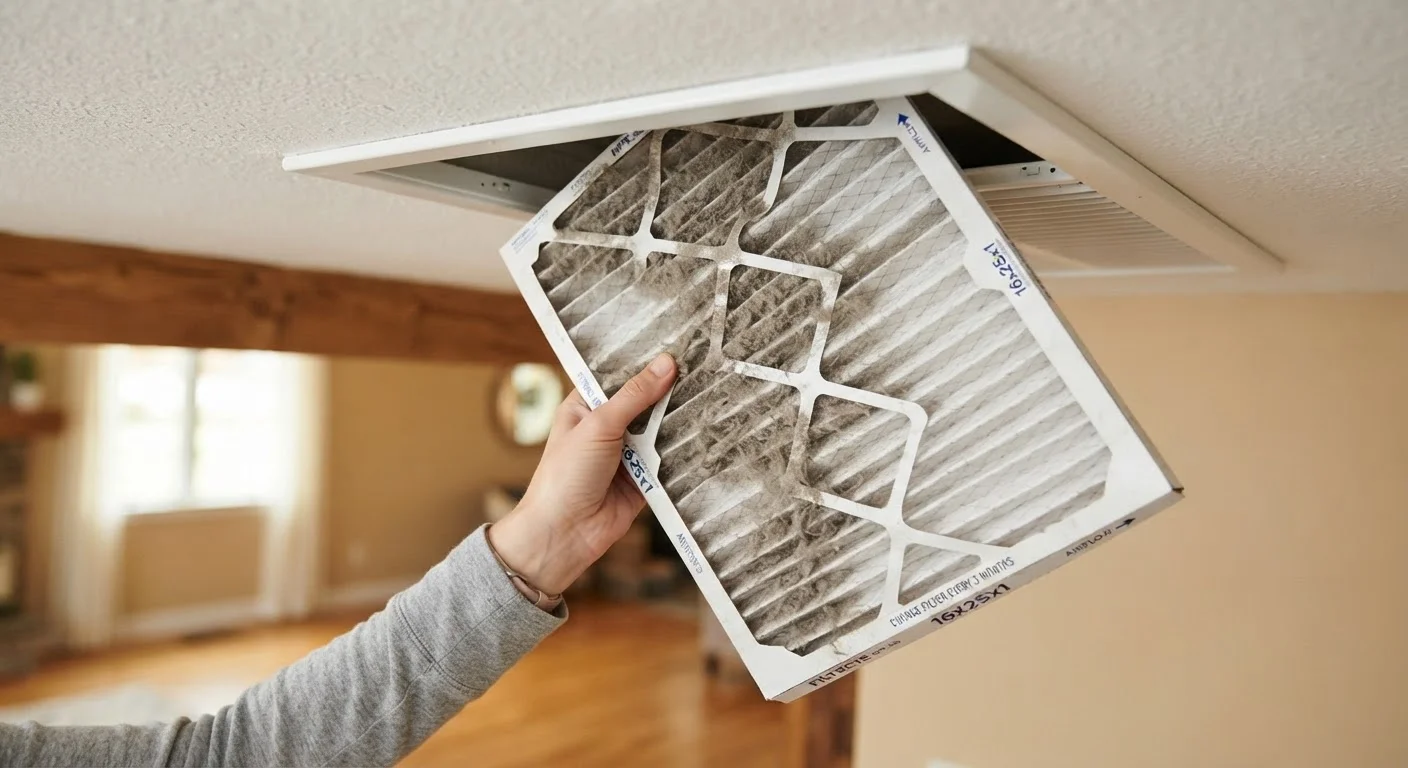
What Your Filter Is Actually Doing
Your HVAC filter has two jobs that most homeowners don't fully appreciate. The first is protecting your equipment: it catches debris before it reaches the blower motor, heat exchanger, and evaporator coil - components that are expensive to repair and sensitive to buildup. The second job is improving indoor air quality by removing particles from the air that circulates through your home.
These two functions can occasionally create tension. A filter dense enough to trap very fine particles also creates more resistance to airflow. That's why choosing the right filter - not simply the highest-rated one on the shelf - matters for your specific system.
Air moves through your home in a continuous loop: it's pulled through return vents, pushed through the filter, conditioned (heated or cooled), and then delivered back through supply vents. Every pass through a functioning filter makes that air cleaner. A clogged or missing filter breaks that loop in ways that affect both comfort and cost.
5-15%
Potential energy savings from regular filter changes
The U.S. Department of Energy estimates that replacing a clogged filter with a clean one can lower HVAC energy consumption by 5-15%.
MERV 8-11
Recommended filter range for most US homes
HVAC industry guidance generally identifies this range as balancing effective particle capture with manageable airflow resistance for typical residential systems.
30-90 days
Typical replacement interval for 1-inch filters
Actual intervals vary significantly based on occupancy, pets, allergies, and how often the system runs - monthly visual checks are more reliable than package labels alone.
Understanding MERV Ratings
MERV - Minimum Efficiency Reporting Value - is the industry-standard scale for measuring how well a filter removes particles from the air. The scale runs from 1 to 20, though residential systems typically use filters in the MERV 1-13 range.
- MERV 1-4: Fiberglass panel filters. Capture large debris like lint and dust bunnies. Minimal protection for air quality.
- MERV 5-8: Basic pleated filters. Capture mold spores, dust mite debris, and pollen. A solid baseline for most homes.
- MERV 9-12: Mid-range pleated filters. Also trap fine dust, pet dander, and some bacteria - well-suited to homes with pets or allergy sufferers.
- MERV 13+: High-efficiency filters approaching HEPA territory. Capture very fine particles but significantly restrict airflow. Often require a system designed to handle the added resistance.
Before stepping up to a higher MERV rating, check your system's documentation. Running a high-resistance filter in an undersized or older air handler can reduce airflow enough to cause coil freezing or motor strain. When in doubt, a licensed HVAC technician can advise on the maximum MERV your system can handle comfortably.
Match the Filter to Your System, Not the Other Way Around
Before buying a higher-MERV filter, locate your HVAC system's owner manual or look for a label on the air handler cabinet that specifies the maximum recommended filter rating. Using a filter with too much resistance for your system is a common and avoidable mistake. If you can't find the documentation, a quick call to an HVAC technician is worth it before making the switch.
When to Change It - and What Affects the Timeline
Package guidelines are starting points, not firm rules. A 90-day filter in a dusty household with two dogs may need replacement in 30 days. The same filter in a single-occupant home without pets could comfortably last the full advertised period.
Several factors accelerate how quickly filters load up with debris:
- Pets: Dander and shed fur are among the most common sources of rapid filter clogging.
- Allergies or asthma in the home: More frequent changes help maintain filtration effectiveness when air quality is a health priority.
- Construction or renovation nearby: Drywall dust and particulates from nearby work can overwhelm filters quickly.
- Running the system constantly: High-use periods (peak summer or winter) move more air through the filter, loading it faster.
- Older or dustier homes: Homes with older ductwork or unfinished basements tend to introduce more particulates into the air loop.
A simple habit: pull the filter out monthly and hold it up to light. If you can't see light through it, replace it. Just as skipping routine maintenance on your car leads to compounding repair costs, deferring filter changes quietly degrades both your air quality and your equipment.
The Real Costs of a Clogged Filter
A dirty filter doesn't just reduce air quality - it has measurable financial consequences. When airflow is restricted, your HVAC system must run longer cycles to reach the thermostat's target temperature, consuming more electricity in the process. The U.S. Department of Energy has noted that a clogged filter is one of the most common causes of reduced system efficiency in residential homes.
Beyond energy costs, restricted airflow stresses mechanical components. Blower motors run hotter. Evaporator coils can freeze when insufficient warm air moves across them. Heat exchangers in furnaces may overheat and crack - a serious safety concern, as a cracked heat exchanger can allow combustion gases to enter living spaces. These are scenarios where a licensed HVAC technician should be involved immediately.
Replacing a filter costs a few dollars to a few tens of dollars depending on type and rating. A blower motor replacement or coil cleaning can run into the hundreds. The math is straightforward - consistent filter maintenance is one of the highest-return maintenance habits a homeowner can build. Like following a vehicle maintenance schedule, it's the small, regular actions that prevent large, unplanned expenses.
This article is for general informational purposes only. For safety concerns related to HVAC equipment - particularly issues involving gas furnaces, electrical components, or ductwork - consult a licensed HVAC professional. Always follow local code requirements and manufacturer guidelines.
Frequently Asked Questions
Most standard 1-inch filters should be changed every 30-90 days. Homes with pets, smokers, or allergy sufferers typically need changes closer to every 30 days. Thicker filters (4-5 inches) can last 6-12 months. Check your filter monthly and replace it when it appears visibly gray or clogged.
MERV stands for Minimum Efficiency Reporting Value and rates how effectively a filter captures airborne particles on a scale of 1-16 for residential use. A MERV 8 captures most dust and pollen; MERV 11-13 also traps pet dander and some bacteria. Check your HVAC system's manual before using high-MERV filters, as they can restrict airflow in systems not designed for them.
A severely clogged filter restricts airflow, causing your system to overheat or freeze up, driving up energy consumption and potentially leading to costly repairs or early equipment failure. Indoor air quality also suffers as the overloaded filter stops capturing new particles effectively.
Disposable fiberglass or pleated filters are not designed to be washed - cleaning them typically damages the filtration media, reduces their effectiveness, and can introduce moisture that encourages mold growth. Washable or electrostatic filters are the reusable option, but they require thorough drying before reinstallation.
Generally yes - a MERV 11 filter captures more fine particles than a MERV 6. However, if your HVAC system isn't designed for higher-resistance filters, the reduced airflow can cause more harm than good. Balance filtration quality with your system's specifications, which are listed in the owner's manual.
Most residential HVAC filters are located either at the return air vent (a large grille on a wall or ceiling) or inside the air handler cabinet itself, often in a utility closet, basement, or attic. Some homes have multiple return vents with individual filters. Your system's manual will confirm the exact location.
The content provided on our blog site traverses numerous categories, offering readers valuable and practical information. Readers can use the editorial team’s research and data to gain more insights into their topics of interest. However, they are requested not to treat the articles as conclusive. The website team cannot be held responsible for differences in data or inaccuracies found across other platforms. Please also note that the site might also miss out on various schemes and offers available that the readers may find more beneficial than the ones we cover.