

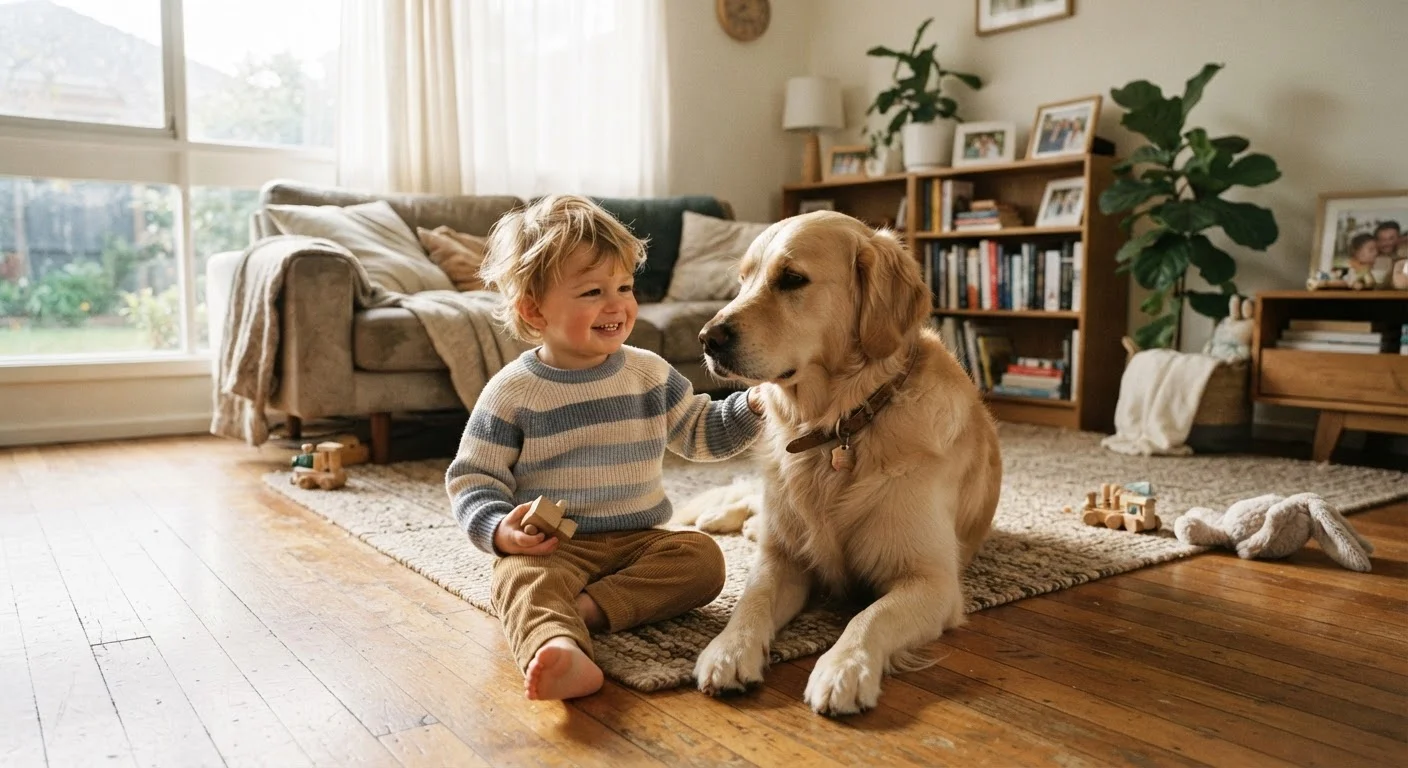
Why Pet Safety Myths Are So Sticky - and So Consequential
When a new baby arrives or a toddler starts exploring the living room floor, parents naturally scrutinize every possible risk. Pets become a focal point for anxiety, and that anxiety tends to attract folklore just as much as facts. Some myths push families toward unnecessary fear; others create false reassurance. Both are genuinely dangerous.
The goal here isn't to make pet ownership seem risk-free - it isn't. The goal is to replace vague worry with accurate, actionable understanding. A parent who knows what real warning signs look like is in a far stronger position than one who's simply waiting for a growl that may never come.
Myth
A dog will always growl or show teeth before biting, so parents will have time to intervene.
Fact
Dogs frequently bite without an obvious visible warning, especially when earlier subtle signals were ignored or suppressed.
Many families operate on the assumption that a bite comes with clear advance notice - a growl, a snap, a visible warning. In reality, dogs communicate stress through a layered range of signals: yawning, lip licking, turning away, a stiff body, or a tail held low. Children are developmentally less equipped to read these cues, and dogs that have been corrected for growling in the past may have learned to skip that step entirely.
The American Veterinary Medical Association notes that children under age 6 are at the highest statistical risk of dog bites, often from a dog they know. Teaching children to recognize early stress signals - and building in adult supervision as a constant rather than an occasional measure - is far more protective than waiting for an obvious warning. For age-appropriate interaction guidance, see our guide to teaching kids safe pet interaction.
Myth
Cats are dangerous to sleep near a newborn because they can suffocate babies.
Fact
There is no credible evidence that cats intentionally smother infants; standard safe-sleep practices address any realistic concern.
This myth has circulated for generations, sometimes described as cats being drawn to the warmth or smell of milk. Pediatric and veterinary consensus does not support the idea that cats pose a specific suffocation threat. The standard guidance - keeping pets out of the sleep space and following safe-sleep recommendations from your pediatrician - addresses the same general concern that applies to any soft object near a sleeping infant.
A cat sharing a home with a newborn is not inherently unsafe. Consistent hygiene, keeping the crib off-limits, and regular veterinary care (including parasite prevention) keep the household low-risk. For a balanced comparison of what cat and dog ownership actually looks like day-to-day with young kids, read our practical parent's comparison.
Myth
Having a dog or cat in the home will make allergies worse for young children.
Fact
Research suggests that early exposure to pet dander may lower - not raise - the risk of developing certain allergies in some children.
Several epidemiological studies, including research published in peer-reviewed journals on childhood asthma and allergy, have found that infants raised in homes with pets (particularly dogs) had a reduced likelihood of developing certain allergic conditions compared to those raised in pet-free homes. The proposed mechanism involves early immune-system programming through microbial diversity.
This does not mean pets are safe for every child. Children who already have diagnosed animal allergies or asthma triggered by pet dander face a different situation, and decisions about pet ownership in those households should be made in consultation with a healthcare provider. The general claim that pets universally worsen childhood allergy risk is not supported by current evidence.
Myth
Certain 'family-friendly' breeds are always safe around children, while others are always dangerous.
Fact
Breed generalizations are poor predictors of individual dog behavior; individual history, socialization, and environment matter far more.
The idea that specific breeds are inherently child-safe - or inherently dangerous - is deeply embedded in popular culture but not supported by behavioral science. A 2020 review in Frontiers in Veterinary Science found that bite incidents involve a wide range of breeds, and that owner behavior, training history, and situational context are more predictive of aggression risk than breed classification alone.
Selecting a dog for a family with young children is better guided by an individual animal's temperament, history with children, and energy level rather than breed reputation. Our article on traits that actually predict a good family fit explores this in more depth.
Myth
Pets and young kids don't need much supervision once they've been together for a while and 'know each other.'
Fact
Familiarity does not eliminate bite or injury risk; consistent adult supervision remains the most effective protective measure regardless of relationship history.
Many bite incidents occur between children and pets that have lived together for months or years without prior incident. A child entering a new developmental stage - becoming more mobile, louder, or more unpredictable - can change how a previously calm animal responds. Similarly, a pet experiencing pain, illness, or stress may react differently than it did when healthy.
Supervision guidelines from veterinary and child safety organizations generally recommend that young children and pets should not be left alone together, even in established households. This isn't about distrust - it's about recognizing that both children and animals are dynamic beings whose responses can shift. Pairing supervision with consistent interaction rules for children builds a genuinely safer environment over time.
For families still weighing which type of pet makes sense given their household's energy level and lifestyle, our overview of matching pet type to your family is a practical starting point.
Building a Safer Home: What the Evidence Actually Recommends
Never Leave Young Children and Pets Unsupervised
Regardless of breed, species, temperament, or how long a pet has lived in the home, children under age 6 should never be left alone with any animal. This applies equally to the family dog you've had for five years and a new kitten. Supervision means an adult is actively present - not just in the next room.
The most reliable safety strategy cuts across every species and every myth on the list: adult supervision is non-negotiable for young children with any pet. That reality doesn't change based on how long the pet has lived in the home, what breed it is, or how gentle it usually seems.
Beyond supervision, evidence-based protective measures include keeping pets on regular veterinary wellness schedules - including up-to-date core vaccinations and parasite prevention - and teaching children interaction rules that are age-appropriate rather than one-size-fits-all. Toddlers need different guidance than six-year-olds, and both benefit from adult modeling of respectful animal handling.
Any Bite or Scratch Warrants Medical Attention
Even a minor bite or deep scratch from a household pet should be evaluated by a healthcare provider, particularly for young children. Animal bites carry infection risk regardless of the pet's vaccination status. Do not rely on home treatment alone - contact your child's pediatrician or seek prompt medical care.
Families considering adding a pet - or reconsidering one they already have - are better served by honest, evidence-grounded thinking than by either myth-driven fear or uncritical reassurance. The real pros and cons of getting a dog with young kids is one resource that tries to present that honest picture. So does our pet health basics hub, which covers ongoing care questions that come up once a family pet is part of the household.
This article provides general information for educational purposes and is not a substitute for guidance from a licensed veterinarian or pediatrician. Always consult qualified professionals for concerns specific to your child's health or your pet's behavior.
The content provided on our blog site traverses numerous categories, offering readers valuable and practical information. Readers can use the editorial team’s research and data to gain more insights into their topics of interest. However, they are requested not to treat the articles as conclusive. The website team cannot be held responsible for differences in data or inaccuracies found across other platforms. Please also note that the site might also miss out on various schemes and offers available that the readers may find more beneficial than the ones we cover.