

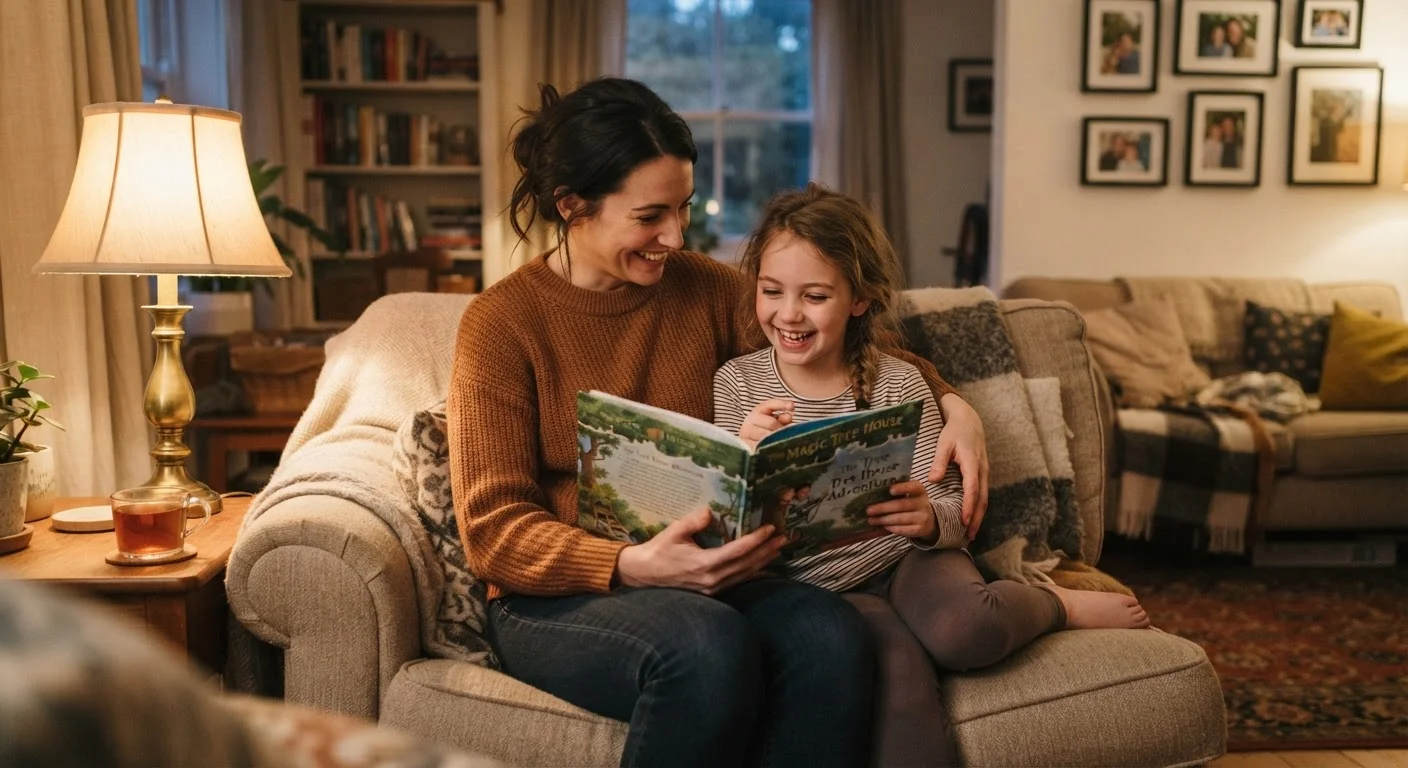
Why Families Stop - and Why That's a Mistake
There's a milestone moment most families recognize: the day a child picks up a book and reads it cover to cover on their own. It feels like a graduation of sorts, and many parents quietly retire the read-aloud habit, assuming their job there is done. It makes intuitive sense - why read to someone who can read themselves?
But that logic misses something important about how children's minds actually develop. Learning to decode words on a page is only one part of reading. Comprehension, vocabulary acquisition, inference, and genuine love of story are all separate skills - and they develop on different timelines. Reading aloud doesn't become less useful once kids can sound out words; in many ways, it becomes more useful.
For families looking to strengthen learning at home, this is genuinely low-effort, high-impact territory. If you're already thinking about how everyday routines build academic skills, adding or continuing a read-aloud habit fits naturally into that framework.
Myth
Once a child can read independently, reading aloud to them is no longer necessary or useful.
Fact
Children's listening comprehension surpasses their reading comprehension for years after they become independent readers - making read-alouds a powerful learning tool well into middle school.
The ability to decode text and the ability to understand complex language are distinct skills. A child who reads at a third-grade level can often comprehend - and be deeply engaged by - stories and ideas written at a fifth- or sixth-grade level, provided someone reads them aloud. That exposure to richer vocabulary and more complex syntax directly accelerates their own reading development over time.
Myth
Reading aloud is mainly a tool for building early literacy - it's most valuable before age six.
Fact
Read-alouds support vocabulary growth, critical thinking, and emotional development throughout elementary and middle school, not just in early childhood.
Literacy researchers often point out that vocabulary exposure is cumulative: the more varied and sophisticated language a child hears, the larger their working vocabulary becomes. Books read aloud to older children tend to contain more rare and domain-specific words than everyday conversation, giving kids consistent exposure to the kind of language they'll encounter in academic reading and standardized assessments.
Myth
Kids who are strong readers don't need to be read to - they can just read the same books themselves.
Fact
Even capable readers benefit from hearing books aloud, because the experience supports fluency modeling, comprehension discussion, and shared emotional engagement that solo reading doesn't replicate.
When an adult reads aloud with expression, pacing, and inflection, they are modeling fluent reading in a way children internalize. Hearing a skilled reader navigate a complex passage - pausing for effect, emphasizing meaning - teaches kids how text is meant to sound and feel. That modeling has documented benefits for reading fluency even in children who already read well on their own.
Myth
Read-alouds stop being bonding experiences once kids outgrow picture books.
Fact
Shared reading of chapter books and longer nonfiction creates rich opportunities for conversation, empathy, and connection that deepen as children's capacity for nuanced thinking grows.
Picture books are a wonderful starting point, but the real emotional and intellectual depth of read-alouds often emerges later - when children are old enough to grapple with complex characters, moral ambiguity, and challenging themes. Discussing a character's difficult choice or an injustice portrayed in a historical novel gives families a shared emotional vocabulary that carries into everyday conversations.
The Real Benefits That Last Into the Teen Years
Research in literacy education consistently shows that a child's listening comprehension outpaces their reading comprehension until roughly the eighth grade. That gap is significant: when a parent reads aloud a book that's slightly above the child's independent reading level, the child is exposed to richer vocabulary, more complex sentence structures, and more sophisticated ideas than they could access alone.
8th Grade
When listening and reading comprehension typically converge
Literacy researchers generally estimate that children's listening comprehension exceeds their reading comprehension until around the eighth grade, leaving a long window where read-alouds add unique value.
~30 million
Word-exposure gap by age 3 (Hart & Risley research)
Classic research by Hart and Risley documented enormous differences in children's early word exposure - a gap that read-alouds at any age help narrow by consistently introducing rich, varied vocabulary.
Shared reading also creates space for conversation. When a story raises a moral dilemma, a moment of injustice, or an unfamiliar historical event, families can pause and talk through it - modeling the kind of critical thinking that strengthens comprehension at every grade level. These moments are harder to manufacture in any other context.
Then there's the relationship dimension. Many parents of tweens and teens describe a creeping distance that sets in as kids become more independent. A shared book - even ten minutes before bed - keeps a low-pressure channel of connection open. It's a ritual that requires nothing but presence.
For a broader look at supporting your child across developmental stages, the family learning roadmap is worth exploring alongside these strategies.
Read-Alouds Are Not a Substitute for Independent Reading
While reading aloud to older children carries real benefits, it works best alongside - not instead of - independent reading practice. Children still need regular time reading on their own to build stamina, decoding fluency, and the habit of sustained solo reading. Think of read-alouds as a complement that expands vocabulary and comprehension, while solo reading builds the mechanics of literacy.
Making It Work in a Busy Household
The most common objection families raise is time. Between homework, activities, and screens competing for attention, a daily read-aloud session can feel like one more obligation. But the research bar here is actually quite accessible - even a few sessions per week, consistently maintained, appear to deliver meaningful gains in vocabulary and comprehension.
Choosing the right book matters more than the schedule. Look for titles a level or two above what your child reads independently - novels with chapters, nonfiction on topics they're curious about, or even well-written magazine articles. The key is genuine interest: a child who's invested in the story will absorb far more than one who's tolerating it.
If your child is resistant to sitting and listening, try reading during car rides, while they draw, or at meals - contexts where the activity feels ambient rather than assigned. Some families find that audiobooks narrated by the parent (or listened to together) serve a similar purpose when schedules are tight. The goal is sustained, shared engagement with language - the format is flexible.
If you're building a reading habit from scratch, starting with read-alouds is often the gentlest on-ramp, even for kids who resist books on their own.
The content provided on our blog site traverses numerous categories, offering readers valuable and practical information. Readers can use the editorial team’s research and data to gain more insights into their topics of interest. However, they are requested not to treat the articles as conclusive. The website team cannot be held responsible for differences in data or inaccuracies found across other platforms. Please also note that the site might also miss out on various schemes and offers available that the readers may find more beneficial than the ones we cover.