

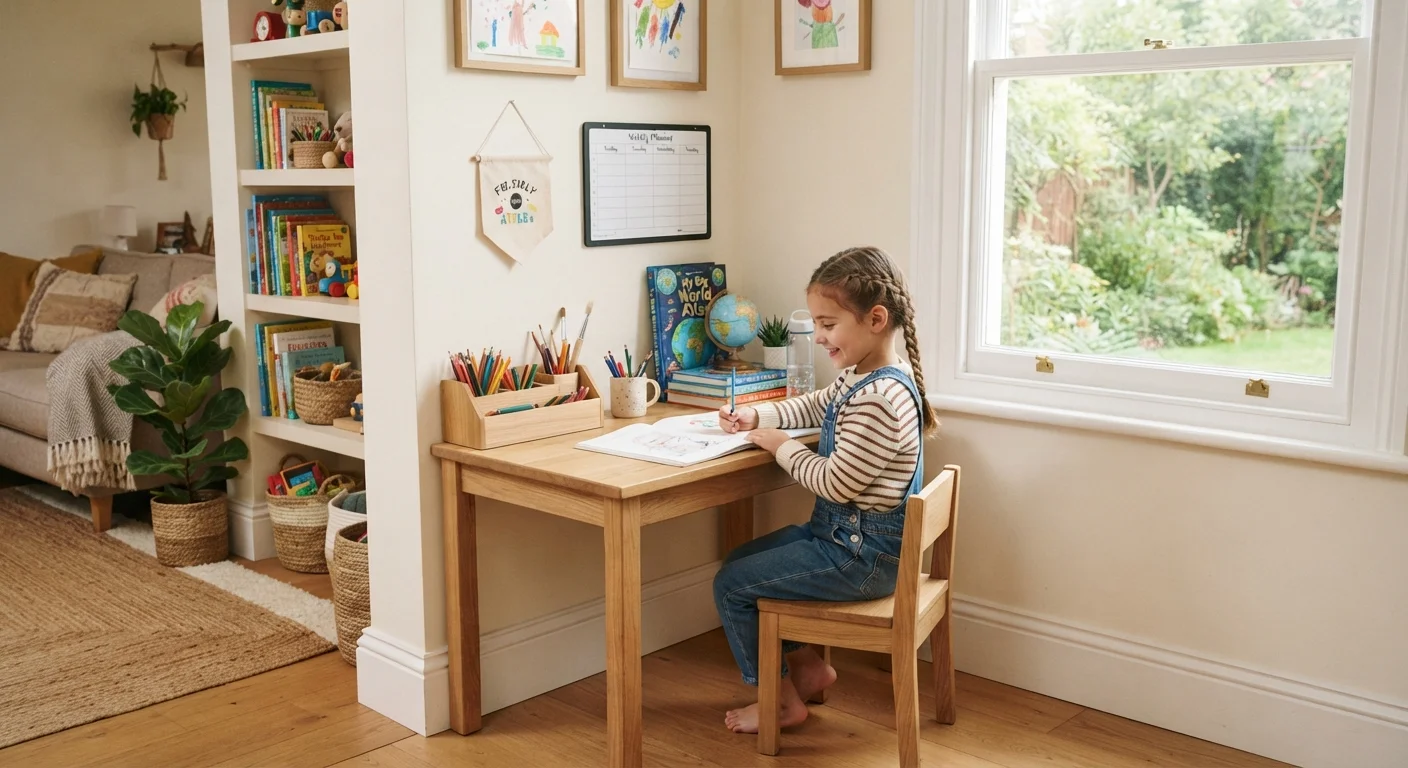
Why the Environment Shapes the Habit
Most children don't resist learning - they resist the friction that precedes it. A misplaced pencil, an uncomfortable chair, a noisy background, or the simple absence of a dedicated spot can make starting feel harder than it needs to be. Environmental design is one of the most underrated tools parents have.
Research in educational psychology consistently points to physical environment as a meaningful factor in children's ability to concentrate and retain information. That doesn't mean families need a purpose-built study room - it means that small, deliberate choices about space and setup add up to a noticeably different experience for the child sitting down to learn.
This is also general educational information, not a prescription for any individual child's needs. Every child is different, and what works well in one household may need adapting in another. Use the steps below as a starting framework, then adjust based on what you observe. For a broader look at what home learning involves beyond the physical setup, explore what learning at home actually means.
Space Setup Is Only One Piece
A well-arranged desk supports learning but doesn't replace it. Routines, parental engagement, and a child's sense of purpose all play a significant role in whether home learning sticks. See our broader guide to learning at home for context on the full picture.
What You'll Need Before You Start
The good news: setting up an effective home learning space rarely requires significant spending. Most families already have the basics. What's often missing is intentionality - pulling those elements together into a coherent setup rather than leaving them scattered.
What you will need
Adjustable desk lamp
Provides focused, consistent light for reading and writing regardless of time of day.
Desktop organizer or caddy
Keeps frequently used supplies within reach so children can start work without hunting for materials.
Noise-canceling headphones
Helpful in busier households to reduce auditory distractions during focused work sessions.
Wall calendar or whiteboard
Gives children a visual overview of assignments, deadlines, and routines.
Sturdy, height-appropriate chair
Supports good posture and physical comfort during longer study sessions.
For families watching their budget, keep in mind that a simple, well-organized space will outperform a cluttered, expensive one every time. You can find practical ideas for managing household spending without sacrificing quality at our family budgeting hub.
Let Your Child Have a Say
When children help choose where the space goes, how it's organized, or what goes on the wall, they feel ownership over it. That sense of ownership is a surprisingly strong motivator for actually sitting down and working. Even small choices - the color of a folder, the placement of a lamp - matter to kids.
Step-by-Step: Building the Space
Choose and commit to a specific location
Pick a spot your child can return to consistently - not just any available surface. It doesn't need to be a separate room. A corner of a bedroom, a section of the dining table that's kept clear, or even a hallway nook can work well. What matters is that the location feels designated rather than improvised.
Avoid high-traffic areas where household activity constantly pulls attention. Proximity to the kitchen during cooking or a TV in use makes focus significantly harder, especially for younger children.
Get the lighting right
Poor lighting causes eye strain and fatigue, which shortens the time a child can concentrate comfortably. Natural light is ideal - position the workspace near a window if possible, with the light source coming from the side rather than directly behind or in front of the child to reduce glare.
For evenings or darker rooms, a good desk lamp with warm-to-neutral light (around 3000-4000K color temperature) is a practical addition. Harsh overhead lighting alone is rarely sufficient for detailed work.
Set up the physical workspace for comfort
Children who are physically uncomfortable disengage faster. Ensure the chair allows your child's feet to rest flat on the floor and that the desk surface sits at roughly elbow height when seated. If furniture isn't adjustable, use a firm cushion on the seat or a footrest to compensate.
Clear the surface of everything that isn't relevant to the current task. A tidy, uncluttered surface reduces the mental load before your child even begins.
Organize supplies so they're easy to access
Friction is the enemy of starting. When a child has to search for scissors, a ruler, or the right notebook, that small obstacle often becomes a reason to delay or give up. Keep everyday supplies in a visible, reachable organizer on or directly beside the desk.
Use simple categories: writing tools in one spot, paper and notebooks in another, reference materials (dictionary, ruler, calculator) in a fixed location. Involve your child in setting this up - children who organize their own space are more likely to maintain it.
Minimize digital and auditory distractions
If your child uses a device for schoolwork, agree in advance which apps or tabs are permitted during study time. Many devices allow you to set focus modes or app restrictions - use them as a default rather than an exception.
For auditory distractions, soft background music without lyrics is generally less disruptive than silence for some children, while others need quiet. Pay attention to what your child responds to rather than assuming one approach fits all. If the household is noisy, this is where noise-canceling headphones earn their place.
Establish a simple routine around the space
A physical space works best when it's anchored to a predictable time. Even a loose structure - homework after a snack, reading before dinner - signals to children's brains that it's time to shift into learning mode. Consistency matters more than rigidity.
Post a simple visual schedule or use a whiteboard near the workspace to outline the afternoon routine. This reduces the daily negotiation about when homework gets done and builds a habit that becomes self-sustaining over time. For more on balancing structure with child-led exploration, see our guide on structured vs. unstructured learning time.
Avoid Over-Engineering the Space
It can be tempting to turn a learning corner into a fully outfitted mini-classroom, but clutter and novelty can be distracting. Start with the basics and add only what your child genuinely needs. An overstuffed space often ends up less functional than a simple, clear one.
Once the space is set up, consider reviewing the parent's checklist for a strong home learning environment to audit whether your routines and habits support what the physical space is designed to do. The room is only one part of the equation.
The content provided on our blog site traverses numerous categories, offering readers valuable and practical information. Readers can use the editorial team’s research and data to gain more insights into their topics of interest. However, they are requested not to treat the articles as conclusive. The website team cannot be held responsible for differences in data or inaccuracies found across other platforms. Please also note that the site might also miss out on various schemes and offers available that the readers may find more beneficial than the ones we cover.