

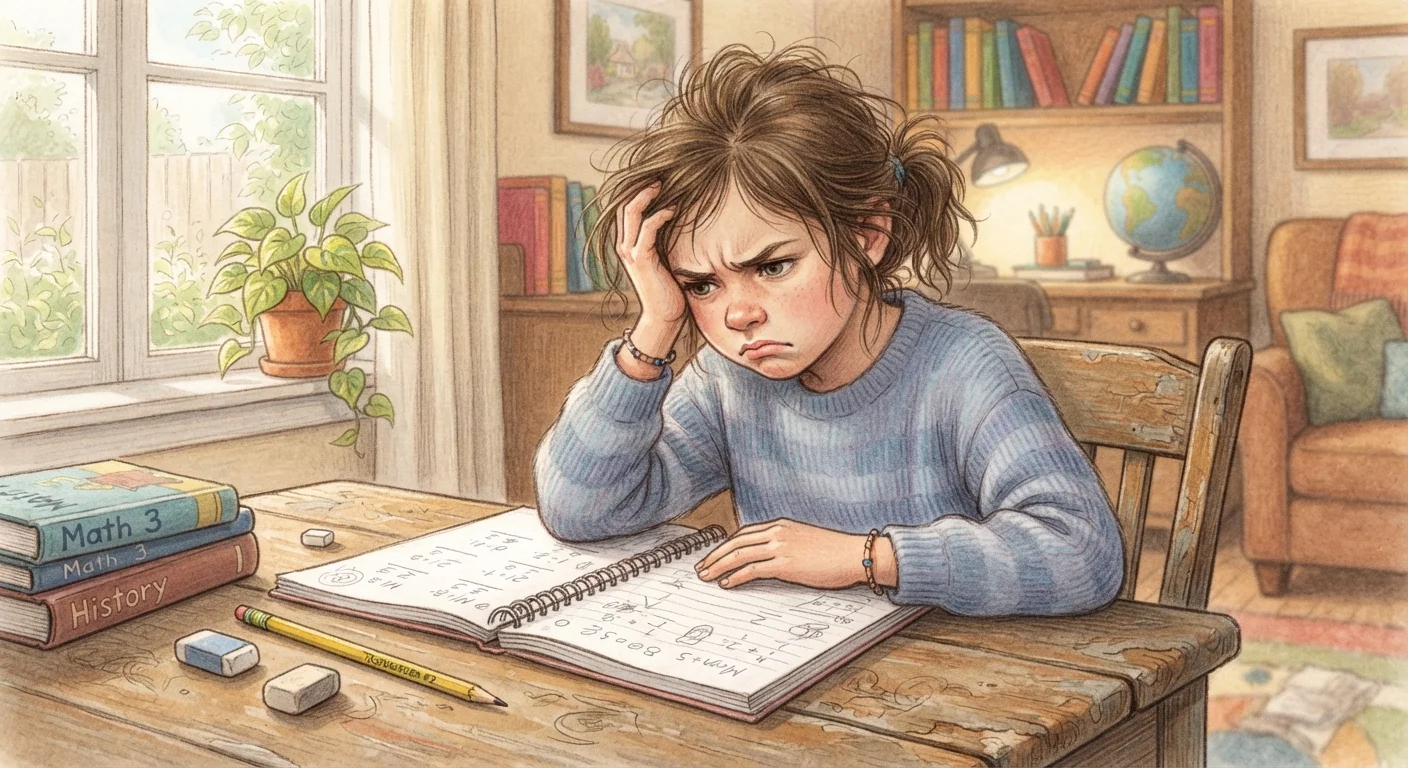
Recognizing the Warning Signs
Every child hits a rough patch with schoolwork now and then. But when struggles show up consistently - across subjects, weeks, or moods - they deserve a closer look. The tricky part is that learning difficulties rarely announce themselves clearly. Instead, they often disguise themselves as behavior.
| Common age range for first noticeable learning gaps | Ages 6-9 (early elementary) (National Center for Learning Disabilities) |
| Children with a learning disability in the US | Approximately 1 in 5 (National Center for Learning Disabilities) |
| Most common learning difficulty | Dyslexia (reading-based) (Yale Center for Dyslexia & Creativity) |
| When to involve a teacher | After 4-6 weeks of consistent struggle (General educational guidance) |
| Cost of school-based evaluations | Free under IDEA (federal law) (Individuals with Disabilities Education Act (IDEA)) |
Below are some of the most common patterns parents notice, along with what each might indicate:
- Avoidance and procrastination: A child who routinely delays homework, claims not to have any, or finds elaborate distractions may be avoiding tasks that feel overwhelming or embarrassing.
- Emotional outbursts around schoolwork: Tears, anger, or shutting down when asked to read or practice math can signal that a child feels genuinely stuck - not lazy or defiant.
- Loss of interest in topics they previously enjoyed: A child who once loved reading but now resists it may have encountered a skill gap that eroded their confidence.
- Complaints of headaches or stomachaches before school tasks: Physical symptoms tied to specific activities can reflect anxiety around academic performance.
- Consistently forgetting instructions: Difficulty holding multi-step directions in mind may point to working memory challenges rather than inattentiveness.
- Falling behind peers on specific skills: Grade-level benchmarks exist for a reason - a notable gap in reading fluency, number sense, or writing development is worth discussing with a teacher.
None of these signs alone confirms a learning difficulty. Context matters enormously - a big transition, a family stressor, or even a growth spurt can temporarily disrupt a child's learning. But if several patterns persist over four to six weeks, that's a reasonable prompt to act.
What to Do When You Notice the Signs
Once you've identified a pattern, the goal isn't to panic - it's to gather information and take small, deliberate steps.
Learning disability
A neurological condition that affects how a person processes, remembers, or communicates information. It is not related to intelligence and is identified through professional evaluation.
Dyslexia
A reading-based learning difficulty that affects the ability to decode words, spell accurately, and read fluently. It is one of the most common learning disabilities.
Dyscalculia
A learning difficulty that affects a child's ability to understand numbers, learn arithmetic facts, and carry out mathematical reasoning.
Working memory
The brain's short-term system for holding and using information while completing a task. Weaknesses here can make following multi-step instructions difficult.
IEP (Individualized Education Program)
A legally binding plan developed by a school team and parents that outlines specific learning goals and accommodations for a child with an identified disability.
Start With Observation, Not Diagnosis
Keep a simple log for one to two weeks. Note which tasks trigger frustration, how long the child can focus before disengaging, and whether any subjects feel easier. This record becomes useful when you talk to teachers or professionals.
Open a Low-Stakes Conversation With Your Child
Ask open questions like "What feels hard lately?" rather than "Why aren't you trying?" Children are often aware something isn't clicking but lack the words - or the safety - to say so. Validate their feelings before moving to problem-solving. See our guide on the line between helping and doing for ways to stay supportively present without taking over.
Reach Out to the Teacher Early
Teachers see your child in a structured learning environment you can't replicate at home. Request a brief check-in - not a formal meeting - to share what you've observed and ask what they're noticing. Ask specifically: "Are there any areas where you'd recommend extra support?"
Consider a School-Based Evaluation
If the teacher shares concerns, or if struggles persist despite support, ask about the school's evaluation process. Under federal law in the United States, schools are required to evaluate children for learning disabilities at no cost to families when there is reasonable suspicion of a disability. A formal evaluation can identify conditions such as dyslexia, dyscalculia, or attention-related challenges - and opens the door to accommodations.
Build Confidence Through Small Wins at Home
While the formal process unfolds, keep the home environment low-pressure. Short, consistent practice in a child's area of difficulty - ideally linked to something they enjoy - builds resilience without adding shame. Our math confidence strategies for parents offer a useful starting point for number-related gaps. For a broader picture of age-appropriate support, the family learning roadmap covers strategies from early childhood through the teen years.
This article is for general informational and educational purposes only. If you have concerns about your child's development, learning, or emotional wellbeing, please consult a qualified educator, school psychologist, or licensed health professional.
The content provided on our blog site traverses numerous categories, offering readers valuable and practical information. Readers can use the editorial team’s research and data to gain more insights into their topics of interest. However, they are requested not to treat the articles as conclusive. The website team cannot be held responsible for differences in data or inaccuracies found across other platforms. Please also note that the site might also miss out on various schemes and offers available that the readers may find more beneficial than the ones we cover.