

Why Pet Food Labels Are More Regulated Than You Might Expect
Pet food sold in the United States is regulated at both the federal level - by the FDA's Center for Veterinary Medicine - and at the state level through model regulations developed by the Association of American Feed Control Officials (AAFCO). This layered oversight means the information panel on a bag of dog or cat food follows a defined format and uses terms with specific legal meanings.
That's genuinely good news for pet owners, because it means the label is a reliable source of information - if you know how to read it. The challenge is that front-of-package marketing language is far less constrained than the regulated back panel, so a bag can make compelling-sounding claims up front while the real nutritional story sits quietly in smaller print on the side.
Understanding a few key conventions transforms the label from confusing fine print into a useful decision-making tool. The steps below walk you through each section in the order most useful for a quick evaluation.
What you will need
Labels Are Not a Substitute for Vet Guidance
This article provides general educational information about how pet food labels work - it is not veterinary advice. Every pet has individual nutritional needs shaped by age, breed, weight, and health status. Always consult a licensed veterinarian before making significant changes to your pet's diet, especially for puppies, kittens, seniors, or animals with chronic conditions.
Step-by-Step: How to Evaluate Any Pet Food Label
Find the AAFCO Nutritional Adequacy Statement
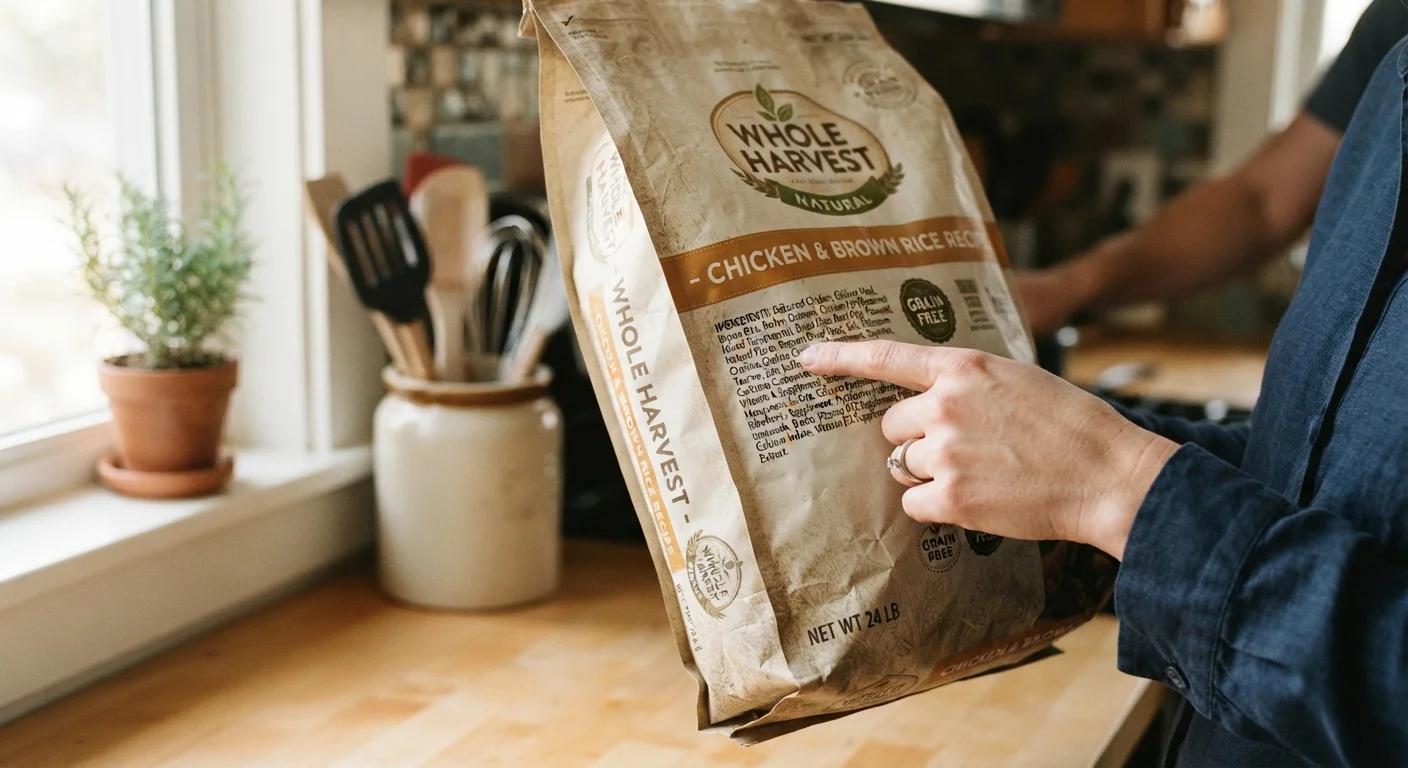
Flip the package to the information panel and locate the nutritional adequacy statement - often a single paragraph beginning with something like "[Product name] is formulated to meet the nutritional levels established by the AAFCO [Dog/Cat] Food Nutrient Profiles for [life stage]."
This statement is the single most important line on the label. It tells you two things: whether the food has been formulated to meet AAFCO nutrient standards or tested via a feeding trial, and which life stage it covers - growth (puppies/kittens), adult maintenance, all life stages, or senior. Match this to your pet's current stage.
Read the Ingredient List - Understanding the Weight Rule
Ingredients must be listed in descending order by weight before cooking or processing. Raw chicken, for example, contains a lot of water, so it weighs heavily before processing but shrinks considerably afterward. A food that lists 'chicken' first and 'chicken meal' fourth may actually deliver more chicken protein from the meal - because meal is already a concentrated, moisture-removed form.
This doesn't mean the first ingredient is meaningless, but it does mean a single ingredient's position isn't the whole story. Look at the first five to eight ingredients together to get a more accurate picture of what makes up the bulk of the food.
Decode Regulated Terms: By-Products, Meal, and Digest
Several ingredient names have precise, regulated definitions under AAFCO that often differ from how they sound colloquially:
- By-products (e.g., chicken by-products): Organ meats, necks, feet, and other parts not typically sold for human consumption. They are not rendered (cooked into a dry powder) and can be a legitimate, nutritious protein source.
- Meal (e.g., chicken meal, salmon meal): Rendered and dried protein concentrate. Because moisture is removed, meal is a calorie- and protein-dense ingredient.
- Digest (e.g., chicken digest): Chemically or enzymatically broken-down animal tissue used primarily as a palatability enhancer rather than a primary protein source.
None of these terms automatically signals a low-quality food. What matters is the overall nutrient profile confirmed by the AAFCO statement.
Check the Guaranteed Analysis Panel
Directly below or beside the ingredient list, the guaranteed analysis lists minimum percentages of crude protein and crude fat, and maximum percentages of crude fiber and moisture. These are regulatory minimums and maximums - not exact values - so a 'minimum 26% crude protein' food could contain more.
To compare a wet food and a dry food fairly, you need to account for moisture differences by converting both to a dry matter basis. Subtract the moisture percentage from 100 to get the dry matter percentage, then divide the nutrient percentage by that number. This step levels the playing field between canned and kibble options.
Evaluate the Manufacturer's Statement and Feeding Guidelines
Look for the manufacturer's name and contact information - required by federal and state regulations. A company that makes it easy to reach them with questions generally signals greater accountability.
Feeding guidelines are provided as a starting point based on body weight, not as a precise prescription. Your individual pet's activity level, metabolism, and health status may mean they need more or less than the stated range. Treat these as an estimate and adjust based on body condition - a topic your vet can walk you through directly.
For a broader look at label literacy across product categories, the approach mirrors skills covered in reading a human nutrition label - the habit of looking past front-of-pack claims applies equally to pet food. And since food is one of the larger ongoing costs of pet ownership, it's worth seeing the full picture in our guide to the hidden costs of owning a family pet.
Involve Kids in Label Reading
Teaching children to look at pet food labels alongside you is a genuine learning moment. It builds early habits around reading carefully and thinking critically about product claims - skills that transfer to evaluating human food labels too. For more on how everyday pet care supports children's development, see how caring for animals supports children's learning.
What the Label Can't Tell You - and What to Do Instead
Even a well-crafted label has limits. It won't tell you about ingredient sourcing practices, manufacturing quality control, or how a specific food performs for pets with sensitivities. It also won't account for your individual pet's health history.
Ingredient and nutrient information on labels is also not immune to marketing pressure. Terms like 'grain-free,' 'raw-inspired,' or 'limited ingredient' describe formulation approaches but carry no standardized nutritional guarantee on their own. As with product awards and rankings across other categories, these signals often say more about positioning than performance - a pattern explored in our piece on why award-winning labels are almost meaningless.
The most reliable complement to label reading is a relationship with a veterinarian who knows your pet. Annual wellness visits give you an opportunity to confirm whether your pet's current diet is working - through body condition scoring, coat quality, and bloodwork - rather than relying on the label alone.
Marketing Terms Can Mislead Well-Meaning Pet Owners
Words like 'holistic,' 'human-grade,' 'ancestral,' and 'premium' are not defined or regulated by the Association of American Feed Control Officials (AAFCO) or the FDA for pet food. They signal a marketing position, not a nutritional standard. Focus on the AAFCO statement and ingredient list rather than front-of-package claims when evaluating a food.
This article is for general informational and educational purposes only and does not constitute veterinary advice. Consult a licensed veterinarian for guidance specific to your pet's health and nutritional needs.
The content provided on our blog site traverses numerous categories, offering readers valuable and practical information. Readers can use the editorial team’s research and data to gain more insights into their topics of interest. However, they are requested not to treat the articles as conclusive. The website team cannot be held responsible for differences in data or inaccuracies found across other platforms. Please also note that the site might also miss out on various schemes and offers available that the readers may find more beneficial than the ones we cover.