

What 'Award-Winning' Actually Requires
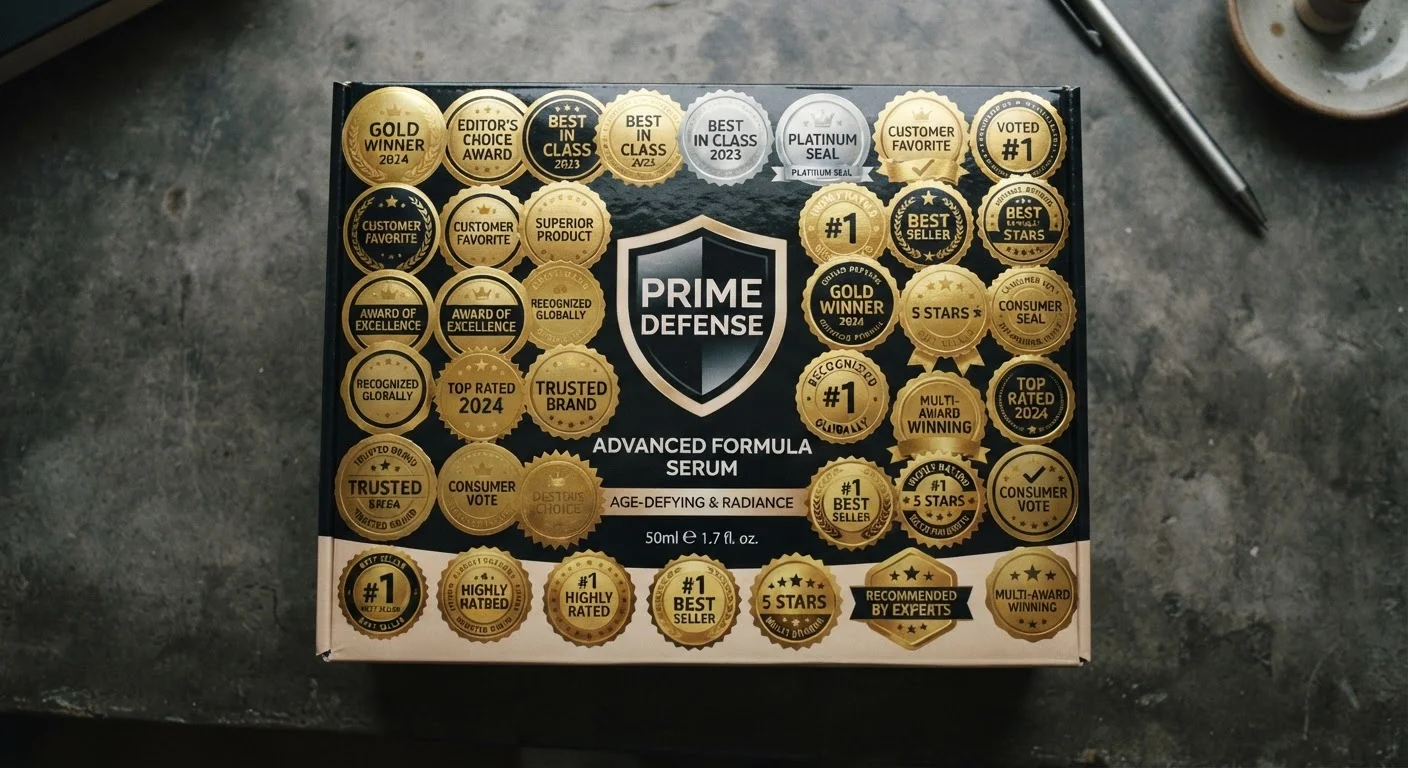
Walk through any store aisle and you'll see starburst seals, trophy icons, and boldface claims: "Award-Winning Formula," "#1 Rated by Consumers," "Gold Standard Since 2019." These labels feel like external validation. In most cases, they aren't.
In the United States, there is no overarching regulatory body that defines what qualifies a product as "award-winning." The Federal Trade Commission requires that advertising claims be truthful and substantiated, but the bar for substantiation on vague prestige labels is low in practice. A brand can legitimately print "award-winning" on its label if it received any award-from a trade publication, a regional contest, an industry association, or even a competition it paid an entry fee to participate in.
Many awards programs are structured as revenue-generating businesses. Organizers charge submission fees, sell enhanced placements in results guides, and sometimes offer licensing deals that let brands pay to use the award seal in perpetuity. Winning is often contingent on entering, not on outperforming a rigorous competitive field.
Myth
If a product won an award, it was independently evaluated and outperformed its competitors.
Fact
Most product awards are pay-to-enter programs where winning is tied to submission fees, not performance benchmarks.
Award programs vary enormously in rigor. Some involve blind testing by credentialed evaluators with disclosed methodologies. Many others are trade or media awards where any brand willing to submit an entry fee and fill out a nomination form is eligible. Some programs don't publish winner selection criteria at all. The award seal on a package tells you nothing about which type of program it came from.
Myth
'#1 Rated by Consumers' means independent consumer research confirmed the product is the best in its category.
Fact
Consumer rating claims are frequently based on proprietary surveys with undisclosed sample sizes, methodology, or sponsorship.
A brand can commission a survey, control the questions asked, select the comparison set, and use the resulting data to support a "#1 rated" claim. Without knowing who conducted the survey, how participants were recruited, and what alternatives were included, the claim cannot be meaningfully evaluated. Legitimate independent surveys disclose their methodology in full.
Myth
Regulatory agencies verify award and rating claims before brands can print them on packaging.
Fact
No federal agency pre-approves prestige marketing claims; enforcement is complaint-driven and after the fact.
The FTC's truth-in-advertising framework requires that claims be substantiated, but it does not proactively review product packaging before it hits shelves. Enforcement typically happens in response to formal complaints or investigative reporting, not routine pre-market screening. This means the burden of skepticism falls on the consumer, not the agency.
Myth
Products that display more awards and seals are generally higher quality than those with none.
Fact
Award volume reflects marketing budget and award-program participation more than it reflects product quality.
Entering award programs costs money and requires dedicated marketing staff time. Smaller manufacturers-including some that produce high-quality goods-often skip these programs entirely because of cost or philosophical objection. Meanwhile, large brands with robust marketing budgets routinely enter many programs, accumulate seals, and display them prominently. The number of seals is a proxy for marketing investment, not a quality index.
Myth
A 'bestseller' label means customers consistently prefer that product over alternatives.
Fact
'Bestseller' reflects sales volume only, which is driven by factors like price, shelf placement, and advertising spend-not necessarily quality.
Sales volume is shaped by distribution reach, promotional pricing, favorable shelf positioning, and brand recognition built through advertising. A product can dominate sales figures while accumulating mediocre long-term satisfaction scores. Volume and quality are separate measurements that frequently diverge, especially in commodity product categories.
How Rankings Get Built-and Who Controls Them
"#1 Rated" claims follow a parallel logic. Consumer survey-based rankings-"voted best by real customers"-can sound like grassroots validation, but the methodology rarely appears on the label. Key questions worth asking: Who was surveyed? How many respondents? Was the survey commissioned by the brand itself or by a genuinely independent party? Was the rating based on purchase satisfaction, brand familiarity, or marketing exposure?
~75%
Of shoppers influenced by "award-winning" claims
Multiple consumer behavior studies have found that a substantial majority of shoppers report prestige labels increase their purchase confidence, even when no information about the award's source is provided.
Thousands
Active product award programs in the US
Industry analysts who track marketing certification programs have documented that the US alone hosts thousands of award programs across consumer goods categories, with widely varying independence and rigor.
Retailer-generated rankings add another layer of complexity. "Bestseller" reflects sales volume, not quality. "Staff pick" may reflect vendor incentives. "Customer favorite" may be algorithmically driven by return rates or page views. None of these directly measure whether a product performs well against comparable alternatives.
For a deeper look at how comparison frameworks get distorted before they reach consumers, see our guide on how marketers construct skewed comparisons.
What to Look For Instead
Third-party testing from genuinely independent organizations-those that buy products on the open market, do not accept advertising from the brands they test, and publish their methodologies-provides a stronger signal than any shelf badge. These organizations are imperfect, and their scope has limits. Our article on what independent testing organizations actually test explains where those gaps appear.
Award Seals Are Marketing Assets, Not Certifications
There is a meaningful difference between a regulated certification-like USDA Organic or UL safety listing-and a marketing award. Regulated certifications involve documented standards, audits, and legal accountability. Award seals have none of those requirements by default. When evaluating a product, look for the former and treat the latter as unverified branding.
Verified purchase reviews from large, unfiltered pools of buyers-particularly when sorted by most critical or most recent-offer practical ground-level data. No single review source is definitive, but patterns across thousands of independent accounts are more informative than a gold seal applied during a brand's own marketing process.
Category-specific regulatory language also matters more than prestige claims. In food and personal care, for example, ingredient lists, nutrient panels, and regulated terms like "organic" or "USDA-certified" carry enforceable meaning that "award-winning" simply does not. The same principle applies in adjacent categories: our pet food label guide illustrates how regulated terminology differs from marketing language on packaging.
Finally, consider being deliberate about the mental shortcuts you rely on. Common comparison shortcuts like defaulting to the badge-heavy option or the familiar brand name can consistently steer shoppers toward higher-priced, underperforming products.
The content provided on our blog site traverses numerous categories, offering readers valuable and practical information. Readers can use the editorial team’s research and data to gain more insights into their topics of interest. However, they are requested not to treat the articles as conclusive. The website team cannot be held responsible for differences in data or inaccuracies found across other platforms. Please also note that the site might also miss out on various schemes and offers available that the readers may find more beneficial than the ones we cover.