

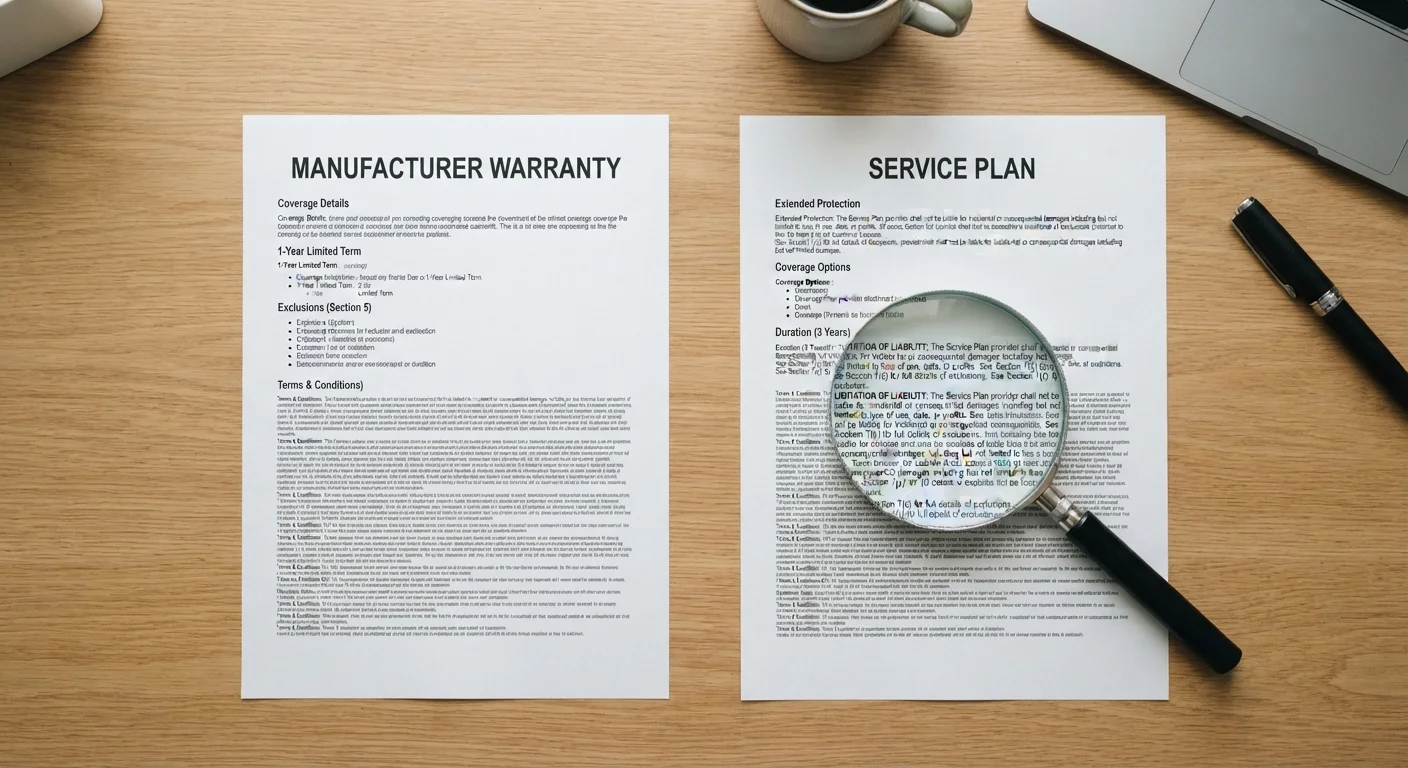
Our Verdict
Manufacturer warranties offer legally enforceable baseline protections at no added cost, making them the foundation of any product's coverage. Third-party service plans can extend that protection but introduce additional complexity, exclusions, and cost - making careful contract review essential before purchase.
| Best for | Recommended |
|---|---|
| Families who want reliable, no-cost baseline coverage | Manufacturer Warranty |
| Those who want coverage beyond the manufacturer's term for high-use items | Third-Party Service Plan |
| Buyers prioritising straightforward claims with minimal paperwork | Manufacturer Warranty |
| Households seeking accidental damage or power surge protection | Third-Party Service Plan |
What Each Coverage Type Actually Is
A manufacturer warranty is a written promise from the company that made the product. It comes automatically with most new purchases and is governed by federal law - specifically the Magnuson-Moss Warranty Act - which sets minimum standards for what a warranty must disclose and how disputes can be pursued. Manufacturers must honor the terms they advertise, and consumers retain specific legal recourse if they do not.
A third-party service plan (often marketed as an extended warranty or protection plan) is a separate contract sold by a retailer, dealer, or independent administrator - not the product's manufacturer. These are regulated differently, typically as insurance or service contracts under state law, and the enforceability of your rights depends on the terms of that private agreement and your state's consumer protection statutes.
This distinction matters: when you file a claim, you are dealing with different companies, different legal frameworks, and often different repair networks. See our guide on warranties versus return policies for additional context on how these protections interact at the point of purchase.
Coverage Scope and Common Exclusions
Manufacturer warranties typically cover defects in materials or workmanship - meaning the product failed due to how it was made, not how it was used. Cosmetic damage, normal wear, accidental drops, and misuse are almost universally excluded. Coverage periods vary widely: 90 days for some electronics, one year for most appliances, and longer for vehicles or structural components.
Third-party service plans often advertise broader coverage - including accidental damage, power surges, or mechanical breakdowns after the manufacturer's term expires. However, their exclusion lists can be equally extensive. Common exclusions include pre-existing conditions, damage from improper installation, consumable parts (filters, batteries, bulbs), and failures caused by third-party modifications.
| Manufacturer Warranty | Third-Party Service Plan | |
|---|---|---|
| Who provides it | Product manufacturer | Retailer or independent administrator |
| Legal framework | Magnuson-Moss Warranty Act (federal) | State insurance or service contract law |
| Cost to consumer | Included with purchase | Separate fee required |
| Typical coverage | Manufacturing defects only | May include accidental damage, power surges |
| Claims contact | Manufacturer directly | Third-party administrator hotline |
| Repair network | Authorized manufacturer centers | Plan-approved technicians only |
| Transferability | Often automatic | Varies; may require fee or be non-transferable |
| Cancellation | Not cancellable by consumer | Usually cancellable, often with fees |
A critical read-through of the "what is not covered" section - not just the marketing summary - is the most important step before purchasing any service plan. Extended warranty trade-offs are worth weighing carefully before committing.
Claims Process and Repair Networks
Filing a manufacturer warranty claim typically means contacting the brand directly, using their authorized service centers, and following a defined process outlined in the warranty document. Turnaround times, loaner options, and repair-versus-replace decisions are set by the manufacturer.
Third-party service plans introduce a separate administrator into that process. You may need to call a plan-specific hotline, obtain pre-authorization before any repair, and use only the plan's approved technicians - which may not include the manufacturer's own service network. Reimbursement-based plans (where you pay upfront and submit receipts) add further steps and potential for partial reimbursement disputes.
Request the Full Contract Before You Buy
Retailers are required to provide the complete service plan contract upon request before purchase. Ask for the full document - not the summary brochure - and specifically review the exclusions, claims process, and cancellation terms. If a retailer cannot provide the full contract before the sale, that is itself a red flag worth noting.
For practical guidance on navigating either type of claim, see how to make a warranty claim without getting the runaround.
Transferability, Cancellation, and Overlap
Manufacturer warranties often transfer to a subsequent owner automatically, which can add resale value. Third-party service plans vary: some allow transfer for a fee, others terminate upon sale of the product. Always confirm transfer terms before assuming coverage passes with the item.
Cancellation policies are another key differentiator. Many third-party plans allow cancellation within a stated window for a full or prorated refund - but beyond that window, fees may apply. Manufacturer warranties cannot be cancelled by the consumer (they are a manufacturer obligation), though some are voided by specific actions like unauthorized repairs.
Overlap is a frequently overlooked cost driver. If a retailer sells a two-year service plan starting at purchase, and the manufacturer provides a one-year warranty, the first year of your paid plan duplicates coverage you already have for free. Some plans address this with a "gap" structure that activates only after the manufacturer's term expires - that structure generally offers better value. For a broader analysis of when service plan costs outweigh their benefits, comparing service contracts to product purchases provides a useful analytical lens.
This article is for general informational purposes only and does not constitute legal or financial advice. Consult a qualified professional for guidance specific to your circumstances.
The content provided on our blog site traverses numerous categories, offering readers valuable and practical information. Readers can use the editorial team’s research and data to gain more insights into their topics of interest. However, they are requested not to treat the articles as conclusive. The website team cannot be held responsible for differences in data or inaccuracies found across other platforms. Please also note that the site might also miss out on various schemes and offers available that the readers may find more beneficial than the ones we cover.