

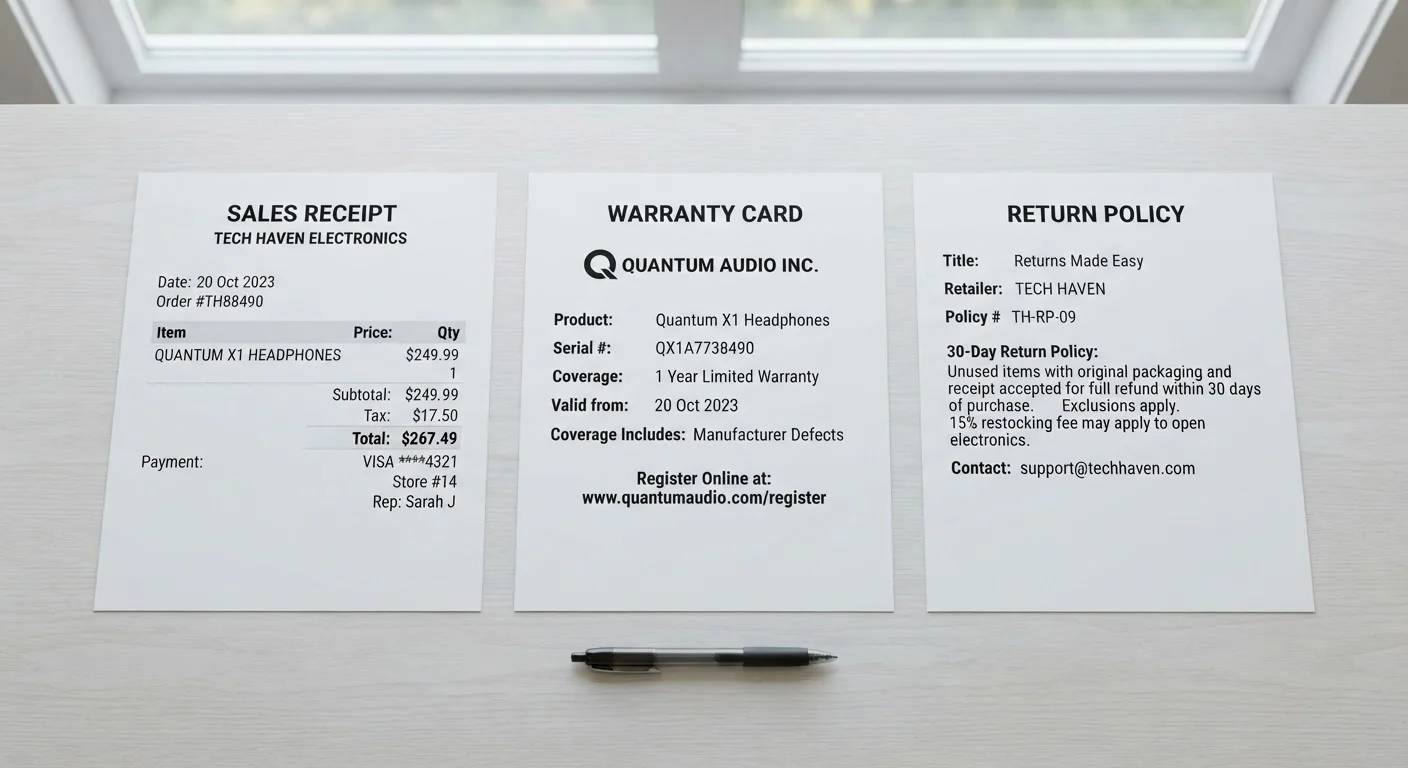
Option A
Warranty
The long-term defect protection promise.
Best for: Buyers who want coverage against manufacturing defects or failures after the return window closes.
Option B
Return Policy
The short-term change-of-mind safety net.
Best for: Shoppers who want flexibility to reverse a purchase quickly if it doesn't meet expectations.
What Each Protection Actually Covers
A warranty is a written promise - typically from the manufacturer - that a product will function as described for a defined period. If it fails due to a defect in materials or workmanship during that window, the manufacturer is obligated to repair or replace it. Warranties do not cover accidental damage, normal wear, or buyer's remorse.
A return policy, by contrast, is a retailer's voluntary agreement to accept a product back within a set timeframe - often 14 to 30 days - usually for any reason, or at minimum if the item is unused and in original condition. It's a short-term flexibility tool, not a long-term quality guarantee.
The critical distinction: a warranty kicks in when the product fails; a return policy kicks in when you change your mind or find a problem immediately. They protect against completely different risks. For more on how legal consumer rights interact with posted store policies, see Return Policies vs. Statutory Rights.
| Criterion | Warranty | Return Policy |
|---|---|---|
| Primary purpose | Covers defects and failures over time | Allows reversal of purchase decision |
| Typical timeframe | 90 days to several years | 14 to 90 days |
| Who provides it | Manufacturer (sometimes retailer) | Retailer |
| Trigger condition | Product fails or is defective | Buyer is unsatisfied or changes mind |
| Typical remedy | Repair or replacement | Refund or exchange |
| Applies after opening | Yes - required to use the product | Often restricted once opened |
| Legally regulated | Yes (Magnuson-Moss Act in the US) | Voluntary; varies by retailer |
How to Weigh Them Before You Buy
Most shoppers check the price tag and maybe the star rating - then discover the return policy or warranty terms only after something goes wrong. Flipping that habit is straightforward and costs nothing.
Before completing any significant purchase, ask two questions:
- If I'm unhappy in the first few weeks, what can I do? - That's your return policy question.
- If this breaks in year two, what happens? - That's your warranty question.
For everyday low-cost items, a generous return policy matters more: the replacement cost is low enough that long-term warranty coverage rarely pays off. For large appliances, electronics, or anything you expect to use for three or more years, warranty terms carry more weight because that's the timeline on which failures become expensive.
72%
Shoppers who don't read warranty terms before buying
A Consumer Reports survey found the majority of consumers review warranty details only after a problem occurs, not before purchase.
30 days
Common standard return window in US retail
While 30 days is a widely used baseline, return windows vary significantly by product category and retailer policy.
1 year
Minimum warranty many manufacturers provide
One year is a common floor for manufacturer warranties on consumer electronics and appliances, though terms and exclusions differ widely.
When comparing options across retailers or brands, treat warranty length and return window as concrete, comparable numbers - not marketing language. A 90-day return window paired with a one-year limited warranty tells you something very different from a 15-day return window paired with a two-year full warranty. Neither is automatically superior; it depends on what risk you're trying to manage. For a closer look at what happens after purchase, Making a Warranty Claim Without Getting the Runaround walks through the claims process step by step.
Common Traps and What to Watch For
Both protections come with fine print that can significantly reduce their value if you don't read it first.
Warranty traps to know:
- "Limited" vs. "full" warranty - A limited warranty may exclude labor costs, require you to ship the item, or only cover certain components. A full warranty under the Magnuson-Moss Warranty Act must remedy defects at no charge.
- Voiding conditions - Using a product outside its stated purpose, failing to register it, or having unauthorized repairs can void coverage.
- Pro-rated coverage - Some warranties reduce their benefit over time, so a defect in year three may only result in partial compensation.
Return policy traps to know:
- Restocking fees - Some retailers charge 15-25% of the purchase price to process a return, drastically reducing what you recover.
- Opened vs. unopened rules - Certain categories (software, personal care, mattresses) often have stricter or non-existent return options once opened.
- Return shipping costs - Online retailers may not cover return shipping, meaning the effective cost of a return isn't zero.
If a retailer offers extended warranty add-ons at checkout, that's a separate product with its own terms. Extended Warranties: The Trade-Offs Families Should Weigh and Manufacturer Warranty vs. Third-Party Service Plan cover those distinctions in detail.
The content provided on our blog site traverses numerous categories, offering readers valuable and practical information. Readers can use the editorial team’s research and data to gain more insights into their topics of interest. However, they are requested not to treat the articles as conclusive. The website team cannot be held responsible for differences in data or inaccuracies found across other platforms. Please also note that the site might also miss out on various schemes and offers available that the readers may find more beneficial than the ones we cover.