

Why Lifecycle Thinking Changes Every Decision
Most families focus on the monthly payment when choosing a car. That single number, however, reflects only one slice of what a vehicle will actually cost over the years you own it. A more complete lens - lifecycle cost thinking - accounts for every dollar from the day you acquire the vehicle to the day you sell or trade it.
This approach transforms how you evaluate choices. A vehicle with a lower purchase price but higher fuel consumption, steeper insurance premiums, and faster depreciation may cost significantly more than a slightly pricier alternative over a five-year ownership period. Understanding this framework is the foundation of smart automotive financial planning for families.
For a broader look at how this principle applies to large purchases generally, see total cost of ownership explained. And if you're still deciding how to acquire your next vehicle, leasing vs. buying for families covers how each path affects long-term costs.
Acquisition: The Cost Clock Starts Before You Drive Away
The acquisition phase includes more than the negotiated price. Taxes, title fees, registration, and dealer documentation charges are typically added at closing and can add several hundred to over a thousand dollars to your out-of-pocket cost depending on your state.
Financing terms deserve careful attention. A longer loan term lowers the monthly payment but increases total interest paid - and may leave you "underwater" (owing more than the car is worth) during the middle years of ownership. A larger down payment reduces both interest exposure and the risk of negative equity.
Lock In Insurance Costs Before You Buy
Get insurance quotes on any vehicle you're seriously considering before signing any paperwork. Insurance costs vary significantly by model, trim level, and safety rating - and can shift your cost comparison meaningfully. A five-minute call or online quote before purchase could save you hundreds annually over the ownership period.
Gap insurance, which covers the difference between what you owe and what the car is worth if it's totaled or stolen, is worth evaluating during this phase - especially when financing with a small down payment.
For context on average acquisition costs and what families typically spend, the annual car ownership cost reference provides useful baseline figures.
Ongoing Ownership: The Costs That Compound Quietly
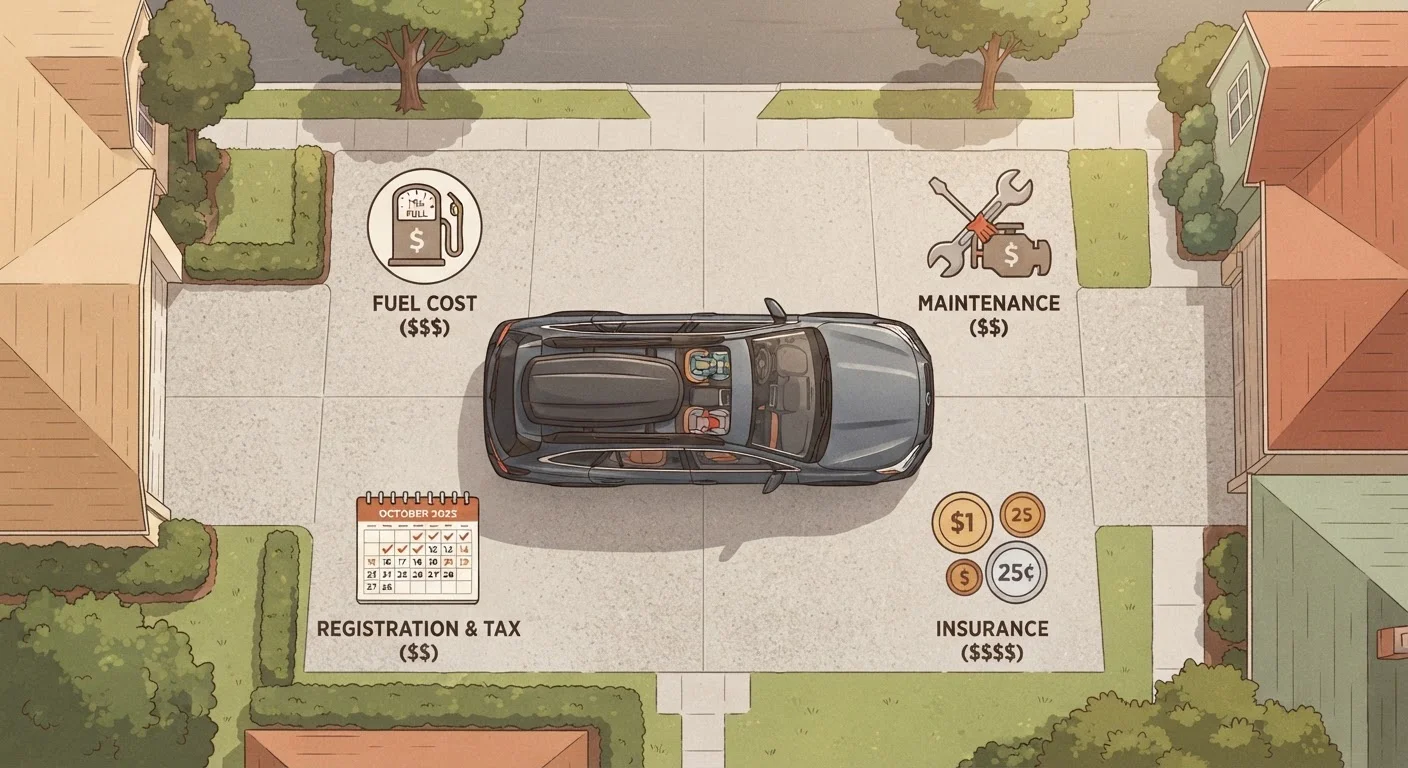
After acquisition, four major cost categories run concurrently throughout ownership:
- Depreciation: For most vehicles, this is the largest single cost. A new car can lose 15-25% of its value in the first year alone, with the steepest decline in years one through three.
- Fuel: Highly variable based on vehicle type, driving habits, and regional prices. Over five years, fuel costs for a family vehicle can rival or exceed the interest paid on a loan.
- Insurance: Premiums fluctuate based on your driving record, location, vehicle age, and coverage levels. Review coverage annually to ensure it remains appropriate as the car depreciates.
- Registration and taxes: Annual fees that vary widely by state and, in some states, are tied to the vehicle's assessed value - meaning they decline as the car ages.
~$12,000
Average annual cost to own a new vehicle
According to AAA's annual Your Driving Costs study, average total annual ownership costs for a new vehicle - including depreciation, fuel, insurance, and maintenance - exceed $10,000-$12,000 for many vehicle categories.
15-25%
First-year depreciation for new cars
Industry data consistently shows new vehicles lose a substantial portion of their value in the first twelve months, making the depreciation curve steepest at the start of ownership.
5-7 years
Ownership horizon for lowest average annual cost
Automotive financial analysts generally find that holding a well-maintained vehicle through the five-to-seven-year range spreads fixed acquisition costs over more years, reducing the annual average.
Families operating two vehicles face all of these costs doubled. strategies for two-vehicle households offers targeted approaches to managing that compounded financial load.
Maintenance Strategy: Protecting Value Over Time
Scheduled maintenance - oil changes, tire rotations, brake inspections, fluid replacements - is not just about reliability. It directly influences resale value and helps avoid the far more expensive reactive repairs that follow neglect.
Following the manufacturer's recommended service intervals (found in the owner's manual) is the baseline. Beyond that, keeping every service record creates a documented history that buyers and dealers weigh when assessing trade-in value.
Request a pre-purchase inspection from an independent mechanic - even on certified pre-owned vehicles. A $100-$150 inspection can surface issues that change the value equation entirely.
Dealer certifications vary in thoroughness, and an independent assessment gives families unbiased information before committing to a multi-year financial obligation.
Set a calendar reminder every six months to review your auto insurance coverage. As a vehicle depreciates, carrying comprehensive and collision coverage on an older high-mileage car may cost more annually than the coverage would pay out.
Insurance premiums are one of the few ongoing ownership costs families can actively reduce by adjusting coverage to match the vehicle's current market value.
For a practical overview of what routine upkeep involves, the car maintenance hub covers essential tasks families should understand and budget for.
One often-overlooked maintenance investment is tires. Properly inflated and rotated tires improve fuel economy, extend tire life, and affect handling safety - all of which have financial and safety implications for families carrying passengers.
Exit Stage: Getting the Most From Trade-In or Private Sale
How and when you exit a vehicle significantly affects your net cost. A well-maintained car with complete service records will command a meaningfully higher trade-in or private-sale price than an identical model without documentation.
Timing also matters. Most vehicles depreciate most sharply in years one through three. Holding a vehicle through years four through seven - after the steepest depreciation curve - typically yields a lower average annual cost. Selling too early means absorbing maximum depreciation without recouping the investment through avoided payments.
Private sales generally yield higher prices than dealer trade-ins, but require more time and carry additional steps such as title transfer and payment verification. Dealer trade-ins offer convenience and can simplify sales-tax calculations in states where the trade-in value offsets taxable purchase price on the replacement vehicle.
Families managing vehicle costs within a broader financial plan may find it useful to revisit how auto decisions fit into longer-term priorities - see managing debt and savings across family life stages for that wider context.
Building a Whole-Lifecycle Budget for Your Family
A practical lifecycle budget starts with a realistic ownership horizon - how many years or miles do you plan to keep this vehicle? From there, you can project each cost category over that period:
- Estimate depreciation based on the vehicle type and typical resale curves for that segment.
- Project fuel costs using current average prices, estimated annual mileage, and the vehicle's EPA fuel economy rating.
- Get insurance quotes before purchase, not after - premiums vary substantially by vehicle model.
- Budget a maintenance reserve: a general guideline used by many financial planners is setting aside a modest monthly amount that grows as the vehicle ages and warranty coverage shrinks.
- Factor in financing costs if applicable, and calculate total interest over the loan term.
Adding these figures together gives you a credible estimate of total ownership cost - and lets you compare vehicles on a level playing field rather than by sticker price alone. This kind of planning also integrates naturally with household budgeting; family budgeting strategies provides a useful framework for fitting vehicle costs into the broader family financial picture.
For families with young children, vehicle selection also involves safety dimensions beyond cost - car seat safety and vehicle fit is a practical companion resource when evaluating which vehicle best serves your family's needs.
This article provides general financial and automotive information for educational purposes only. It is not personalised financial or legal advice. Consult a qualified financial professional regarding decisions specific to your circumstances.
The content provided on our blog site traverses numerous categories, offering readers valuable and practical information. Readers can use the editorial team’s research and data to gain more insights into their topics of interest. However, they are requested not to treat the articles as conclusive. The website team cannot be held responsible for differences in data or inaccuracies found across other platforms. Please also note that the site might also miss out on various schemes and offers available that the readers may find more beneficial than the ones we cover.