

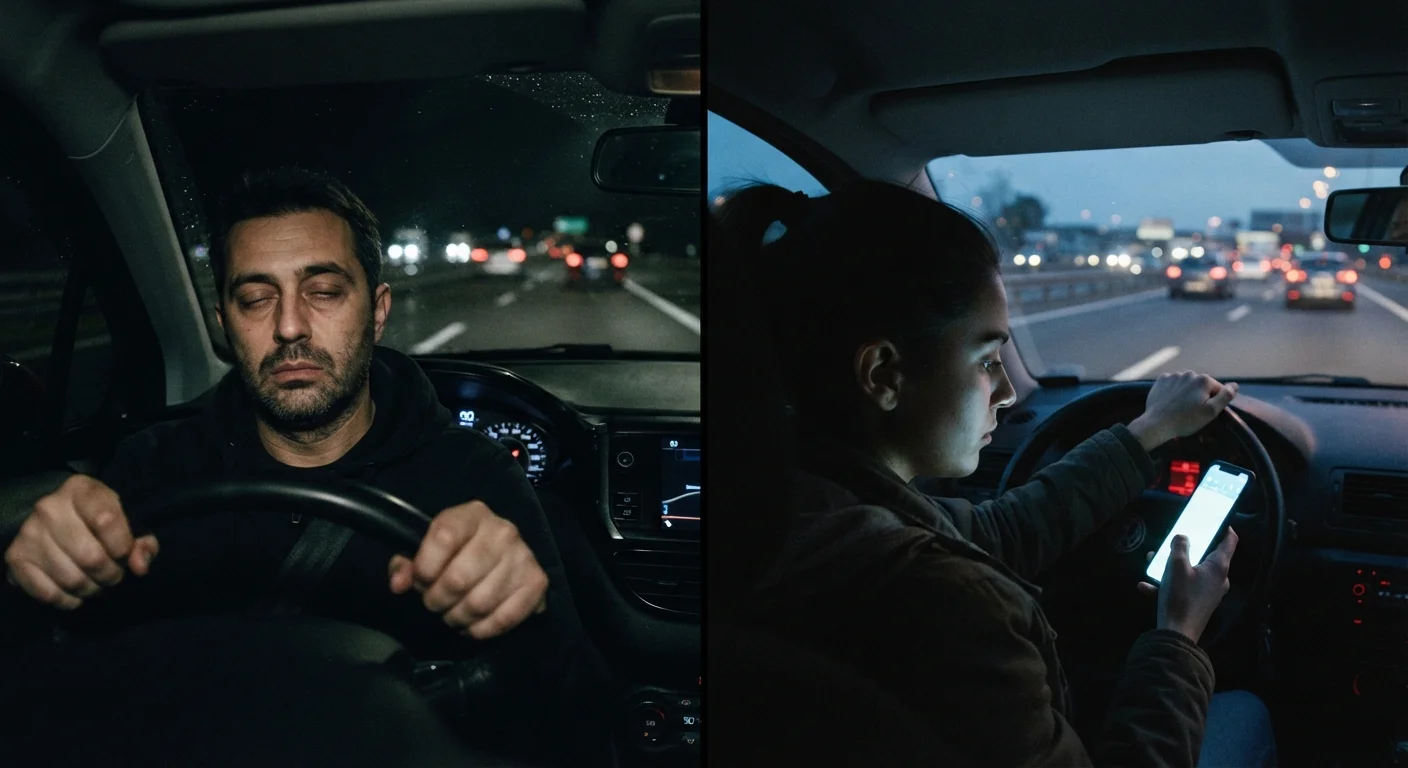
Option A
Drowsy Driving
The silent impairment that creeps up without warning.
Best for: Understanding why sleep deprivation is often compared to alcohol impairment in terms of cognitive and physical effects on drivers.
Option B
Distracted Driving
The moment-to-moment attention thief that most drivers underestimate.
Best for: Understanding how visual, manual, and cognitive distractions each chip away at a driver's ability to react in time.
What Each Risk Actually Does to Your Brain and Body
Drowsy driving and distracted driving are often mentioned in the same breath, but they impair drivers in fundamentally different ways. Understanding the distinction helps you recognize and counter each risk more effectively.
Drowsy driving is a systemic impairment. Sleep deprivation affects executive function, slows neural processing, and degrades coordination progressively over time. Research published by the AAA Foundation for Traffic Safety has found that driving after 17-19 hours without sleep produces impairment comparable to a blood-alcohol concentration near the legal limit of 0.08% in many U.S. states. Crucially, fatigued drivers are often poor judges of their own impairment - the same cognitive degradation that slows reaction time also dulls self-awareness.
Distracted driving creates discrete gaps in attention rather than a gradual slide. The National Highway Traffic Safety Administration (NHTSA) identifies three categories of distraction: visual (eyes off the road), manual (hands off the wheel), and cognitive (mind off the task). Phone use is particularly hazardous because it combines all three. At 55 mph, looking at a screen for five seconds means traveling roughly the length of a football field without actively processing the road ahead. See our research on cognitive distraction from phone use for a deeper look at how this unfolds.
| Criterion | Drowsy Driving | Distracted Driving |
|---|---|---|
| Type of impairment | Systemic - whole-body degradation | Episodic - discrete attention gaps |
| Onset | Gradual; hard to self-detect | Immediate when distraction begins |
| Primary cause | Sleep deprivation, circadian rhythm | Visual, manual, or cognitive triggers |
| Common crash type | Single-vehicle run-off-road | Rear-end, urban collisions |
| Peak risk window | Midnight - 6 a.m.; early afternoon | Any time; higher in commute hours |
| Most affected groups | Shift workers, long-haul drivers | Young drivers, high-commute drivers |
| Self-awareness of impairment | Often low - fatigue dulls judgment | Moderate - distraction is visible |
| Primary countermeasure | Adequate sleep; scheduled breaks | Phone-free policies; pre-trip setup |
Crash Patterns and Who Is Most Affected
Drowsy-driving crashes follow recognizable patterns: they tend to occur on rural roads or highways during late-night and early-morning hours, often involve a single vehicle running off the road, and may produce no skid marks - suggesting the driver didn't brake before impact. The NHTSA estimates drowsy driving contributes to tens of thousands of crashes annually, though the true number is likely underreported because drowsiness is difficult to detect after the fact.
Distracted driving crashes are more diffuse in their timing and location, occurring across all road types and times of day. They frequently involve rear-end collisions and are concentrated in congested urban environments. Risk profiles shift significantly by age group: younger drivers show higher rates of phone-related distraction, while older drivers may face greater cognitive fatigue from the same driving duration as a younger counterpart.
When both factors are present simultaneously - a tired driver who is also engaging with a phone - risk compounds. Each impairment narrows the margin of error; together, they can eliminate it entirely. Our related article on stopping distances and reaction time illustrates just how little road is available to course-correct when attention or alertness is compromised.
~20%
Share of fatal crashes involving drowsy driving
The AAA Foundation for Traffic Safety estimates drowsy driving may be a factor in up to 21% of fatal crashes in the U.S.
~5 sec
Average glance duration during phone use
NHTSA research indicates that a typical phone-related visual distraction lasts approximately five seconds - enough to travel a football field at highway speed.
18-24
Age group with highest distraction-related crash rates
According to NHTSA data, drivers aged 18-24 are disproportionately represented in distraction-affected crashes compared to other age groups.
Practical Strategies to Counter Both Risks
Despite their differences, both risks respond well to intentional habits built into everyday routines.
For drowsy driving:
- Prioritize sleep - adults generally need seven to nine hours; consistently sleeping less creates cumulative fatigue that doesn't disappear after one normal night.
- Schedule break stops - on long drives, plan a stop every two hours or 100 miles, even if you feel alert.
- Recognize warning signs early - yawning repeatedly, difficulty keeping eyes open, lane drifting, and missing exits are signals to pull over safely, not to push through.
- Avoid driving during peak fatigue windows - midnight to 6 a.m. and, to a lesser extent, early afternoon.
For distracted driving:
- Phone-free policies - place your phone in the back seat or glove compartment, or use a dedicated do-not-disturb driving mode before departing.
- Set navigation before moving - programming a GPS while in motion is a significant distraction; enter your destination while parked.
- Manage in-car passengers - for newer drivers especially, limiting passengers reduces conversation-related distraction.
- Keep eating and grooming for outside the car - these manual distractions are more common than most drivers admit.
These driving habits also affect your vehicle's long-term condition. How driving behavior affects long-term vehicle costs explains how erratic inputs from impaired or distracted driving - hard braking, swerving - can accelerate mechanical wear over time.
This article is for general informational and educational purposes only. It does not constitute legal, medical, or professional safety advice. Always consult qualified professionals and official sources for guidance specific to your situation.
The content provided on our blog site traverses numerous categories, offering readers valuable and practical information. Readers can use the editorial team’s research and data to gain more insights into their topics of interest. However, they are requested not to treat the articles as conclusive. The website team cannot be held responsible for differences in data or inaccuracies found across other platforms. Please also note that the site might also miss out on various schemes and offers available that the readers may find more beneficial than the ones we cover.