

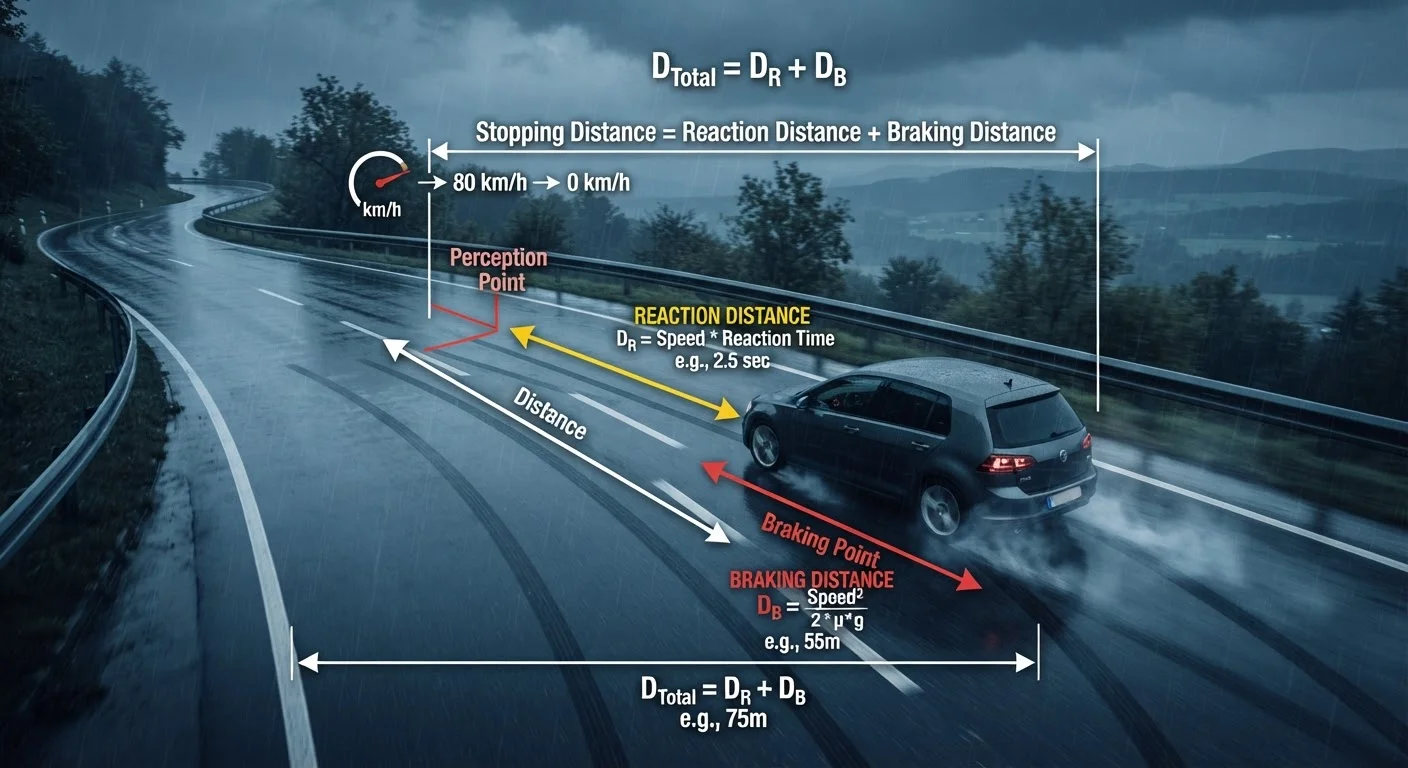
Two Distances, One Collision
Most drivers think of stopping as a single event: you hit the brakes, the car stops. In reality, stopping involves two distinct phases, each consuming precious road space.
Reaction distance is the ground covered between the moment your brain registers a hazard and the moment your foot actually depresses the brake pedal. An alert, undistracted driver typically takes around 1.5 seconds to react. At 60 mph - 88 feet per second - that's roughly 130 feet of travel before braking even begins.
Braking distance is what follows: the distance the vehicle actually slides while decelerating to a stop. Add these together and you get total stopping distance - a number that surprises most people the first time they see it on paper.
Understanding both phases matters, because each one is independently affected by different factors. Fixing only one without addressing the other still leaves drivers dangerously short on stopping room. Distractions, for instance, attack reaction time; bald tires attack braking distance. Both reduce the safety margin between you and the car ahead in measurable, physics-driven ways.
The Physics That Most Drivers Never Learned
Here's the piece of physics that explains why speed is so consequential: kinetic energy - the energy a moving vehicle carries - scales with the square of velocity. The formula is KE = ½mv², where m is mass and v is speed.
What this means in practice: going from 30 mph to 60 mph doesn't double your kinetic energy. It quadruples it. Your brakes have to dissipate that entire energy load as heat before the car stops. The faster you're going, the more energy they must shed, and the more road distance that requires.
300+ ft
Typical stopping distance at 60 mph
Under ideal dry conditions, a standard passenger vehicle needs roughly 240-300+ feet to stop from 60 mph, including reaction distance.
4×
Braking distance increase when speed doubles
Because kinetic energy scales with velocity squared, doubling speed approximately quadruples the braking distance required to stop.
1.5 sec
Average alert driver reaction time
Traffic safety research generally cites 1.5 seconds as a baseline for an alert, unimpaired driver's perception-reaction time.
Up to 10×
Braking distance increase on black ice
Extremely low friction on ice-covered roads can extend stopping distances to ten or more times those observed on dry asphalt.
This squared relationship is why highway speeds are so unforgiving. A driver going 70 mph instead of 60 mph isn't just 10 mph faster - they carry roughly 36% more kinetic energy and need substantially more stopping room. Yet on many highways, the speed variance between drivers in adjacent lanes regularly exceeds that gap.
The same physics governs why posted speed limits assume ideal conditions - rain, curves, and traffic all mean the safe speed is often lower than the sign says.
How Road Conditions Change Everything
Tire friction - technically called the coefficient of friction - is what actually stops a car. Brakes apply force; friction converts that force into deceleration. When road surfaces reduce friction, braking distance expands rapidly.
- Dry asphalt: Baseline conditions. Maximum friction, shortest braking distances.
- Wet pavement: Water reduces tire-to-road contact and grip. Braking distances commonly extend by 30-50% or more depending on tire tread depth and vehicle speed.
- Packed snow: Friction drops significantly; stopping distances can be three to four times longer than dry pavement.
- Black ice: The most dangerous surface condition. Friction can fall so low that braking distances become ten or more times the dry-road figure.
Tire condition compounds everything. Worn tread channels less water away from the contact patch, worsening wet-weather grip. Underinflated tires reduce the stability of that contact patch. Drivers who wouldn't speed in a storm often unknowingly carry the same risk through aged tires on wet roads.
Check Your Tires Before Winter Arrives
Tire tread depth has a direct impact on wet- and cold-weather braking distance. A simple way to check: insert a penny into a tread groove with Lincoln's head pointing down. If you can see the top of his head, tread depth may be too low for safe wet-weather stopping. Have a qualified mechanic inspect tires if you have any concerns about wear or inflation.
Why Drivers Consistently Underestimate Stopping Distance
Research in traffic safety and human factors consistently finds that drivers underestimate stopping distances - especially at higher speeds. Several psychological and perceptual factors drive this:
Speed compression: Human perception of speed is logarithmic, not linear. Speeds above 50 mph tend to feel similar subjectively, even as the physics diverge sharply. A driver who feels comfortable at 55 mph often doesn't register how different 70 mph is in stopping terms.
Overconfidence in vehicle technology: Modern vehicles with ABS, electronic stability control, and advanced braking systems are safer than older generations - but they do not suspend physics. These systems help drivers maintain control; they do not eliminate the fundamental relationship between speed and stopping distance.
Distraction and fatigue underappreciation: Most drivers underestimate how much their own reaction time degrades when they're tired or distracted. Both drowsiness and distraction impair reaction time in measurable ways, stretching the reaction-distance component of every stop. Similarly, night driving reduces how early a driver can perceive a hazard, effectively compressing the time available to react.
The practical upshot: the gap between where most drivers think they can stop and where they actually will stop is frequently measured in dozens of feet - enough to matter enormously in an emergency.
This article is for general informational and educational purposes. For safety-critical guidance, always consult qualified driving safety resources and follow the regulations in your state.
Frequently Asked Questions
Under ideal dry conditions, a typical passenger vehicle traveling at 60 mph needs roughly 240-300 feet to stop completely. This includes approximately 60-90 feet of reaction distance and 180-240 feet of braking distance. Real-world conditions such as wet pavement, worn tires, or driver inattention can extend this significantly.
Speed affects stopping distance exponentially, not linearly. Because kinetic energy grows with the square of velocity, a vehicle traveling at 60 mph has four times the kinetic energy of one at 30 mph - meaning it needs roughly four times the braking distance. This is why small speed increases at highway speeds carry outsized risk.
Wet roads typically reduce tire friction by around 30-50%, extending braking distance noticeably. Ice is far more extreme - braking distances on ice can be four to ten times longer than on dry pavement. Speed limits are set for ideal conditions, so reducing speed in adverse weather is a critical safety adjustment.
An alert driver's reaction time is typically 1.5 seconds, during which the vehicle continues at full speed before braking begins. At 60 mph, that's roughly 132 feet traveled before the brakes engage. Distraction, fatigue, or impairment can more than double reaction time, dramatically increasing total stopping distance.
Traffic safety guidance commonly recommends a three-second following gap under ideal conditions - longer in rain, fog, or heavy traffic. You can measure this by picking a landmark and counting how long after the car ahead passes it before you reach it. See our related article on tailgating for a deeper look at following distance at speed.
ABS is designed primarily to help drivers maintain steering control during hard braking, not necessarily to shorten stopping distance. On dry pavement, ABS stopping distances are comparable to skilled threshold braking. On loose gravel or deep snow, ABS can sometimes result in slightly longer distances - though it still improves control.
The content provided on our blog site traverses numerous categories, offering readers valuable and practical information. Readers can use the editorial team’s research and data to gain more insights into their topics of interest. However, they are requested not to treat the articles as conclusive. The website team cannot be held responsible for differences in data or inaccuracies found across other platforms. Please also note that the site might also miss out on various schemes and offers available that the readers may find more beneficial than the ones we cover.