

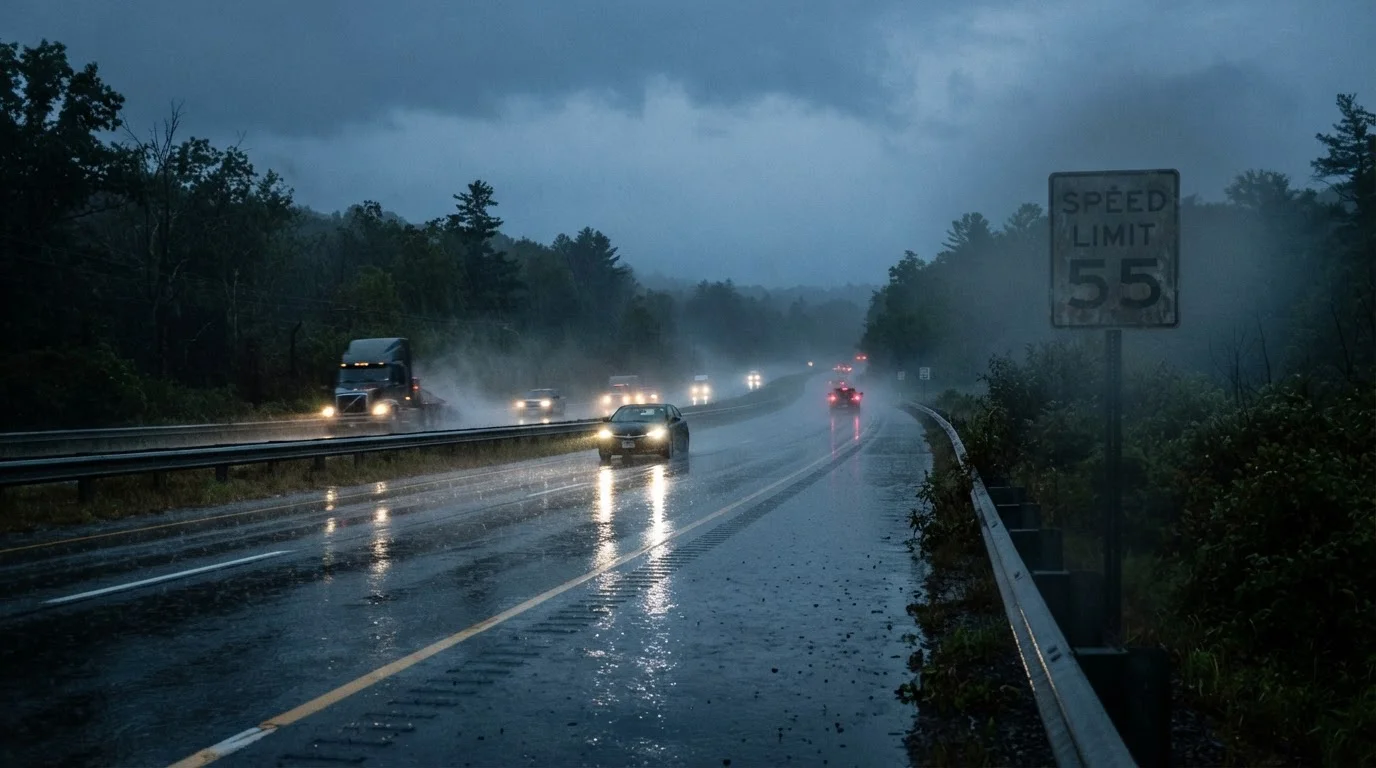
What Speed Limits Actually Measure
Speed limit signs reflect engineering judgments made under a specific set of assumptions: dry pavement, good visibility, a typical vehicle in working order, and normal traffic flow. Traffic engineers use a measure called the 85th percentile speed - the speed at or below which 85% of vehicles travel under those baseline conditions - to help set limits on many roads.
What that process does not account for is the weather on any given Tuesday morning, the patch of black ice that formed overnight, or the construction zone that reduced a four-lane highway to two. The sign stays the same; the road does not. Recognizing this gap is the foundation of genuinely safe driving.
~30%
Of traffic fatalities involving speeding
According to the National Highway Traffic Safety Administration (NHTSA), speeding is consistently cited as a factor in roughly 29-31% of all U.S. traffic fatalities annually.
50%+
Increase in stopping distance on wet roads
Road safety research consistently shows that wet pavement can increase braking distances by 50% or more compared to dry conditions, depending on speed, tires, and vehicle weight.
85th
Percentile speed used in limit-setting
Traffic engineers commonly reference the 85th percentile speed - the speed at or below which 85% of vehicles travel in free-flow, ideal conditions - as a key input when establishing posted limits.
How Conditions Change the Equation
Every variable that differs from the idealized baseline shrinks the margin of safety at a given speed. Here's how common conditions affect the math:
- Wet pavement: Water reduces tire friction significantly. Stopping distances that are measured in feet on dry roads can stretch dramatically on wet ones - by 50% or more depending on speed and tire condition. Hydroplaning risk rises with speed.
- Ice or snow: Stopping distances can increase several times over compared to dry conditions. Even light frost on a bridge or shaded curve is enough to cause a loss of control at legal speeds.
- Reduced visibility: Fog, heavy rain, glare, and darkness all shorten how far ahead you can detect a hazard. If you cannot stop within the distance you can see, your speed is too high for conditions - a principle sometimes called driving within your headlights.
- Curves and elevation changes: Posted limits on curves already account for geometry, but wet or sandy pavement lowers the threshold further. Speed that felt stable on a dry curve may not be on a slick one.
- Heavy traffic: High-volume roads compress reaction time. The faster you're traveling relative to surrounding vehicles, the less time you have to respond to a sudden slowdown.
For practical guidance on how to adapt when rain arrives, see our rainy weather driving habits guide.
The Two-Second Rule Needs Updating in Bad Weather
The standard two-second following distance is designed for dry, ideal conditions. In rain, ice, or fog, many safety authorities recommend extending that gap to four seconds or more. The worse the conditions, the more space you need between your vehicle and the one ahead. Adjusting your following distance is just as important as adjusting your speed.
The Legal Side: Basic Speed Laws
Most U.S. states have enacted what is commonly called a basic speed law - a statute requiring drivers to operate at a speed that is reasonable and prudent under actual conditions. This means a driver who causes a crash while traveling exactly at the posted limit in a snowstorm may still be found negligent. The sign does not provide legal cover when conditions clearly demanded a lower speed.
Understanding this framing matters for practical reasons too. Insurance companies and courts assess fault based on whether a driver exercised reasonable care - and 'I was doing the speed limit' is not, by itself, a complete defense when conditions had visibly deteriorated.
Speeding consistently ranks among the top contributing factors in U.S. traffic fatalities, according to federal crash data. When conditions degrade, the risk associated with any given speed rises - even speeds that would be conservative on a clear day.
Proactive Adjustment vs. Reactive Braking
There is an important distinction between anticipating a hazard and reacting to one. Drivers who monitor conditions continuously and reduce speed before a problem materializes give themselves far more room to respond. Drivers who wait until a skid or obstacle appears and then brake have already consumed much of their safety margin.
Practical habits that support proactive adjustment include:
- Checking weather and road conditions before departure, not just at the destination
- Reducing speed gradually as conditions change, rather than all at once when danger appears
- Increasing following distance well beyond the standard guideline in poor conditions - see our explainer on following distance and rear-end risk for the underlying data
- Disengaging cruise control when roads are wet, icy, or unpredictable
- Scanning further ahead than usual so you have more time to process and respond
Speed choice is also a factor that interacts with driver experience and age. How driving risk shifts across a lifetime explores how different driver groups may need to account for additional factors when adjusting for conditions.
Building the Habit of Condition-Aware Driving
The core shift is a simple but meaningful one: treating the speed limit as a ceiling rather than a target. On a clear, dry highway in light traffic, driving at or near the limit may be perfectly appropriate. On a foggy two-lane road in autumn rain, the same limit may represent a meaningful risk.
Condition-aware driving is not timid driving. It is driving that reads the actual environment - not just the sign - and responds accordingly. That distinction, practiced consistently, is one of the most reliable ways to reduce crash risk without requiring special equipment or training. It simply requires attention and a willingness to let the conditions, not the sign, set the pace.
Frequently Asked Questions
Yes. Driving below the posted speed limit is legal and often appropriate when conditions warrant it. The posted limit is a maximum, not a required speed. Some states do have minimum speed regulations on certain roadways, so unusually slow driving in normal conditions may be restricted.
There is no single universal figure, but many safety experts and transportation agencies suggest reducing speed by at least 5-10 mph in light rain and significantly more in heavy rain or standing water. Your actual safe speed depends on your vehicle, tires, visibility, and traffic.
A basic speed law is a legal principle present in most U.S. states requiring drivers to travel at a speed that is reasonable and prudent for the actual road and weather conditions - even if that speed is below the posted limit. Violating it can make a driver legally liable in a crash.
No. Safety and transportation authorities generally advise against using cruise control on wet or icy roads. If a wheel loses traction and the system tries to maintain speed, it can cause a loss of control. Disengage cruise control whenever conditions deteriorate.
Potentially, yes. Under basic speed laws, an officer can cite a driver for traveling at an unsafe speed even if that speed matches the posted limit. Courts and insurers may also find a driver at fault if a crash occurs because they failed to reduce speed for conditions.
The content provided on our blog site traverses numerous categories, offering readers valuable and practical information. Readers can use the editorial team’s research and data to gain more insights into their topics of interest. However, they are requested not to treat the articles as conclusive. The website team cannot be held responsible for differences in data or inaccuracies found across other platforms. Please also note that the site might also miss out on various schemes and offers available that the readers may find more beneficial than the ones we cover.