

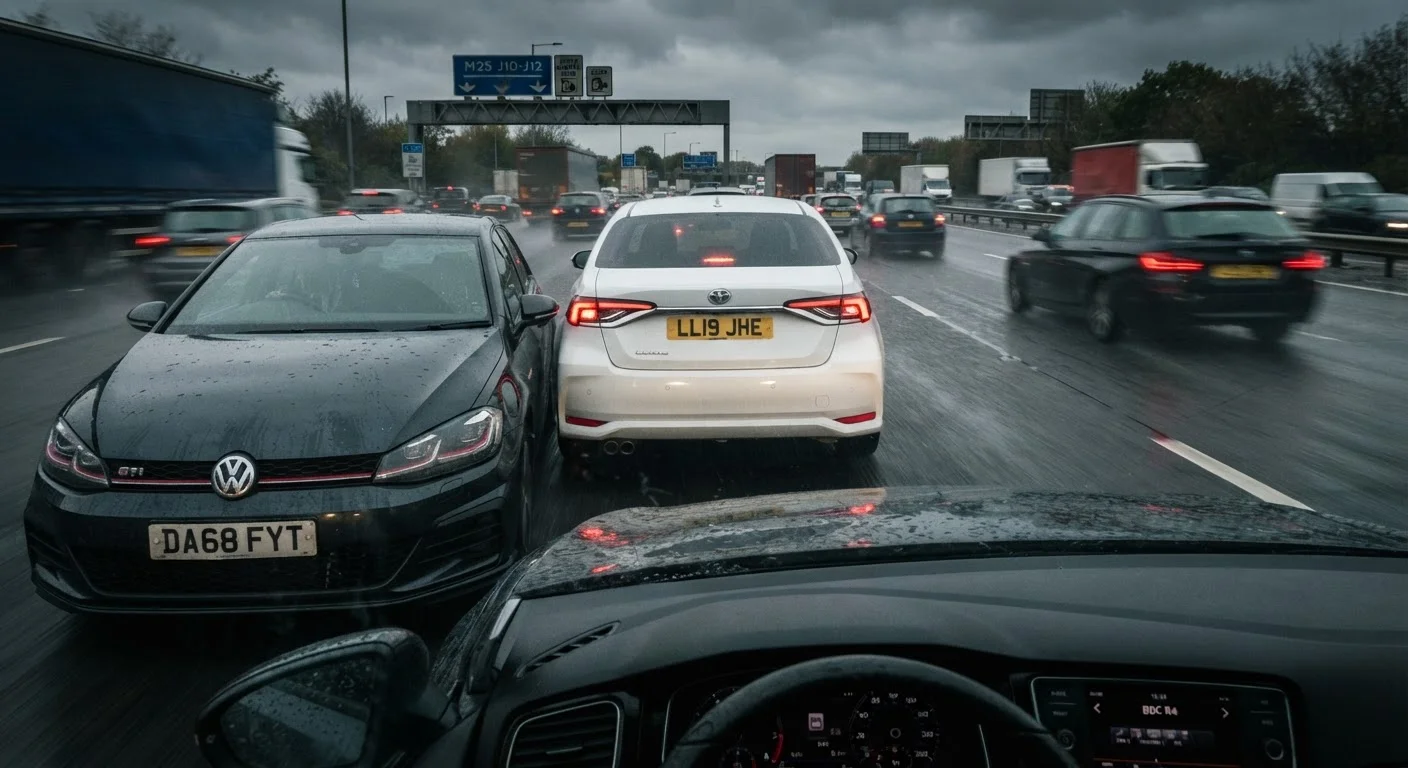
Why Tailgating Feels Harmless - But Isn't
Most drivers who tailgate don't think of themselves as reckless. They're running late, frustrated by slow traffic, or simply unaware of how little time they'd have to react if the car ahead braked suddenly. That disconnect between perceived and actual risk is exactly what makes following too closely so dangerous.
At 60 mph, your vehicle covers approximately 88 feet every second. If you're following just one car length behind - roughly 15 feet - you have less than a fifth of a second before impact if the lead vehicle stops abruptly. Human reaction time alone averages around 1.5 seconds, which means a collision is nearly guaranteed before your foot even reaches the brake pedal.
Understanding situational awareness behind the wheel helps explain why tailgating is such a compounding problem: the closer you follow, the less visual field you have ahead, which further reduces your ability to anticipate hazards.
Myth
Staying close to the car ahead keeps traffic moving more efficiently and is normal driving behavior.
Fact
Tailgating actually worsens traffic flow by triggering chain-reaction braking that creates slowdowns far behind the original vehicle.
Traffic researchers have documented a phenomenon sometimes called a phantom traffic jam - a ripple of unnecessary braking that originates when one driver follows too closely and taps the brakes. Each driver behind them reacts a little harder, compounding the slowdown. Maintaining adequate spacing reduces these chain reactions and helps traffic move more steadily overall.
Myth
As long as you have fast reflexes, a short following distance is safe enough.
Fact
Even the fastest human reaction time - roughly 1.5 seconds - means a vehicle traveling at 60 mph covers over 130 feet before the driver can begin braking.
Reaction time is only part of the equation. After your foot hits the brake, the vehicle still needs additional distance to physically stop - a distance that grows with speed and road conditions. The combination of reaction distance and braking distance makes short gaps genuinely unrecoverable in most emergency stops. Relying on reflexes alone ignores the basic physics involved.
Myth
Tailgating is mostly a problem at highway speeds - following closely in city driving is fine.
Fact
Lower-speed rear-end collisions are extremely common and still cause significant injuries, particularly whiplash and pedestrian involvement.
Urban and suburban roads produce a high volume of rear-end crashes precisely because drivers are more complacent at lower speeds. Stop-and-go traffic, pedestrians, cyclists, and unpredictable intersection behavior all demand adequate following distance - often more so than a clear highway. Injury severity may be lower at 30 mph than at 70 mph, but the risk of collision is not meaningfully reduced just because the speed is lower.
Myth
Tailgating the driver ahead will pressure them to speed up or move over faster.
Fact
Research consistently shows that tailgating does not reliably cause the lead driver to accelerate and often triggers braking or erratic behavior instead.
Being followed closely is a recognized stressor for drivers. Rather than speeding up, many drivers instinctively slow down, become distracted, or brake unpredictably - the exact outcome that raises crash risk. Any time savings from pressuring a driver ahead are minimal and vastly outweighed by the probability of a collision. The perceived gain is almost always an illusion.
Myth
Modern cars with automatic emergency braking (AEB) make following distance less important.
Fact
AEB systems have real-world limitations and are designed to assist - not replace - safe following distances.
Automatic emergency braking can reduce collision severity in some situations, but these systems have documented limitations: they may not activate at very high closing speeds, can be affected by weather conditions, and typically cannot compensate for gaps so short that no system could stop the vehicle in time. Automakers and safety organizations consistently stress that these technologies are driver-assist features, not substitutes for safe driving practices.
The Real Numbers Behind Following Distance
Traffic safety researchers and agencies such as the National Highway Traffic Safety Administration (NHTSA) consistently identify rear-end crashes as one of the most frequent collision types on U.S. roads. Following distance - or the lack of it - is a primary contributing factor.
~29%
Share of all U.S. crashes that are rear-end collisions
According to NHTSA data, rear-end crashes are one of the most frequent crash types on American roads, with following distance cited as a key contributing factor.
132 ft
Minimum stopping distance at 60 mph on dry pavement
This figure - combining average reaction distance and braking distance - illustrates why gaps of just one or two car lengths are dangerously insufficient at highway speeds.
3 sec
Recommended minimum following gap (dry conditions)
Traffic safety educators and agencies recommend a minimum three-second gap in ideal conditions, with four or more seconds recommended in rain, snow, or reduced visibility.
The widely taught 3-second rule provides a practical baseline: pick a fixed point on the road, and make sure at least three full seconds pass between when the car ahead passes it and when your vehicle does. In wet, icy, or low-visibility conditions, that gap should increase to four seconds or more. Posted speed limits also assume ideal conditions - the safe speed and safe gap are often lower than the sign suggests.
Tailgating also carries a financial cost many drivers overlook. Hard, sudden braking from short following distances stresses brake pads, rotors, and tires - expenses that quietly add up. Aggressive driving behaviors measurably raise long-term vehicle ownership costs, making safer habits a practical financial choice, not just a safety one.
Adjusting Your Habits for Real-World Conditions
Knowing the right following distance is only useful if you can apply it consistently. A few practical anchors help:
- Use time, not distance. Counting seconds is easier than estimating feet and automatically adjusts as speed changes.
- Add buffer for large vehicles. Trucks and SUVs block your sightlines ahead - give them extra space so you can see what's coming.
- Increase distance in poor conditions. Rain reduces tire grip and lengthens stopping distances significantly. Night driving also shortens your effective reaction window - darkness changes your perception of speed and distance in ways that compound tailgating risk.
- Resist the pressure to close gaps. If another driver fills the space you leave, simply ease back and re-establish a safe gap. Engaging in a distance battle escalates into the kind of aggressive driving that puts everyone at risk.
Poor Weather Demands a Larger Gap
In rain, braking distances can increase by 50% or more compared to dry pavement. On ice or snow, stopping distances may triple or quadruple. The 3-second rule is a dry-condition minimum - always add significant additional buffer when visibility or road surface conditions are compromised. Tailgating in bad weather dramatically reduces your odds of avoiding a collision.
Merging situations are another flashpoint where following distance collapses - understanding proper merging technique reduces the sudden braking events that make tailgating catastrophic.
This article provides general road safety information for educational purposes only. Always follow local traffic laws and consult official driving guidance for your state.
The content provided on our blog site traverses numerous categories, offering readers valuable and practical information. Readers can use the editorial team’s research and data to gain more insights into their topics of interest. However, they are requested not to treat the articles as conclusive. The website team cannot be held responsible for differences in data or inaccuracies found across other platforms. Please also note that the site might also miss out on various schemes and offers available that the readers may find more beneficial than the ones we cover.