

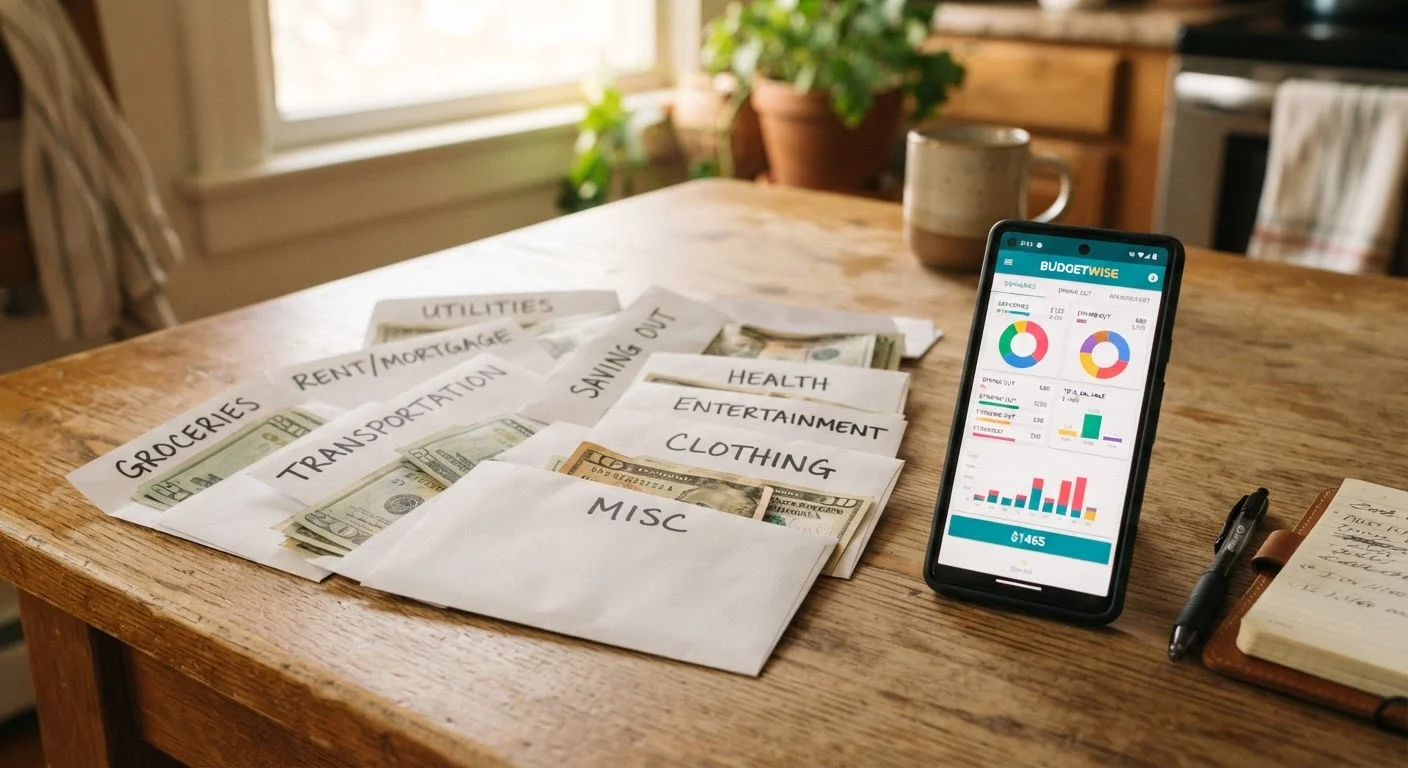
Option A
Cash Envelope System
The tactile, zero-tolerance spending method.
Best for: Families who overspend on variable categories and need a physical barrier to stop impulse purchases.
Option B
Digital Budgeting Apps
The automated, data-rich tracking alternative.
Best for: Households comfortable with technology who want real-time visibility across multiple accounts and income streams.
How Each Method Works
The cash envelope system is straightforward: at the start of each budget period, you withdraw cash and divide it among labeled envelopes - groceries, dining, entertainment, clothing, and so on. Once an envelope is empty, spending in that category stops until the next period. There is no app to check, no alert to dismiss, and no credit card to swipe. The constraint is physical and immediate.
Digital budgeting apps operate differently. They typically connect to your bank accounts and credit cards via secure data feeds, categorize transactions automatically, and display spending against set limits in real time. Some apps use a zero-based budgeting framework; others apply percentage-based rules. Alerts, spending trend graphs, and shared household dashboards are common features. The effort shifts from physically handling cash to reviewing and adjusting categories on a screen.
For a broader look at how these approaches compare to percentage-based frameworks, see how the 50/30/20 rule stacks up against envelope budgeting.
| Criterion | Cash Envelope System | Digital Budgeting Apps |
|---|---|---|
| Spending barrier | Hard stop - cash runs out | Soft stop - alerts and limits |
| Setup effort | Low-tech, manual weekly | Initial setup, then mostly automated |
| Works for online spending | No | Yes, fully |
| Shared household use | Difficult to coordinate | Shared dashboards available |
| Savings goal tracking | Manual, envelope-based | Built-in progress tracking |
| Privacy considerations | No data sharing required | Requires linking financial accounts |
| Cost | Free | Free to paid tiers |
| Best budget period | Weekly or biweekly | Any - syncs continuously |
What the Evidence Says About Spending Behavior
Behavioral economics research has consistently found that paying with cash activates a stronger psychological response than swiping a card or tapping a phone. Studies from researchers including Drazen Prelec and Duncan Simester have described this as the pain of paying - the discomfort associated with handing over physical money. That discomfort functions as a natural brake on impulse spending.
A 2016 study published in the Journal of Consumer Research found that consumers who paid with cash tended to feel a stronger attachment to their purchases and were more deliberate in their choices. While this research covers cash versus cards broadly - not envelopes versus apps specifically - the implication for envelope budgeters is meaningful: the physical act of handling cash changes the decision-making calculus.
18%
Average reduction in discretionary spending with cash
Multiple consumer behavior studies have found that people spend roughly 12-18% less when using cash compared to card payments, though figures vary by study design and population.
60%+
US adults who have tried a budgeting app
Surveys conducted by personal finance research organizations consistently find the majority of American adults have experimented with at least one digital budgeting tool.
~1 in 3
App users who abandon within 3 months
Engagement data from financial wellness research indicates a significant share of budgeting app users stop using the tool within the first quarter, often citing complexity or lack of habit formation.
Digital apps, by contrast, work primarily through awareness and friction reduction. Their strength is surfacing information - showing you that you've spent 80% of your grocery budget by the 15th of the month - rather than physically preventing overspending. For families who respond well to data visibility and don't need a hard stop, that transparency can be highly effective. For those who find it easy to override alerts, it may not be enough.
The paper budgets vs. budgeting apps comparison covers the accuracy and habit-formation angles in more detail if you're evaluating manual tracking as a middle ground.
Practical Trade-offs for US Families
Cash envelopes have real limitations in modern American life. A growing share of household spending happens online - subscriptions, utilities, Amazon orders - where cash simply doesn't apply. Carrying envelopes with significant amounts of cash introduces security risk. And for families with two earners spending from shared categories, coordinating physical envelopes across two wallets is genuinely cumbersome.
Digital apps remove those frictions but introduce others. They require ongoing maintenance: uncategorized transactions need to be reviewed, linked accounts can occasionally disconnect, and some family members - particularly those less comfortable with financial apps - may disengage after the initial setup. Privacy is also a consideration; linking bank accounts to third-party apps involves accepting data-sharing terms that not every household is comfortable with.
A practical middle path that many families use: maintain a digital app for fixed expenses, income tracking, and savings goals, while using physical envelopes for the two or three spending categories where overspending is the chronic problem. This hybrid approach takes advantage of automation where it works best while preserving the psychological power of cash where willpower tends to fail.
For category-level insight into where families typically lose budget discipline, understanding grocery spending patterns is a useful companion read. And for ideas on reducing routine spending regardless of the budgeting method you use, see this guide to spending less on everyday purchases.
This article is for general informational and educational purposes only and does not constitute personalized financial advice. Consult a qualified financial professional for guidance specific to your household's situation.
The content provided on our blog site traverses numerous categories, offering readers valuable and practical information. Readers can use the editorial team’s research and data to gain more insights into their topics of interest. However, they are requested not to treat the articles as conclusive. The website team cannot be held responsible for differences in data or inaccuracies found across other platforms. Please also note that the site might also miss out on various schemes and offers available that the readers may find more beneficial than the ones we cover.