

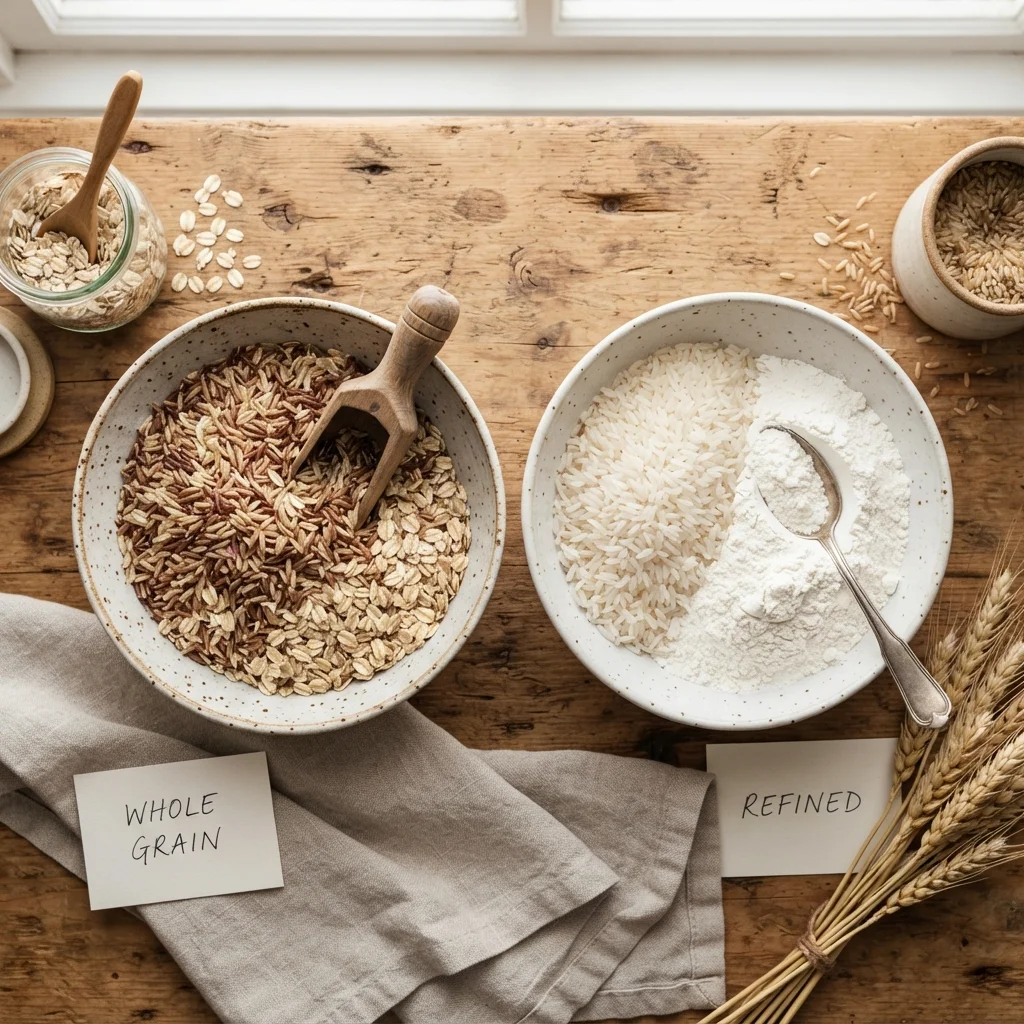
Option A
Whole Grains
The nutritionally complete, fiber-rich original.
Best for: Families looking to support digestive health, sustained energy, and long-term nutritional balance.
Option B
Refined Grains
The processed, longer-shelf-life staple.
Best for: Situations where palatability, cost, or availability limits whole grain options - with enrichment partially offsetting nutrient loss.
What Makes a Grain 'Whole' or 'Refined'?
Every grain kernel - whether wheat, rice, oats, or corn - is made up of three distinct layers: the bran (outer layer, rich in fiber and B vitamins), the germ (nutrient-dense inner core containing healthy fats and antioxidants), and the endosperm (starchy middle layer). A whole grain keeps all three intact. A refined grain has had the bran and germ mechanically removed, leaving mostly the starchy endosperm.
That milling process extends shelf life and creates the softer textures many families are used to - white bread, white rice, standard pasta - but it strips away a significant portion of the original fiber, iron, and B vitamins. In the United States, many refined grain products are subsequently enriched, meaning manufacturers add back some B vitamins and iron. However, enrichment does not restore dietary fiber or the full range of naturally occurring phytonutrients and minerals. For a practical primer on interpreting these details on packaging, see how to read a nutrition label for straightforward guidance.
| Criterion | Whole Grains | Refined Grains |
|---|---|---|
| Grain layers retained | Bran, germ, and endosperm | Endosperm only |
| Dietary fiber | High (naturally occurring) | Low (not restored by enrichment) |
| B vitamins | Naturally present | Partially restored via enrichment |
| Iron | Naturally present | Partially restored via enrichment |
| Phytonutrients & antioxidants | Present in bran and germ | Largely absent after milling |
| Shelf life | Shorter (oils in germ can go rancid) | Longer, more stable |
| Typical texture / palatability | Denser, chewier | Softer, milder flavor |
| Examples | Brown rice, oats, whole wheat bread | White rice, white bread, regular pasta |
Why Fiber Is the Central Difference for Families
Dietary fiber - found in the bran layer that refining removes - plays several meaningful roles in family health. It slows the digestion of carbohydrates, which helps prevent rapid blood sugar spikes and supports a longer feeling of fullness after meals. For children, this can translate to more consistent energy levels through a school day and fewer mid-morning hunger dips.
The DGA, published jointly by the U.S. Department of Agriculture and the Department of Health and Human Services, recommends that at least half of all grain servings come from whole grains. Most American families - children and adults alike - fall considerably short of this target. The good news is that even modest, consistent shifts toward whole grains can contribute to improved overall diet quality over time.
~5%
Americans meeting whole grain recommendations
Research drawing on NHANES data consistently shows fewer than one in ten Americans meet the Dietary Guidelines recommendation to make half their grains whole grains.
3x
More fiber in whole vs. refined wheat
A standard slice of whole wheat bread generally contains roughly three times more dietary fiber than an equivalent slice of white bread, based on USDA food composition data.
25%+
Micronutrients lost in typical milling
Studies on wheat milling estimate that processing can remove more than a quarter of several key micronutrients, including magnesium and zinc, which enrichment does not fully replace.
It is worth noting that fiber needs vary by age and body size. Consulting a registered dietitian or your child's pediatrician is the most reliable way to understand what grain and fiber targets make sense for your specific family members, particularly for children under five or those with any digestive health concerns.
Making the Switch Without a Family Revolt
Nutritional value means little if food ends up uneaten. A gradual approach tends to work better than an abrupt elimination of familiar favorites. Blending whole wheat flour with all-purpose flour in baked goods, serving brown rice alongside a flavorful sauce, or choosing oatmeal for breakfast are low-friction entry points most families tolerate well.
Label reading matters here more than many shoppers realize. A product labeled "multigrain" or "wheat bread" is not necessarily a whole grain product - look for the words "whole grain" or "whole wheat" as the first ingredient on the ingredient list. Marketing language on the front of packages can be misleading. For related context on navigating these claims at the grocery store, store brand vs. name brand comparisons also sheds light on how ingredient lists often matter more than packaging.
Involving children in choosing and preparing grain-based dishes can also improve acceptance. Cooking with kids has genuine nutritional benefits alongside its developmental ones. If broader family nutrition principles feel unclear, getting started with family nutrition offers a plain-language foundation worth revisiting.
This article is for general informational and educational purposes only and is not a substitute for professional medical or dietary advice. Consult a qualified healthcare provider or registered dietitian before making significant changes to your family's diet, especially for young children or individuals with specific health conditions.
The content provided on our blog site traverses numerous categories, offering readers valuable and practical information. Readers can use the editorial team’s research and data to gain more insights into their topics of interest. However, they are requested not to treat the articles as conclusive. The website team cannot be held responsible for differences in data or inaccuracies found across other platforms. Please also note that the site might also miss out on various schemes and offers available that the readers may find more beneficial than the ones we cover.