

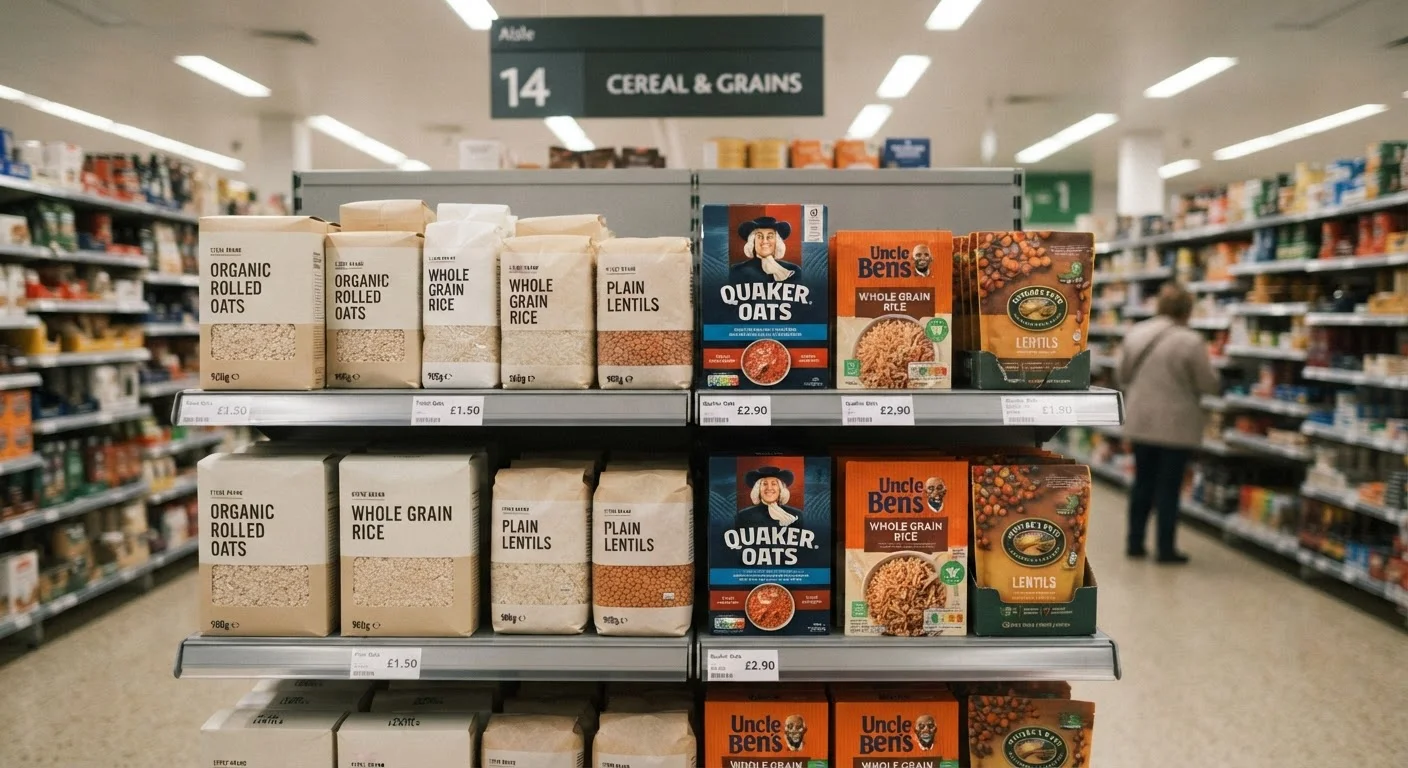
Option A
Store Brand (Private Label)
The value-focused, retailer-controlled alternative.
Best for: Budget-conscious families looking to reduce routine grocery spending without sacrificing quality on everyday staples.
Option B
Name Brand (National Brand)
The heavily marketed, nationally recognized option.
Best for: Shoppers who prioritize specific formulations, proven performance in certain categories, or brand-specific preferences.
The Price Gap and Where It Actually Comes From
Store brand products - also called private label goods - are typically priced 20-30% below their name brand equivalents. That spread is not primarily explained by lower ingredient quality. It largely reflects what name brands spend on advertising, celebrity endorsements, national distribution infrastructure, and retail shelf placement fees (known as slotting fees). When you buy a name brand, a meaningful portion of the price covers the cost of making you aware the product exists.
Retailers, by contrast, control the entire chain for their private label products - from sourcing to shelf - and pass some of those margin efficiencies on to shoppers. This is why store brand products have expanded dramatically in quality and range over the past two decades: retailers have strong financial incentive to make them good enough that customers keep choosing them.
Understanding this dynamic is the starting point for making objective comparisons - price alone doesn't tell you whether you're getting a worse product or simply cutting out the marketing budget.
| Criterion | Store Brand | Name Brand |
|---|---|---|
| Typical price difference | 20-30% lower | Baseline reference price |
| Marketing spend included in price | Minimal | Significant |
| OTC drug active ingredients | FDA-equivalent by law | FDA-regulated standard |
| Manufacturing origin | Often same facility as name brand | Brand-owned or contracted plant |
| Formulation consistency (condiments, cleaners) | Varies by retailer and supplier | Consistent across markets |
| Packaging and branding investment | Minimal | High |
| Range of product categories | Expanding, most major categories | Full range, national distribution |
When the Products Are Genuinely the Same
The most clear-cut category is over-the-counter medications. The U.S. Food and Drug Administration (FDA) requires that generic OTC drugs contain the same active ingredients at the same concentrations as name brand equivalents. A store brand ibuprofen tablet is, by regulatory definition, equivalent to the name brand version. The inactive ingredients - binders, fillers, coatings - may differ, but the therapeutic component does not.
A similar dynamic applies to many pantry staples. Industry reporting has consistently noted that a significant share of store brand products are manufactured in the same facilities as national brands, sometimes even on the same production lines, with the only meaningful difference being the label applied at the end. This is especially common with canned vegetables, cooking oils, flour, sugar, and bottled water.
~20-30%
Typical store brand price discount
Consumer research from organizations including the Private Label Manufacturers Association consistently estimates store brand products are priced 20-30% below name brand equivalents on average.
~40%
Share of US grocery units sold as store brand
Industry data from the Private Label Manufacturers Association has reported store brands accounting for roughly 40% of unit sales in US grocery stores in recent years.
For these categories, the only rational question is whether you have a specific formulation preference - and if you don't, the store brand is straightforward value. See also: pantry staples that consistently stretch a grocery budget.
When the Name Brand Difference Is Real
Not every category is equivalent. Three areas where genuine differences are more likely to matter:
- Fresh and refrigerated foods: Dairy products, deli meats, and fresh breads can differ noticeably in flavor and texture, and quality control varies between suppliers. Your palate is actually a reliable instrument here - trial and comparison is the right method.
- Condiments and sauces: Recipes differ, not just packaging. The spice profile, sweetness, and consistency of ketchup, mayo, or hot sauce are product-specific and vary between manufacturers.
- Cleaning and laundry products: Enzyme blends, concentration levels, and surfactant combinations vary more meaningfully in this category. Some store brand versions perform comparably; others fall noticeably short on tough stains or grease. This is a category worth testing before committing to a bulk purchase - and bulk buying has its own math worth examining in our piece on when bulk buying actually saves money.
The honest answer is that you won't know without trying. A structured side-by-side test - buying both versions once and comparing - is more reliable than any generalization.
It's also worth remembering that labels like "#1 Rated" on a name brand package rarely mean what they imply. Our analysis of what product awards actually signal explains the mechanics behind these claims.
A Note on "Natural" and "Organic" Labels
Both store brands and name brands use terms like "natural" on packaging, but the FDA does not have a formal regulatory definition for this term in food labeling. "Organic" is regulated by the USDA under the National Organic Program, and products carrying that seal - store brand or otherwise - must meet the same certification standards. Don't assume a name brand "natural" claim indicates a higher standard than a store brand equivalent; check for actual certification marks instead.
A Practical Decision Framework for Weekly Shopping
Rather than memorizing rules for every aisle, most families benefit from a simple default: start with store brand, then selectively switch based on personal experience. This approach treats the name brand as something you justify through direct comparison, not something you default to out of habit or marketing familiarity.
Organize your switches by category rather than individual products. If store brand canned tomatoes work fine, that applies across the canned goods aisle. If you find a meaningful difference in a specific condiment, note it and stay with the name brand only there. Over time you'll build a personalized map that's grounded in your household's actual preferences - not shelf theater or promotional pricing tactics designed to steer decisions.
Families with specific dietary needs - managing sodium, allergen sensitivities, or particular nutritional targets - should always read ingredient labels on both options rather than assuming equivalence. And for decisions that cross product categories entirely, the same evidence-based comparison mindset applies.
This article is for general informational purposes only and does not constitute medical, nutritional, or financial advice. Consult a qualified professional for decisions specific to your household's health or financial circumstances.
The content provided on our blog site traverses numerous categories, offering readers valuable and practical information. Readers can use the editorial team’s research and data to gain more insights into their topics of interest. However, they are requested not to treat the articles as conclusive. The website team cannot be held responsible for differences in data or inaccuracies found across other platforms. Please also note that the site might also miss out on various schemes and offers available that the readers may find more beneficial than the ones we cover.