

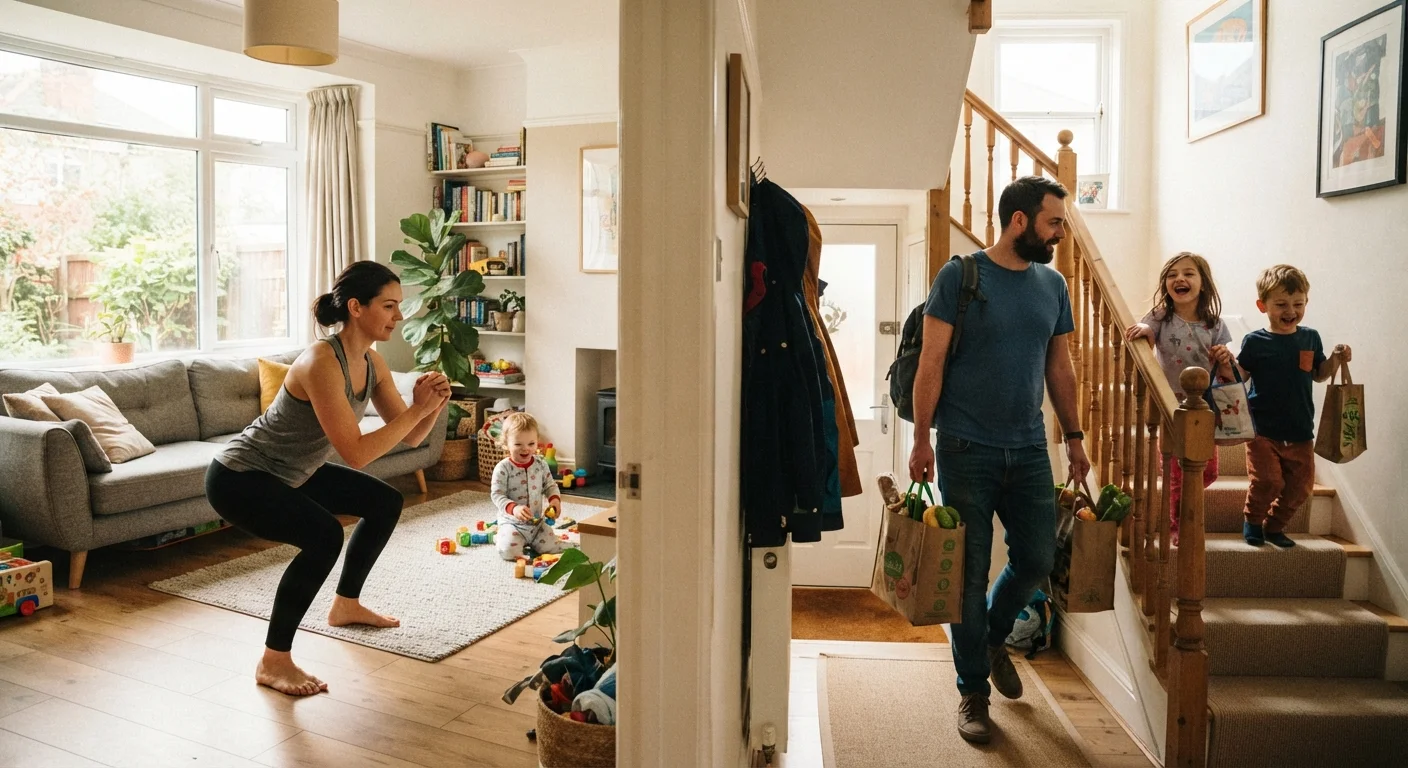
Our Verdict
Structured home workouts and incidental daily movement are not rivals - they address different aspects of physical health and work best together. Dedicated sessions build fitness capacity and strength, while consistent everyday movement prevents the health costs of prolonged inactivity. Most families will benefit from weaving both into their routine rather than treating it as an either-or choice.
| Best for | Recommended |
|---|---|
| Families with limited free time seeking measurable fitness gains | Structured Home Workouts |
| Households looking to reduce sedentary time without dedicated sessions | Incidental Daily Movement |
| Those new to exercise or returning after a long break | Incidental Daily Movement as a starting point |
| Most families seeking well-rounded, sustainable activity habits | A combination of both approaches |
What Each Approach Actually Means
Structured home workouts are planned, intentional exercise sessions - think a 20-minute bodyweight circuit, a yoga flow, or a resistance session done in your living room. They have a defined start and end, a purpose, and usually some form of progression over time. Our guide to building a family fitness routine explains how to make these sessions sustainable even in busy households.
Incidental daily movement refers to the physical activity woven into ordinary life - carrying groceries, climbing stairs, walking to the mailbox, tidying the house, gardening, or playing in the backyard with kids. It isn't exercise in the traditional sense, but it is movement, and it accumulates across the day in ways that matter for health.
Understanding what each category does - and doesn't - accomplish is the foundation for making an informed choice about how your family spends its energy.
The Case for Structured Workouts
Planned exercise sessions offer something incidental movement generally cannot: progressive overload and measurable intensity. When you follow a structured routine, you can gradually increase resistance, duration, or complexity - the mechanism through which cardiovascular fitness improves and muscles strengthen over time.
Public health guidelines from organizations such as the U.S. Department of Health and Human Services broadly recommend at least 150 minutes of moderate-intensity aerobic activity per week for adults, plus muscle-strengthening activities on two or more days. Structured sessions are the most reliable way to hit those targets intentionally.
Structured workouts also tend to be time-efficient. A focused 20- to 30-minute session can deliver cardiovascular and strength benefits that would be difficult to replicate through incidental movement alone. If your home is short on space, our article on exercising in small spaces offers practical layout ideas that require very little room.
Short Sessions Still Count
You don't need a full hour to benefit from structured exercise. Evidence broadly supports the value of shorter, more frequent sessions - even 10 to 15 minutes of intentional movement can contribute to weekly activity totals. If a long session isn't realistic on a given day, a brief focused effort is meaningfully better than skipping altogether. See our mobility and stretching guide for ideas that work in under 15 minutes.
There's also a mental health dimension worth noting. Consistent structured exercise is associated in research literature with improvements in mood, stress regulation, and sleep quality - benefits that carry over to every member of a household, including children who observe and often adopt a parent's habits.
The Case for Incidental Daily Movement
Research in exercise science has increasingly highlighted a concern that goes beyond simply not exercising: prolonged unbroken sitting. Studies suggest that even people who meet weekly exercise guidelines may face elevated health risks if they spend the majority of their waking hours seated. Incidental movement directly addresses this by breaking up sedentary time throughout the day.
For families managing packed schedules, incidental movement can be the most realistic entry point. Taking the stairs, parking further away, walking during phone calls, or encouraging kids to help with active household tasks all contribute to daily step counts and overall energy expenditure without requiring any dedicated time block.
| Structured Home Workouts | Incidental Daily Movement | |
|---|---|---|
| Time required | Dedicated block (20-60 min) | Woven into existing tasks |
| Equipment needed | None to minimal | None |
| Cardiovascular fitness gains | Strong - progressive intensity possible | Modest - rarely reaches target heart rate |
| Strength building | Effective with resistance or bodyweight | Limited |
| Reduces sedentary time | During session only | Throughout the day |
| Barrier to entry | Moderate - requires scheduling | Very low - fits existing routines |
| Suitable for all fitness levels | Yes, with modifications | Yes, universally accessible |
| Measurable progress | Easier to track and build on | Harder to quantify |
Incidental movement is also barrier-free. It requires no equipment, no schedule, and no specific space - making it accessible to virtually every household regardless of budget or home size. This is especially valuable for family members who feel intimidated by formal exercise or who are managing health conditions that limit higher-intensity activity. Always consult a qualified healthcare professional before significantly changing activity levels, particularly for those with existing health concerns.
Where the Evidence Points
The broader scientific picture suggests that both approaches contribute independently to health outcomes, and the relationship between them is additive rather than substitutional. Reducing sitting time improves certain metabolic markers; structured exercise improves cardiovascular capacity and muscular strength. Neither fully replaces the other.
For families, this is actually good news. It means that progress doesn't require perfection in either category. A household that manages two structured sessions per week and actively looks for ways to move more on other days is likely doing more for its collective health than one that either exercises intensely but sits for the rest of the day, or moves gently throughout the day but never raises its heart rate significantly.
Our piece on common exercise myths addresses several misconceptions - including the idea that workouts must be long or intense to count - that can discourage families from starting at all. And if you're thinking about how to track meaningful progress, understanding which fitness metrics matter can help you focus on what's actually useful.
This article is for general informational and educational purposes only and does not constitute medical advice. Consult a qualified healthcare professional before making changes to your or your family's exercise routine.
The content provided on our blog site traverses numerous categories, offering readers valuable and practical information. Readers can use the editorial team’s research and data to gain more insights into their topics of interest. However, they are requested not to treat the articles as conclusive. The website team cannot be held responsible for differences in data or inaccuracies found across other platforms. Please also note that the site might also miss out on various schemes and offers available that the readers may find more beneficial than the ones we cover.