

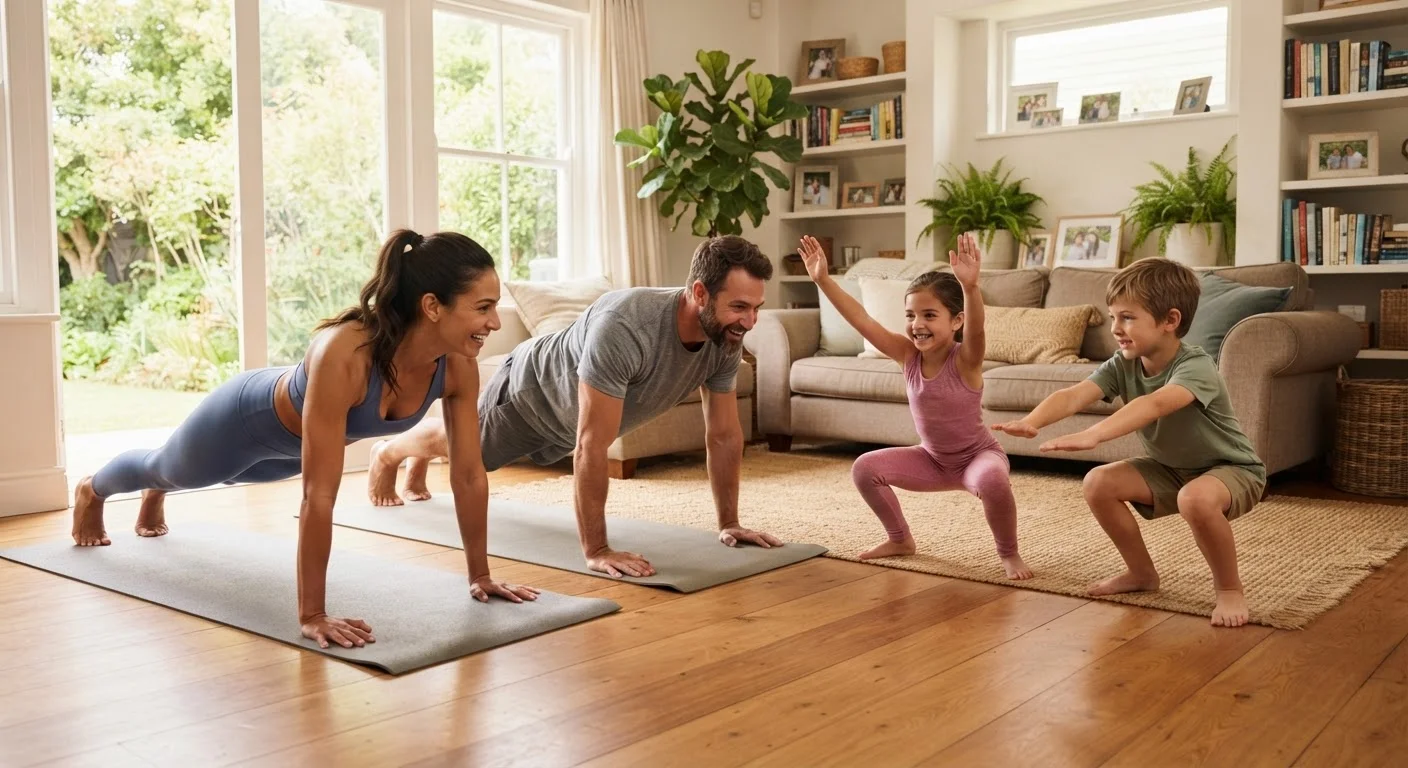
The Science Behind Bodyweight Resistance
The core principle driving any strength or fitness adaptation is mechanical tension - the force placed on muscle fibers during movement. Weight machines create this tension through external load. Bodyweight exercises create it through gravity acting on your own mass, combined with joint angles, leverage, and movement tempo.
When you perform a push-up, your chest, shoulder, and triceps muscles must work against a meaningful percentage of your body weight. Research published in exercise science literature has consistently shown that the stimulus required to produce muscle hypertrophy and strength gains is not exclusively tied to external weight - it is tied to the degree of effort and tension applied to the muscle.
This explains why well-conditioned athletes incorporate bodyweight movements, and why beginners can see rapid strength improvements from a structured push-up or squat progression. The mechanism is the same; only the tool differs.
“The body doesn't know the difference between a barbell and its own weight - it only knows tension, effort, and recovery. Program those intelligently, and adaptation follows.”
— Brad Schoenfeld, Exercise scientist and published researcher in hypertrophy and resistance training
Progressive Overload Without a Single Weight Plate
Progressive overload - gradually increasing the challenge placed on muscles over time - is the foundational principle of any effective training program. Many families assume this requires heavier dumbbells or machine adjustments. In reality, bodyweight training offers multiple dimensions of progression.
- Leverage shifts: Elevating your feet during a push-up increases the percentage of body weight your muscles handle.
- Single-limb variations: Moving from a two-legged squat to a single-leg squat dramatically increases demand with no added equipment.
- Tempo manipulation: Slowing the lowering phase of any movement - a concept called eccentric training - increases time under tension and muscular effort.
- Reduced rest intervals: Compressing rest periods sustains elevated heart rate and adds a cardiovascular demand.
These variables mean a bodyweight program can remain challenging for months to years, adapting alongside the individual's growing fitness level. For a broader look at why home workout progress sometimes stalls, see why your home workout stops working.
Track Your Reps and Variations, Not Just Time
Rather than simply logging minutes of exercise, note which variation of each movement you performed and how many repetitions you completed. This gives you a clear record of progression - the moment a movement becomes easy, you have a concrete signal to advance to the next variation. Treating bodyweight training with the same structure you'd give a gym session dramatically improves long-term results.
Functional Strength That Transfers to Everyday Life
One advantage frequently cited by exercise physiologists is that bodyweight movements - squats, lunges, push-ups, hip hinges - mirror the movement patterns humans use throughout daily life: lifting, carrying, rising from chairs, and stabilizing on uneven surfaces. Weight machines, by contrast, are often designed to isolate a single muscle group in a fixed plane of motion.
This distinction matters for families. Strength gained through functional compound movements tends to translate into better posture, injury resilience, and ease of everyday physical tasks. This doesn't make machines inferior - they serve specific purposes - but it does mean bodyweight training delivers meaningful, applicable fitness outcomes for most people's real-world needs.
Concerned about whether home training can fully replace a gym? Explore the trade-offs of skipping the gym entirely for an honest comparison.
~60-70%
Body weight loaded in a standard push-up
Biomechanical analyses suggest a standard push-up places approximately 60-70% of total body weight through the upper body musculature, providing a significant training stimulus.
Similar
Strength gains vs. machine training in general populations
Multiple peer-reviewed studies have found comparable strength and hypertrophy outcomes between bodyweight and machine-based resistance programs when effort and progression are matched.
$0
Minimum equipment cost for a complete bodyweight program
Core bodyweight exercises - push-ups, squats, lunges, planks, glute bridges - require only floor space, making the barrier to entry effectively zero for most families.
Making Bodyweight Training Work for Your Whole Family
One of bodyweight training's most practical strengths is its adaptability. A single movement pattern can be modified to suit a six-year-old, a teenager, a parent, or an older grandparent - all at the same time, in the same room.
A wall push-up is appropriate for someone building initial upper-body strength. A standard push-up suits an intermediate exerciser. An archer push-up or single-arm variation challenges an advanced family member. Everyone works on the same pattern at their own level, making shared family workouts genuinely inclusive.
If you've dismissed home exercise as impractical or ineffective, many of those hesitations may be rooted in common misconceptions. Learn which exercise myths may be keeping your family off the living room floor.
This article is for general informational and educational purposes only and is not a substitute for professional medical or fitness advice. Consult a qualified healthcare provider before beginning any new exercise program, particularly if you or a family member has an existing health condition.
Frequently Asked Questions
Yes. Muscle growth and strength gains depend on progressively challenging the muscles, which is achievable with bodyweight exercises. Adjusting leverage, tempo, range of motion, or adding single-limb variations increases difficulty meaningfully. Studies have found comparable strength outcomes between bodyweight and resistance-machine programs for general fitness goals.
Bodyweight exercise is widely considered safe and appropriate for most beginners and older children, as resistance is self-limiting and naturally scaled to the individual. Children should focus on movement quality and fun rather than structured programming. Always consult a pediatrician or family doctor if a child has existing health concerns before starting any new exercise routine.
Progress by adjusting variables such as tempo (slowing the movement down), range of motion, leverage (elevating feet during push-ups), or transitioning to single-limb versions of exercises like pistol squats or single-arm rows. Adding more repetitions or reducing rest time also increases challenge. This mirrors the principle of progressive overload used in gym-based training.
Most foundational bodyweight exercises require nothing more than floor space. A yoga mat adds comfort, and a sturdy chair or low table can assist certain movements like incline push-ups or step-ups. Our <a href="/health-wellness/fitness-at-home/setting-up-a-home-workout-space-on-a-tight-budget">guide to setting up a home workout space</a> covers what genuinely helps versus what you can skip.
Machines offer advantages in isolation exercises and controlled loading, which can benefit rehabilitation or advanced strength sports. For general fitness, fat loss, cardiovascular conditioning, and functional strength, bodyweight training is a well-supported alternative. The best choice depends on individual goals, access, and preference - not an absolute hierarchy.
Most effective bodyweight routines fit within a space roughly the size of a yoga mat - about 2 by 6 feet. Exercises like planks, push-ups, squats, and lunges can all be performed within that footprint. For more ideas on fitting workouts into tight spaces, see <a href="/health-wellness/fitness-at-home/small-spaces-real-workouts-exercising-when-your-home-has-no-room-to-spare">exercising in small spaces</a>.
The content provided on our blog site traverses numerous categories, offering readers valuable and practical information. Readers can use the editorial team’s research and data to gain more insights into their topics of interest. However, they are requested not to treat the articles as conclusive. The website team cannot be held responsible for differences in data or inaccuracies found across other platforms. Please also note that the site might also miss out on various schemes and offers available that the readers may find more beneficial than the ones we cover.