

Start here
Why Home Workouts Work for Beginners
Next
What to Expect in Your First Month
Then
Core Movements Every Beginner Should Know
Apply it
Structuring Your Week Without Overcomplicating It
Keep going
Staying Consistent When Motivation Fades
Why Home Workouts Work for Beginners
Starting an exercise routine feels intimidating when you picture crowded gyms, unfamiliar equipment, and the pressure to keep up with experienced exercisers. Home workouts remove nearly all of those barriers. You set the pace, choose the time, and exercise in a space that already feels comfortable.
The physical benefits of regular movement - including improved cardiovascular health, stronger muscles, and better mood - are well supported by public health guidelines, and none of them require a gym membership to achieve. Research from the U.S. Department of Health and Human Services consistently shows that even modest increases in physical activity provide meaningful health benefits for adults of all fitness levels.
If you're working with a small apartment or a living room shared with kids and furniture, that's no obstacle. See our guide to exercising in small spaces for practical ideas on making any area work. And if you've convinced yourself you need expensive gear or hour-long sessions to see results, common exercise myths are worth reading before you begin.
Bodyweight exercise
Physical movement that uses your own body as the resistance, with no weights or machines needed. Examples include squats, push-ups, and lunges.
DOMS
Delayed onset muscle soreness - the achiness felt 24 to 48 hours after unfamiliar exercise. It is a normal sign that muscles are adapting, not a sign of injury.
Progressive overload
Gradually increasing the challenge of your workouts over time - by adding repetitions, sets, or difficulty - so your body continues to adapt and improve.
Rest day
A scheduled day without structured exercise, allowing muscles to repair and strengthen. Rest days are a planned and necessary part of any fitness routine.
Warm-up
A few minutes of gentle movement before the main workout that raises your heart rate gradually and prepares joints and muscles for more vigorous activity.
What to Expect in Your First Month
The first four weeks of any new exercise habit are less about transformation and more about adaptation. Your body is learning new movement patterns, your heart and lungs are adjusting to increased demand, and your brain is forming the neural pathways that will eventually make movement feel automatic.
Week one often feels harder than it should. That's normal. By week two, most beginners notice the same movements feel slightly easier. Weeks three and four typically bring a meaningful boost in energy and confidence - not dramatic physical changes, but the reward of consistency starting to feel real.
Expect some muscle soreness, particularly after the first two or three sessions. Delayed onset muscle soreness (DOMS) is a normal response to new physical stress and typically resolves within 48 hours. It is not a reason to stop - but sharp pain, joint pain, or chest discomfort are signals to stop and consult a healthcare professional promptly.
Track Your First Four Weeks Simply
You don't need an app or spreadsheet. A check mark on a calendar after each completed session gives you a visual streak that becomes its own motivation. At the end of month one, you'll have a concrete record of what you've built - which is often more encouraging than any fitness metric.
Core Movements Every Beginner Should Know
A small set of fundamental movements covers the major muscle groups and forms the foundation of almost every beginner program. You don't need a long list - you need a short one practiced consistently.
- Squats: Strengthen the legs and hips. Stand with feet shoulder-width apart, lower as if sitting into a chair, then return to standing.
- Modified push-ups: Build upper body and core strength. Performed from the knees rather than the toes, these are safe and effective for most beginners.
- Glute bridges: Activate the hips and lower back. Lie on your back with knees bent, then press your hips toward the ceiling.
- Marching in place or stepping side to side: A low-impact way to elevate heart rate without jumping.
- Dead bug: A core stability exercise performed lying on your back, extending opposite arm and leg while keeping your lower back pressed to the floor.
Each of these can be modified to be easier or harder as your fitness progresses. Starting with two sets of eight to twelve repetitions is a reasonable approach for most adults - but your individual capacity may differ, and listening to your body matters more than hitting a specific number.
Structuring Your Week Without Overcomplicating It
Consistency beats intensity every time, especially in the first month. A simple three-day-per-week structure - for example, Monday, Wednesday, and Friday - gives you workout days and built-in recovery time. Each session might include a few minutes of gentle movement to warm up, the core exercises above, and a few minutes of stretching to close.
Rest days are active parts of your plan, not failures. Light walking, stretching, or playing with your kids counts as beneficial movement on off days without taxing recovering muscles.
Avoid the temptation to do more in week one because you feel fine. Overloading too early is one of the most common reasons beginners drop off. Gradual progression - adding one set or a few more repetitions each week - is the approach supported by exercise science for sustainable improvement.
Once you've built a month of consistent sessions, you'll be well positioned to explore more structured programming. Our article on building a family fitness routine that sticks offers a logical next step.
A Note on Special Populations
Adults who are pregnant, postpartum, managing a chronic condition such as diabetes or heart disease, or returning from injury have specific exercise considerations that go beyond general beginner guidance. If any of these apply to you or a family member, please work with a licensed healthcare provider or certified exercise professional to develop an appropriate plan.
Staying Consistent When Motivation Fades
Motivation is useful to get started, but it's unreliable as a long-term driver. Habits and environment carry you through the days when enthusiasm isn't there. A few strategies make consistency more likely:
- Anchor your workout to an existing habit - exercising right after the morning school run or just before dinner removes the need to decide each day.
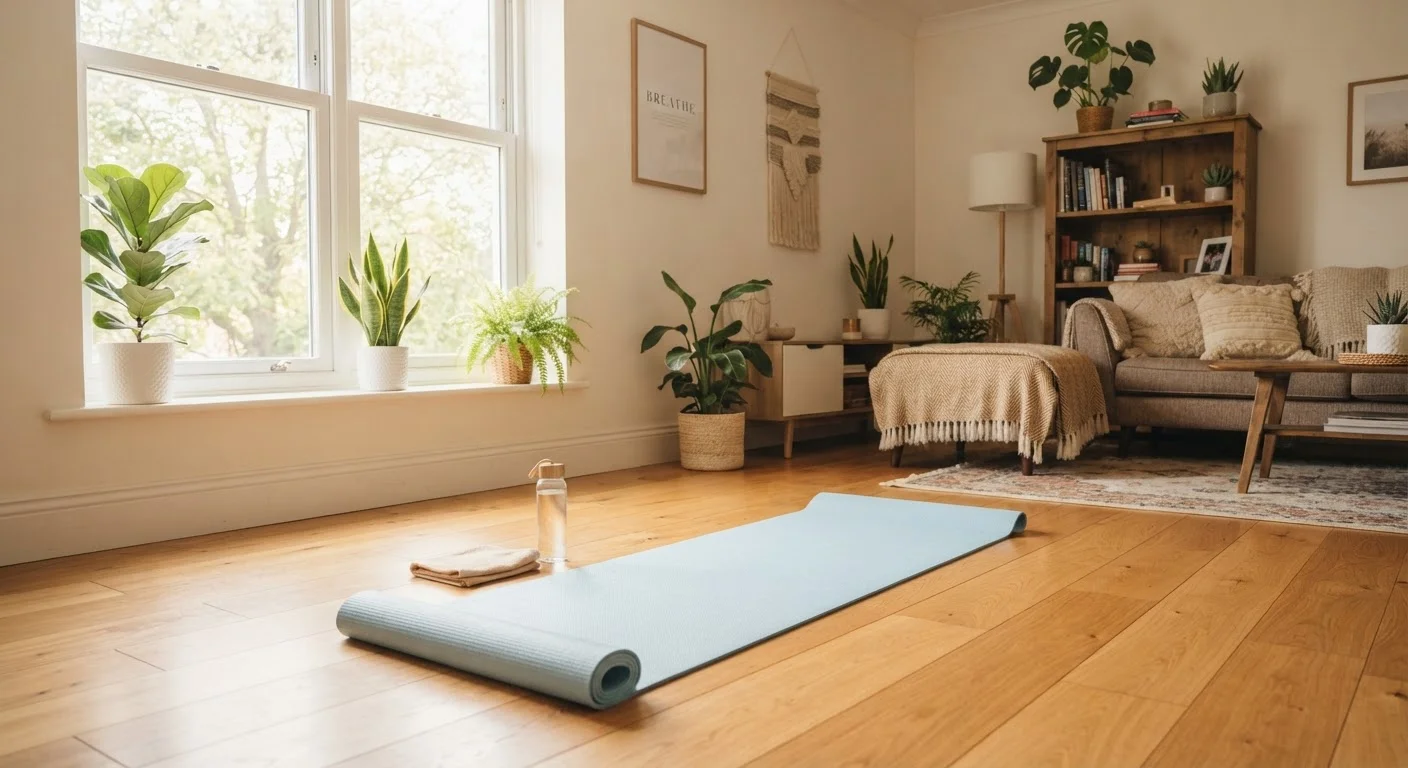
- Keep it visible - a mat left out in the corner of a room is a low-key daily prompt.
- Track simply - a check mark on a paper calendar after each session gives a satisfying sense of progress.
- Involve the family - even informal movement together, like a post-dinner walk or a short stretch before bed, reinforces the habit for everyone.
Missing a session is not a setback - it's a normal part of any long-term routine. The goal is to return to the schedule without guilt. One missed day does not erase the progress of the days before it.
This article provides general health and fitness information for educational purposes only. It is not a substitute for personalized advice from a qualified healthcare provider. If you have any existing health conditions, injuries, or concerns, please consult a licensed medical professional before beginning a new exercise program.
Frequently Asked Questions
For most beginners, 15 to 25 minutes per session is a practical starting point. Short sessions are easier to fit into a busy day and reduce the risk of burnout or injury. As your fitness improves, you can gradually increase duration.
No equipment is necessary for a beginner routine. Bodyweight exercises like squats, push-ups, and marching in place build strength and cardiovascular fitness using only your own weight. A non-slip surface, such as a yoga mat or carpet, is helpful but not essential.
Starting with two to three days per week with rest days in between gives your body time to recover and adapt. Rest is not optional - muscles rebuild and strengthen during recovery, not during the workout itself.
Yes. Delayed onset muscle soreness (DOMS) - a dull aching feeling that peaks 24 to 48 hours after exercise - is common for beginners and is not a sign of injury. Gentle movement, hydration, and adequate sleep help recovery. Sharp or joint pain, however, should be evaluated by a healthcare professional.
Absolutely. Many bodyweight movements are adaptable for different ages and fitness levels, making them well-suited for family sessions. Working out together also provides built-in accountability and models healthy habits for children.
Anyone with a chronic health condition, recent injury, pregnancy, or who has been sedentary for an extended period should speak with a healthcare provider before beginning a new exercise routine. This is general information, not personal medical advice.
The content provided on our blog site traverses numerous categories, offering readers valuable and practical information. Readers can use the editorial team’s research and data to gain more insights into their topics of interest. However, they are requested not to treat the articles as conclusive. The website team cannot be held responsible for differences in data or inaccuracies found across other platforms. Please also note that the site might also miss out on various schemes and offers available that the readers may find more beneficial than the ones we cover.