

Why Evidence Matters in Companion Planting
Companion planting - growing two or more plant species in close proximity for mutual benefit - has been practiced for centuries. But gardening folklore and rigorous field research are not the same thing, and treating them as equivalent can cost you real time, money, and yield.
That doesn't mean traditional practices are worthless. Many have a plausible mechanism and at least some supporting data. Others, however, rest almost entirely on anecdote. If you're planning a productive family garden on a limited budget, it pays to know the difference. This list focuses on combinations where controlled trials or replicated studies point to a genuine benefit - and flags a few widely repeated pairings that the evidence doesn't clearly support.
Before you plant, it's worth reviewing the fundamentals of soil, sun, and spacing - because no companion planting strategy compensates for a poorly prepared bed.
Marigolds and Tomatoes (for Nematode Suppression)
French marigolds (Tagetes patula) produce a compound called alpha-terthienyl from their roots, which has been shown in multiple studies to suppress root-knot nematodes - microscopic soil organisms that damage plant root systems. The key caveat: the effect is most pronounced when marigolds are grown densely for a full season and then tilled into the soil as a green manure, not simply planted nearby as a border.
If your soil has a history of nematode problems, dedicating a bed to marigolds for one season before rotating in tomatoes or peppers is a strategy with genuine research backing. Casual interplanting offers weaker results.
Marigold root compounds suppress soil nematodes most effectively when plants are grown densely and tilled in.
The Three Sisters: Corn, Beans, and Squash
This Indigenous North American polyculture - corn providing vertical structure, beans fixing atmospheric nitrogen, and squash shading the ground to retain moisture and suppress weeds - is one of the best-documented companion systems in agricultural literature. Nitrogen fixation by legumes is a well-established biological process. Field studies have confirmed yield advantages when this combination is managed correctly, particularly in low-input growing conditions.
Spacing matters: corn needs to be established before beans are sown, and squash varieties should be selected to spread without smothering the other crops. See how bed type affects layout and spacing decisions if you're deciding where to try this.
Beans fix atmospheric nitrogen in soil, providing a measurable fertility benefit to companion corn and squash.
Buckwheat as a Cover Crop Companion
Buckwheat (Fagopyrum esculentum) is a fast-growing flowering plant that attracts a wide range of beneficial predatory and parasitic insects - including hoverflies and parasitic wasps - that feed on or lay eggs in common garden pests. Research in agroecology supports the use of flowering insectary plants within or adjacent to vegetable plots as a legitimate pest management approach, a concept called conservation biological control.
Buckwheat establishes quickly, smothers weeds, and can be cut and composted before it sets seed. It works well at bed edges or in short-season gaps between plantings.
Buckwheat's flowers recruit beneficial predatory insects that naturally reduce pest pressure in nearby vegetable beds.
Legumes Preceding Brassicas in Rotation
While not simultaneous companion planting, sequential planting of legumes (peas, beans, clover) followed by nitrogen-hungry brassicas (cabbage, broccoli, kale) is one of the most rigorously supported practices in small-scale agriculture. Rhizobium bacteria on legume roots fix nitrogen that remains bioavailable in the soil after the legume is removed.
The practical benefit for families: reducing or eliminating the need for synthetic nitrogen fertilizer on brassica beds following a legume crop. This is a genuine cost-saving and soil-health strategy with decades of agronomic research behind it.
Growing legumes before brassicas naturally replenishes soil nitrogen, reducing the need for synthetic fertilizers.
Dill and Fennel: Keep Them Apart
Not all companion evidence is about what to grow together - some documents what to keep separate. Dill and fennel are both Apiaceae family plants that cross-pollinate easily, producing hybrid seeds with unpredictable flavor. More practically, fennel is allelopathic - it releases root compounds that inhibit the germination and growth of many vegetable crops, including tomatoes, peppers, and lettuce.
Fennel is best grown in an isolated pot or a dedicated spot well away from the main vegetable garden. This is a case where companion planting knowledge protects your investment rather than enhancing it.
Fennel's root compounds inhibit nearby vegetable growth - isolate it rather than interplanting with the main garden.
What About Basil and Tomatoes?
This is perhaps the most widely cited companion pairing, and it deserves honest treatment. The claim that basil repels aphids, whiteflies, or tomato hornworms from nearby tomatoes is not well supported by controlled field research. Studies testing this pairing have generally found no significant pest reduction effect on the tomato plants.
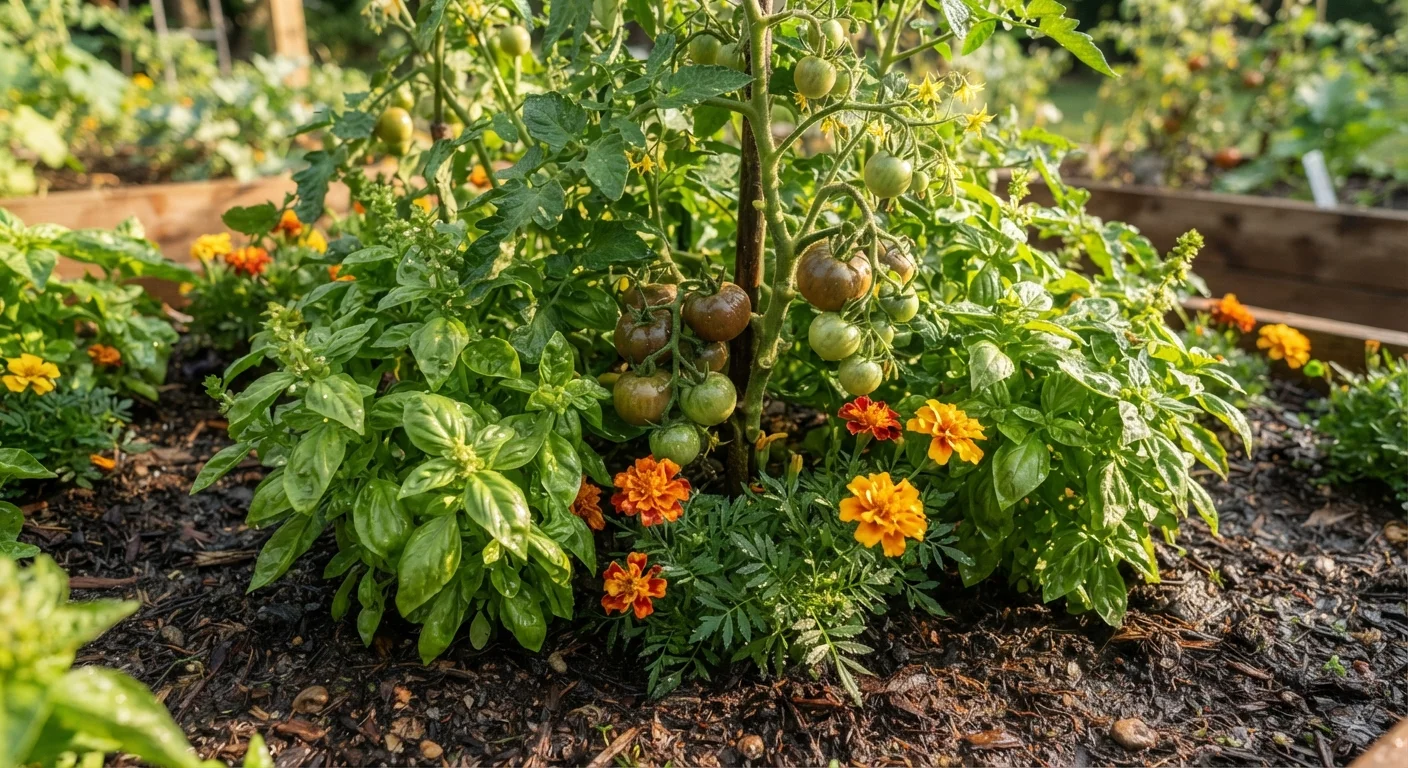
Basil and tomatoes do share cultural requirements - both love heat, well-drained soil, and full sun - making them practical to grow in the same bed from a logistics standpoint. And growing basil near tomatoes means a harvest of both in the same space. That's a practical benefit. Just don't expect it to function as a pest-management strategy. For more on separating useful guidance from garden folklore, see our breakdown of common garden myths.
Basil and tomatoes share good growing conditions, but research does not confirm the pest-deterrence benefit often claimed.
Putting It Into Practice
The combinations above share a common trait: each has a plausible, testable mechanism and at least some controlled evidence behind it. That's a meaningful standard in a field that sometimes blurs the line between tradition and science. For a broader look at gardening claims that don't hold up, see common garden myths worth skipping.
Start With One Combination This Season
Rather than redesigning your entire garden around companion planting, pick one evidence-backed pairing suited to what you already grow. The Three Sisters works well in larger in-ground plots; a buckwheat border suits any garden size. Track your results over one or two seasons before expanding - small-scale observation in your own conditions is genuinely useful data.
If you're working with limited space, most of these combinations adapt well to raised beds and containers - see strategies for compact food gardens for layout ideas that maximize every square foot.
This article provides general gardening education. Results vary depending on local soil conditions, climate, pest pressure, and cultivar selection. Consult your local cooperative extension service for region-specific guidance.
The content provided on our blog site traverses numerous categories, offering readers valuable and practical information. Readers can use the editorial team’s research and data to gain more insights into their topics of interest. However, they are requested not to treat the articles as conclusive. The website team cannot be held responsible for differences in data or inaccuracies found across other platforms. Please also note that the site might also miss out on various schemes and offers available that the readers may find more beneficial than the ones we cover.