

Start here
Why Most First Gardens Struggle (and How to Avoid That)
Next
Understanding Sunlight Requirements
Then
Getting Your Soil Right Before You Plant
Apply it
Spacing, Size, and Keeping It Manageable
Ready to plant
Vegetables Worth Starting With
Why Most First Gardens Struggle (and How to Avoid That)
The most common reason a first vegetable garden disappoints has nothing to do with skill - it's a mismatch between expectations and site conditions. People choose a location based on convenience rather than sunlight, plant more than they can maintain, and skip soil preparation because it feels like a detour before the real work begins. All three of those decisions compound into a frustrating season.
The good news: the core requirements for a productive vegetable garden are few and knowable in advance. Before buying a single seed packet, spend a week observing your yard. Note where direct sun falls, where water puddles after rain, and which areas are hardest to reach with a hose. Those observations do more for your first harvest than any product or technique.
It's also worth checking whether some common advice you've heard holds up. Our guide to garden myths that waste time and money can help you separate proven practice from folk wisdom before you invest effort in the wrong direction.
Loamy soil
A balanced soil type containing roughly equal parts sand, silt, and clay. It drains well, holds moisture, and is easy for roots to grow through - considered ideal for most vegetables.
pH
A measure of how acidic or alkaline your soil is, on a scale of 0-14. Most vegetables grow best in slightly acidic to neutral soil, around 6.0-7.0.
Compost
Decomposed organic matter - kitchen scraps, yard waste, leaves - that improves soil structure, adds nutrients, and supports beneficial soil organisms.
Direct sunlight
Unobstructed sunlight hitting a surface without shade from trees, buildings, or fences. 'Partial shade' means some hours of direct sun; 'full shade' means very little or none.
Soil amendment
Any material mixed into garden soil to improve its physical or chemical properties - compost, perlite, and lime are common examples.
Transplant
A young plant started indoors or in a greenhouse and then moved to its outdoor growing location, as opposed to being seeded directly in the ground.
Understanding Sunlight Requirements
Sun is non-negotiable for most vegetables. Crops that produce fruit - tomatoes, peppers, cucumbers, squash - need a minimum of 6 full hours of direct sunlight each day, and they perform better with 8. Leafy greens like lettuce and spinach are more tolerant of partial shade, making them a better fit for spots that get 4-5 hours.
The practical problem is that most people overestimate how much sun a spot actually receives. Shadows shift with the season, and a site that looks sunny in spring may be partially shaded by a fence or tree canopy by midsummer when crops are actively fruiting. Track your candidate location across at least two or three consecutive days, marking when sun arrives and when shade takes over. A simple notebook record by the hour is enough.
South-facing and west-facing areas tend to capture the longest sun windows in North American yards. Avoid placing your bed directly beside tall structures, dense hedges, or large trees unless you've confirmed the light clears them for enough hours.
Track Sun Before You Dig
Place a simple stake or marker in your candidate bed location and check it every hour from morning to late afternoon over two or three days. Note when direct light arrives and when shade moves in. This one-time observation prevents choosing a low-sun site that will limit your crop options for the whole season.
Getting Your Soil Right Before You Plant
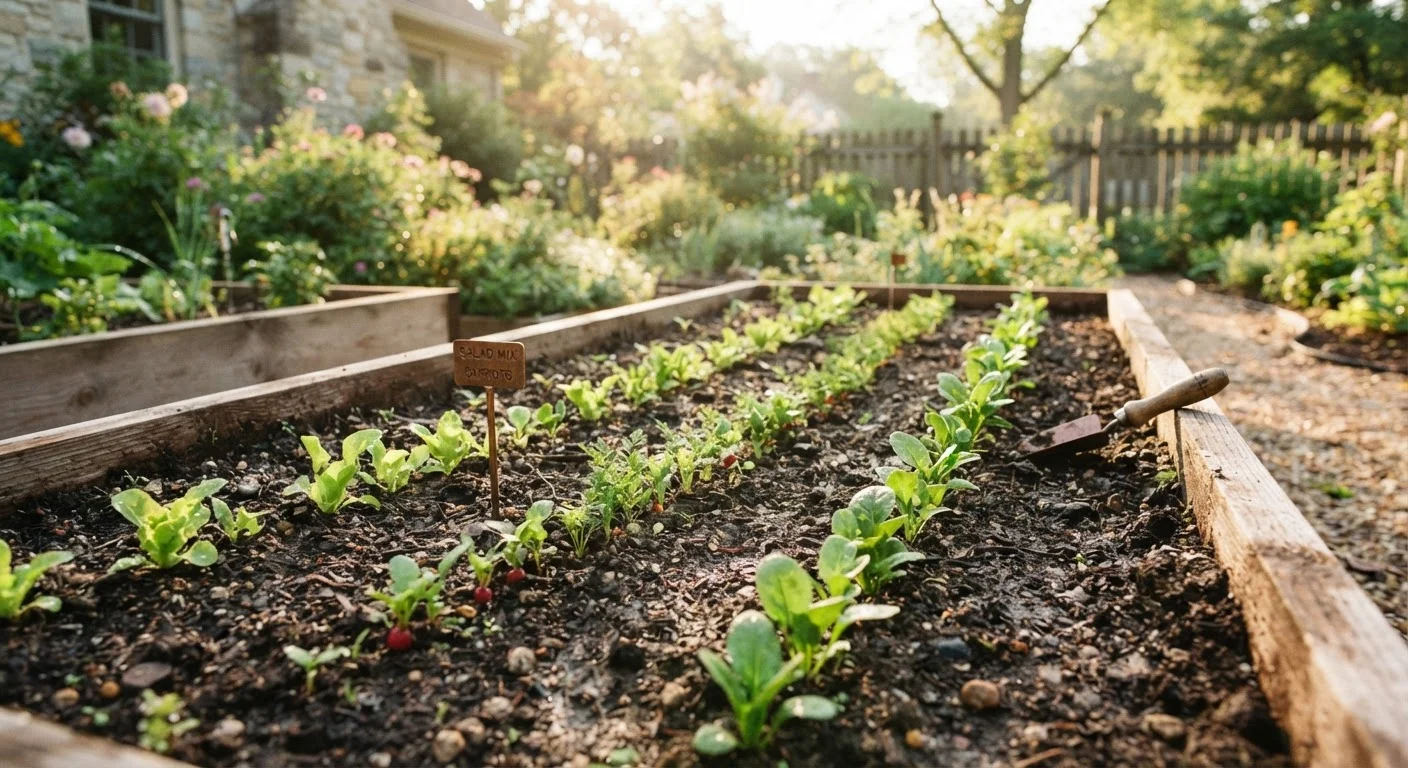
Soil is where most of the real work happens, and where most beginners underinvest. Vegetables are heavy feeders and need soil that does three things: drains excess water quickly, holds enough moisture between waterings, and provides a loose structure that roots can penetrate easily.
Before amending anything, it helps to know what you're working with. A basic soil test - available through many county cooperative extension programs - tells you pH and major nutrient levels. Most vegetables thrive at a pH between 6.0 and 7.0. Adjusting outside that range before planting sets you up for better nutrient uptake without guesswork.
The most universally useful amendment for a first garden is aged compost. Working 2-4 inches of compost into the top 8-10 inches of soil improves drainage in clay soils, adds water retention to sandy ones, and begins feeding the biological ecosystem that makes nutrients available to plants. This is a long-term investment - for more on why soil biology matters beyond year one, see our article on feeding garden soil for long-term health.
If your native soil is heavily compacted or poorly draining, a raised bed gives you much more control over soil quality from day one. Our article on raised beds vs. in-ground planting walks through how to weigh that decision.
Spacing, Size, and Keeping It Manageable
Overcrowding is one of the most predictable beginner mistakes. Seed packets list spacing requirements for a reason: crowded plants compete for water, light, and nutrients, and they create humid conditions that invite disease. A 4×8 foot bed planted thoughtfully will outperform a 10×10 foot bed where plants are jammed together and weeding becomes impossible.
Start with a bed no larger than you can comfortably tend in 30 minutes twice a week. Expansion is easy in future seasons once you've built the habit. Within the bed, respect the spacing on seed packets and transplant labels. If a plant tag says 18 inches apart, that spacing reflects the plant's mature size, not its seedling size.
A layer of organic mulch - straw, shredded leaves, or wood chips - applied around plants helps suppress weeds and retain soil moisture, reducing maintenance demands considerably. Our guide to organic mulch covers how different materials perform in a vegetable garden context.
Don't Let Ambition Outpace Maintenance
A large, neglected garden bed quickly becomes a weed and pest problem that discourages you from continuing. It's far better to succeed with a modest, well-tended 4×8 foot bed than to abandon a 200-square-foot plot by midsummer. Scale up only when your current bed feels genuinely manageable, not overwhelming.
Vegetables Worth Starting With
Choosing the right crops for a first season is a practical decision, not just a preference question. Some vegetables are forgiving of imperfect conditions and provide visible results quickly - both things that keep a new gardener motivated.
- Radishes - germinate in days and mature in 3-4 weeks. Excellent for building confidence.
- Green beans - reliable producers with minimal fuss, especially bush varieties.
- Zucchini - famously productive; one or two plants is usually enough for a family.
- Cherry tomatoes - more forgiving than large slicing types and produce continuously through the season.
- Lettuce and salad greens - fast-maturing and harvestable multiple times by cutting outer leaves.
- Herbs (basil, chives, parsley) - compact, useful in the kitchen, and tolerant of minor neglect.
Pairing certain crops together can also yield real benefits. See our article on companion planting combinations with evidence behind them to learn which pairings are genuinely supported by research.
At season's end, proper garden closedown protects your soil and simplifies next spring's start. Our fall garden closedown checklist covers what to do before the first frost.
Frequently Asked Questions
Most fruiting vegetables - tomatoes, peppers, squash - require a minimum of 6 hours of direct sun per day, and 8 hours is better. Leafy greens and herbs tolerate 4-5 hours but still prefer more. Measuring actual sun exposure at your chosen spot across several days is the most reliable method.
You want loamy soil that drains well but retains moisture - not compacted clay or loose sand. A target pH of 6.0-7.0 suits most vegetables. Adding aged compost is the single most impactful improvement you can make to almost any starting soil.
A 4×8 foot bed is a practical and manageable starting size for most families. It's large enough to grow several crops and small enough to maintain without feeling like a second job. You can always expand in future seasons once you've established your routine.
A basic soil test is genuinely useful and not expensive. It tells you your soil's pH and nutrient levels so you can address deficiencies before planting rather than troubleshoot problems after. Many cooperative extension offices offer affordable testing through local programs.
Radishes, green beans, zucchini, lettuce, and cherry tomatoes are widely considered beginner-friendly because they grow relatively quickly, tolerate minor mistakes, and produce visible results that keep you motivated. Herbs like basil and chives are also very forgiving.
Absolutely. Containers, vertical planters, and compact raised beds can produce meaningful harvests even on a patio or balcony. See our guide on <a href="/home-garden/garden-outdoors/growing-food-in-small-spaces-containers-vertical-beds-and-balconies">growing food in small spaces</a> for specific strategies.
The content provided on our blog site traverses numerous categories, offering readers valuable and practical information. Readers can use the editorial team’s research and data to gain more insights into their topics of interest. However, they are requested not to treat the articles as conclusive. The website team cannot be held responsible for differences in data or inaccuracies found across other platforms. Please also note that the site might also miss out on various schemes and offers available that the readers may find more beneficial than the ones we cover.