

Our Verdict
Feature-rich products aren't inherently bad, but a bloated spec list is a reliable signal that marketing priorities may be overriding genuine engineering value. For most buyers, a focused product that executes core functions well will outperform a loaded alternative in daily use and long-term reliability. Approach every extended feature list as a question, not a selling point.
Shoppers who want to cut through spec-sheet noise and allocate their budget toward performance that actually matters for their household's real-world needs.
What Feature Creep Actually Means for Shoppers
Feature creep - the steady accumulation of extras onto a product beyond what its core purpose requires - is a well-documented pattern in product development. In consumer electronics, appliances, vehicles, and software, it often emerges when manufacturers face competitive pressure but lack meaningful performance advantages to advertise.
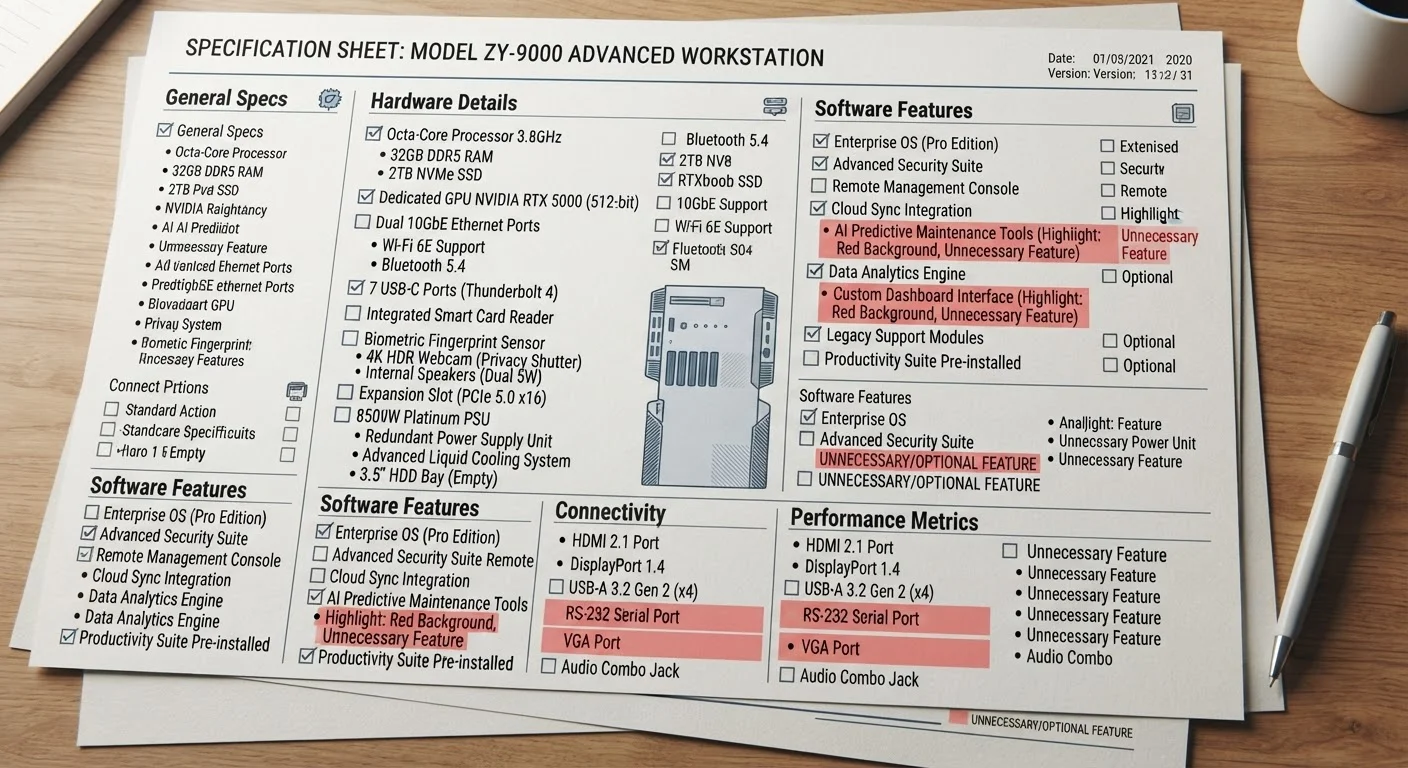
The result: spec sheets grow longer each product cycle, but the additions frequently address problems few buyers actually have. A blender with twelve speed settings, a thermostat with voice-activated aromatherapy integration, a car trim level bundling heated rear seats with a panoramic sunroof as a single package you can't split - these are classic examples. The features exist, but whether they deliver value depends entirely on whether you'd use them.
For families working within a budget, this matters directly. Every bundled feature you won't use represents money redirected away from the core quality you're actually buying. Understanding how spec sheets are structured is the first step toward separating substance from padding.
The Case for Extended Feature Lists
Occasional features address genuine, underserved needs
Some additions - such as improved accessibility controls or energy-saving modes - solve real problems for specific users and represent legitimate value when they align with your actual requirements.
Broader feature sets can future-proof a purchase
In some categories, having capabilities you don't need today may reduce the need to upgrade sooner, provided the core product quality is not compromised to accommodate them.
Bundled features occasionally produce net savings
If multiple features you genuinely need are packaged together at a lower combined cost than purchasing them separately, the bundle can represent real efficiency - though this requires careful per-feature cost analysis.
Extended lists can simplify initial shortlisting
A detailed spec sheet, even an inflated one, gives shoppers more data points to work with when building a comparison framework - provided the data is interpreted critically rather than accepted at face value.
It's worth acknowledging that some feature expansion reflects genuine innovation. When a feature solves a real problem - better energy efficiency, meaningful safety improvements, or accessibility accommodations - a longer list can signal genuine progress. The honest question is whether the additions in front of you fall into that category or are there to fill a marketing checklist.
Why More Features Often Signals Less Value
Extra features inflate price without proportional value
Each addition, whether you use it or not, contributes to the retail price. Buyers effectively subsidize features they'll never activate, reducing the value they receive per dollar spent.
Longer lists obscure meaningful performance comparisons
When two products differ primarily in feature count rather than core performance, it becomes harder to evaluate which is actually better at its primary job - which is usually what matters most.
Complexity increases failure points and maintenance burden
More components and software integrations mean more potential points of failure. Products with high feature counts can carry greater long-term maintenance risk, particularly in electronics and appliances.
Bundling forces payment for unwanted additions
Feature tiers typically bundle items together, preventing buyers from paying only for what they need. This structure benefits manufacturers more than consumers by making targeted purchasing difficult.
Feature-heavy products can signal weak core performance
When a manufacturer cannot demonstrate meaningful improvements in a product's primary function, adding peripheral features is a lower-cost strategy to justify pricing - a pattern worth treating with skepticism.
Extra features complicate long-term comparisons and resale
Unique or proprietary features that seemed appealing at purchase can become liabilities if they require specific accessories, software updates, or ecosystem lock-in that limits flexibility later.
The core problem with feature creep isn't the features themselves - it's the incentive structure behind them. When a manufacturer can't meaningfully improve core performance, adding features is a lower-cost way to justify a price increase or create the appearance of differentiation. Marketers rely on this tactic because most shoppers unconsciously equate longer lists with higher value.
~30%
Software features rarely or never used by typical users
Research cited by the Standish Group on software development has long found that a substantial share of product features go largely unused - a pattern consumer product researchers have observed in hardware categories as well.
3 in 5
Shoppers who equate more features with higher quality
Consumer behavior studies consistently find that a majority of shoppers use feature count as a quality proxy, even when the additional features are unrelated to the product's core function.
The practical consequence for household budgets is real. Paying a premium for a feature tier that bundles three things you want with four you don't is a common and avoidable spending leak - one that compounds across categories. A similar dynamic plays out with subscriptions, where unused tiers quietly drain budgets over time.
A Framework for Filtering Feature Lists Honestly
Rather than reacting to a spec list as presented, apply a consistent filter before comparing products:
- List your actual use cases first. Write down specifically how you'll use the product - before looking at any spec sheet. This becomes your evaluation benchmark.
- Categorize each feature. For every item on a spec list, ask: Does this directly serve a use case I identified? Features that don't map to your list are candidates for elimination from consideration.
- Check whether features are bundled or optional. If a feature tier forces you to buy five additions to get the two you want, calculate the effective cost of each feature you'll actually use.
- Look for what's missing, not what's listed. Spec sheets are designed to highlight additions and obscure omissions. A structured pre-comparison checklist helps you ask the right questions before the marketing framing takes hold.
Feature Tiers Vary by Product Category
The impact of feature creep differs across categories. In safety-critical products - car seats, smoke detectors, medical devices - additional features may carry genuine importance and warrant closer scrutiny rather than dismissal. In consumer electronics and appliances, the pattern of marketing-driven feature expansion tends to be most pronounced. Adjust your skepticism to the category and the stakes involved.
This approach is especially useful for household budget planning, where a consistent evaluation method prevents one-off decisions from eroding financial goals across repeated purchases.
Putting It Into Practice
Feature creep is easiest to spot when you compare two products side by side with your use-case list in hand. Common shortcuts like star ratings or brand reputation won't reveal it - you need a deliberate framework applied before you engage with marketing materials.
When a product's spec list is meaningfully longer than a comparable alternative, treat it as a prompt to investigate rather than evidence of superiority. Ask who benefits from each extra feature, whether it's available separately or only bundled, and whether its presence explains a price difference that would otherwise be hard to justify.
Reading the fine print before committing often reveals whether those extras come with their own costs - extended setup requirements, compatibility limits, or subscription-based activation - that further dilute their value.
The content provided on our blog site traverses numerous categories, offering readers valuable and practical information. Readers can use the editorial team’s research and data to gain more insights into their topics of interest. However, they are requested not to treat the articles as conclusive. The website team cannot be held responsible for differences in data or inaccuracies found across other platforms. Please also note that the site might also miss out on various schemes and offers available that the readers may find more beneficial than the ones we cover.