

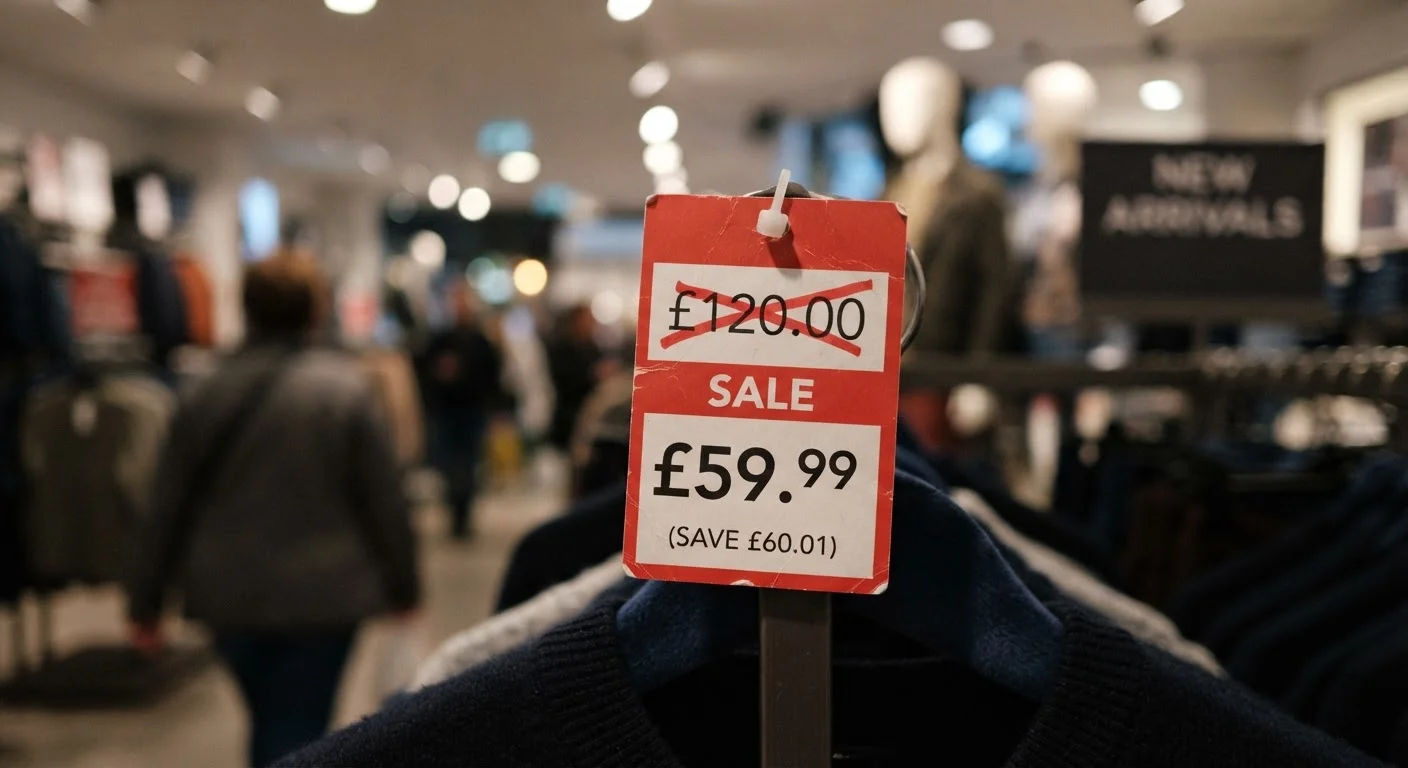
Why Your Brain Can't Ignore the First Number It Sees
Before you consciously decide whether a price is fair, your brain has already used the first number it encountered as a measuring stick. This isn't a flaw in less-informed shoppers - it's a deeply wired cognitive shortcut that affects everyone, including people who study behavioral economics for a living.
The mechanism is straightforward: when you face uncertainty (and "is this a good price?" is always a form of uncertainty), your mind looks for a nearby reference point to reduce cognitive load. Whatever number appeared first - the crossed-out price, the "regular" rate, the competitor figure shown in a comparison ad - gets treated as relevant information even when it isn't. From that point, your judgment adjusts relative to the anchor rather than evaluating the price on independent grounds.
This is why a $180 item marked down from $300 can feel like a deal, while the same $180 item on a plain shelf - with no reference price - feels expensive. The product is identical. Only the framing changed. Your sense of value shifted without your awareness or consent.
“The mind does not evaluate options in isolation. It evaluates them relative to a reference point - and whoever sets that reference point holds enormous power over the outcome.”
— Daniel Kahneman, Nobel laureate in Economic Sciences and author of research on cognitive bias and decision-making
How Retailers Deliberately Set Anchors
Anchoring isn't accidental in retail environments - it's architectural. The "was" price displayed alongside a sale price is the most common form, but the strategy runs deeper than a single tag.
- Decoy pricing: A premium option is placed next to a mid-range option specifically to make the mid-range feel reasonable by comparison - even if it's priced above what you'd otherwise accept.
- Opening offers and quotes: In negotiated purchases - vehicles, home services, large appliances - an initial high quote anchors the conversation so that any lower counteroffer feels like a win, regardless of actual market rates.
- "Starting at" language: A low entry price anchors your expectation of affordability, even when the item you actually need costs significantly more.
Recognizing these as deliberate design choices - not neutral information - is the first step toward evaluating prices on your own terms. For a broader look at how comparisons get skewed before you've noticed, see how marketers frame product comparisons.
~60%
Consumers who rarely verify "original" prices independently
Consumer research from behavioral economics studies consistently finds that a majority of shoppers accept displayed reference prices without checking whether those prices were ever widely charged.
10-30%
Typical overpayment attributable to anchor-influenced decisions
Behavioral economists estimate that anchoring effects in negotiated and retail purchases can lead buyers to pay meaningfully more than independently established market rates would suggest is fair.
Practical Strategies to Counter Anchoring
Because awareness alone doesn't neutralize anchoring, the most effective countermeasures involve changing your process, not just your mindset.
Set your own anchor first
Before entering any retail environment - physical or digital - research what the item typically costs across neutral sources. Write that number down. This gives your brain a reference point it generated independently, which competes with the retailer's anchor rather than surrendering to it.
Ignore the "original" price and evaluate the current price directly
Ask one question: Is this price, on its own merits, acceptable for what I'm getting? Cover the crossed-out figure if you have to. You're evaluating a transaction, not a discount.
Use a pre-comparison checklist
Before comparing any two options, clarify your actual requirements. Asking the right questions before comparing keeps you anchored to your needs instead of a seller's chosen starting point.
Slow down on big purchases
Anchoring is most powerful under time pressure and emotional engagement - exactly the conditions retailers try to create. A mandatory waiting period between seeing a price and making a decision lets the anchor's pull weaken. This is especially relevant for purchases that can quietly cost more over time; routine shopping habits that lead to overpaying often trace back to anchored snap judgments made without that pause.
Build Your Reference Price Before You Shop
Spend five minutes looking up the item's typical price range using neutral, non-retail sources before you visit a store or open a product page. Jot the number down. That figure becomes your personal anchor - one that reflects actual market conditions rather than a number a retailer chose to display first. This single habit is the most effective practical defense against anchoring in everyday purchasing decisions.
This article provides general consumer education and is not a substitute for professional financial advice. Consult a qualified financial professional for guidance specific to your situation.
Frequently Asked Questions
Anchoring bias occurs when the first price you encounter - often a retailer's "original" or "regular" price - becomes the mental benchmark you use to judge whether a deal is good. Even if that initial number is arbitrary or inflated, it skews your perception of value for every price you see afterward.
Awareness helps, but research consistently shows it does not eliminate the effect. Anchoring is largely automatic. The most reliable protection comes from establishing an independent reference price before entering a retail environment, not from simply trying to ignore the anchor.
Not always, but they deserve scrutiny. A legitimate original price reflects what the item actually sold for in the recent past. Many consumer protection frameworks require that advertised "before" prices be genuine - but enforcement varies. When in doubt, research the item's price history independently.
Look up the item's typical market price from a neutral source before visiting a store or product page. Write it down. That becomes your personal anchor. When you encounter a retailer's pricing, you can compare it to a number you chose, not one that was chosen for you.
No. Anchoring influences size, quality, and quantity judgments too. A "family-size" label anchors how much you think you should buy; a premium product placed next to a mid-range one anchors your perception of that mid-range item's quality. The mechanism is the same.
Yes. Subscription pricing tiers routinely use anchoring - a prominently displayed expensive plan makes the mid-tier plan feel like a bargain. Service quotes often open high for the same reason. The anchoring mechanism works wherever a first number sets a frame of reference.
The content provided on our blog site traverses numerous categories, offering readers valuable and practical information. Readers can use the editorial team’s research and data to gain more insights into their topics of interest. However, they are requested not to treat the articles as conclusive. The website team cannot be held responsible for differences in data or inaccuracies found across other platforms. Please also note that the site might also miss out on various schemes and offers available that the readers may find more beneficial than the ones we cover.