

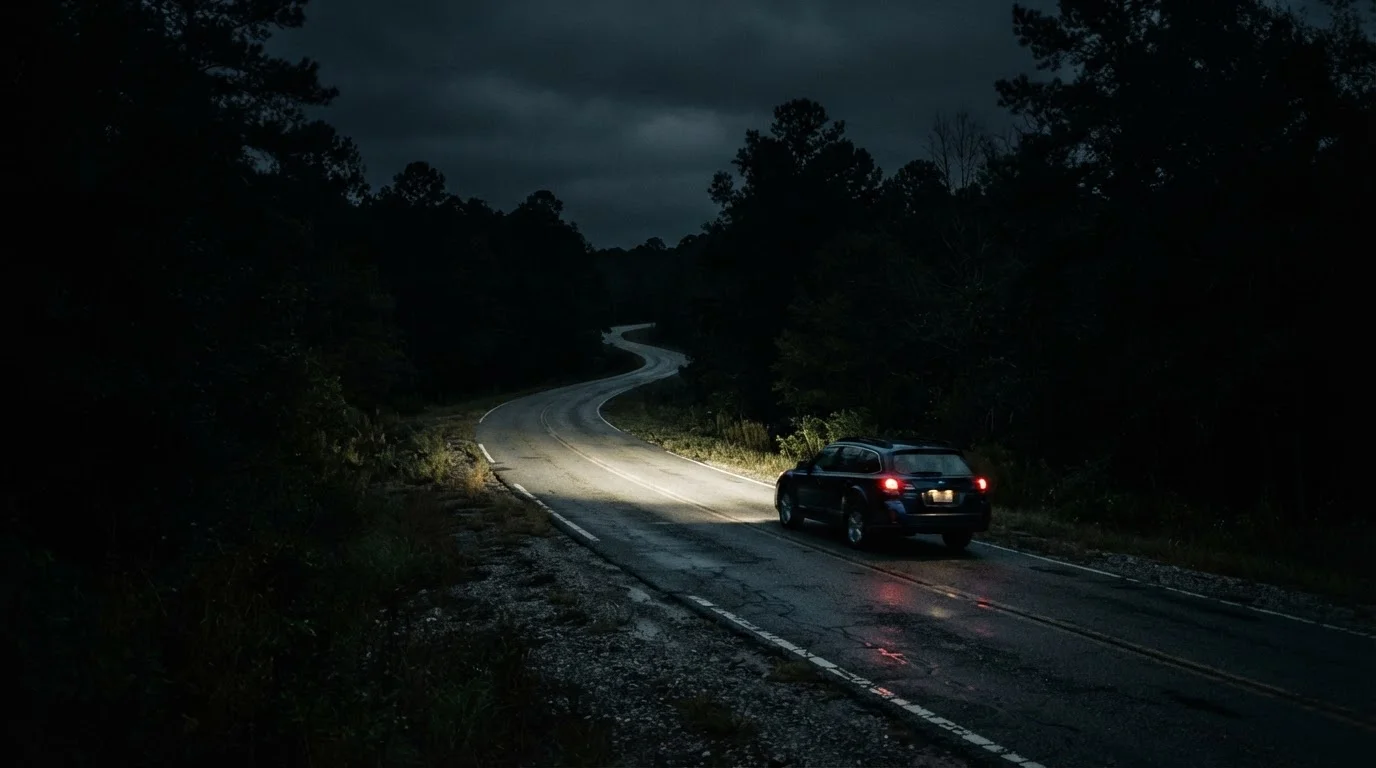
What Changes When the Sun Goes Down
Most drivers recognize that night driving feels different - but few appreciate just how dramatically the visual environment changes. Daylight gives the eye an enormous amount of ambient information: contrast between objects, color cues, peripheral movement, and depth gradients across a wide field. Darkness strips most of that away.
The human eye has two main types of photoreceptors. Cone cells, concentrated at the center of the retina, handle color and sharp detail in bright light. Rod cells, spread across the outer retina, take over in low light but are slower to respond and poor at resolving fine detail. At highway speeds, this shift from cone-dominant to rod-dominant vision means drivers are operating with a fundamentally less precise visual system than they use during the day.
The practical consequence: hazards that would be immediately obvious in daylight - a deer at the roadside, a pedestrian in dark clothing, road debris - may be nearly invisible until a driver is dangerously close. Situational awareness becomes harder to maintain precisely when it matters most.
The Headlight Range Problem
A common misconception is that headlights restore daytime-equivalent visibility. They do not. Standard low-beam headlights on most passenger vehicles illuminate roughly 160 to 250 feet ahead. At 60 mph, a vehicle covers about 88 feet per second. That means a driver has approximately 2-3 seconds to perceive a hazard, react, and begin braking - a margin that shrinks further when reaction time is slowed by fatigue or distraction.
This creates a well-documented phenomenon called overdriving your headlights: traveling at a speed that makes it physically impossible to stop within the distance your headlights illuminate. Many drivers do this routinely on rural roads and highways without realizing it.
~50%
Of traffic deaths occur at night
According to the National Safety Council, roughly half of all traffic fatalities in the U.S. occur during nighttime hours, despite far less traffic volume than daytime.
160-250 ft
Typical low-beam headlight range
Most standard passenger vehicle low beams illuminate only 160 to 250 feet ahead - a distance that is covered in under 3 seconds at 60 mph.
3-7 sec
Time to recover from headlight glare
After exposure to bright oncoming headlights, the eye can take several seconds to readapt to dark conditions, during which hazard detection is significantly impaired.
Depth perception is another casualty of darkness. Humans gauge distance partly through binocular vision and partly through environmental cues - shadows, relative sizes, ground texture. Night removes most of those cues, making it harder to judge how far away another vehicle or obstacle actually is. This matters especially when judging the speed of oncoming traffic or the gap needed to pass safely. For a related look at stopping physics, see how stopping distances are calculated.
Fatigue, Glare, and Compounding Factors
Night driving rarely occurs in isolation from other risk factors. The hours between midnight and 6 a.m. coincide with natural peaks in human sleepiness, driven by the body's circadian rhythm. A driver who feels alert may still be operating with measurably slower reaction times and reduced hazard-detection ability. Drowsy driving is a documented contributor to nighttime crash rates.
Glare from oncoming headlights adds another layer of difficulty. When a bright light source enters the visual field, the eye requires time to readapt to lower light levels - a process called dark adaptation. After a vehicle passes with high beams on, full visual recovery can take several seconds, during which the driver's effective vision is significantly impaired.
Use High Beams Strategically on Open Roads
On unlit rural highways with no oncoming traffic, switching to high beams can extend your visual range to 350-500 feet - more than doubling your reaction window. Return to low beams promptly when another vehicle approaches, both for legal compliance and to avoid impairing the other driver's vision. Develop the habit of toggling beams as a routine part of night driving rather than leaving it to chance.
Wet roads at night combine the challenges of both environments. Reflective glare from wet pavement can obscure lane markings and create misleading light patterns. Drivers who have developed good habits for rainy weather driving are better positioned to handle this combination, but nighttime rain still demands extra caution beyond either condition alone.
Practical Adjustments That Make a Difference
Because visibility is genuinely reduced after dark, the most effective compensating strategy is to increase the margin for error. That means reducing speed below the posted limit when visibility is poor - not as timidity, but as a rational response to a smaller visual window. It also means increasing following distance. The two-second rule used in daylight conditions is generally insufficient at night; extending to three or four seconds gives more time to detect brake lights and respond. For more on following distance, see why tailgating is more dangerous than most drivers assume.
Keeping headlights clean and properly aimed is another practical step that is frequently overlooked. Foggy or yellowed headlight lenses can reduce light output substantially. Many service stations and repair shops can inspect headlight aim, which shifts over time and may direct light poorly even when the bulbs themselves are functioning.
Finally, being honest about fatigue is critical. If drowsiness is present, pulling over in a safe, well-lit location is always the appropriate response. No driving schedule is worth the risk of falling asleep at the wheel.
This article is for general informational purposes. Always follow posted speed limits and traffic laws, and consult a qualified mechanic for vehicle safety inspections.
Frequently Asked Questions
Darkness dramatically reduces the visual information available to drivers. Headlights illuminate only a fraction of the road compared to daylight, and the eye's night-vision system is slower and less precise than its daytime counterpart. Fatigue, glare, and reduced depth perception compound the risk.
Overdriving your headlights means traveling at a speed fast enough that you cannot stop within the distance your headlights illuminate. If your low beams light up 200 feet ahead and you need 250 feet to stop at your current speed, you are effectively driving blind into that gap.
Keep headlight lenses clean and ensure they are properly aimed. Use high beams on open, unlit roads when no oncoming traffic is present. Reduce speed to match your actual sight distance, and increase following distance to give yourself more reaction time.
Yes. As people age, the eye's pupil becomes less able to dilate fully in darkness, reducing available light for vision. Contrast sensitivity also tends to decline. Older drivers may need to take extra precautions and consult an eye care professional if night driving becomes difficult.
Recovery from bright oncoming headlights can take anywhere from a few seconds to as long as seven seconds depending on the intensity of the light and the individual's eyes. During this period, the ability to detect road hazards is meaningfully impaired, which is why maintaining a safe speed and following distance matters.
Not necessarily. An empty road does not eliminate hazards - animals, debris, and pedestrians can appear within or beyond your headlight range. Speed determines how much time you have to react, and that margin is already reduced at night. Driving at or below the speed limit is generally prudent in low-light conditions.
The content provided on our blog site traverses numerous categories, offering readers valuable and practical information. Readers can use the editorial team’s research and data to gain more insights into their topics of interest. However, they are requested not to treat the articles as conclusive. The website team cannot be held responsible for differences in data or inaccuracies found across other platforms. Please also note that the site might also miss out on various schemes and offers available that the readers may find more beneficial than the ones we cover.