

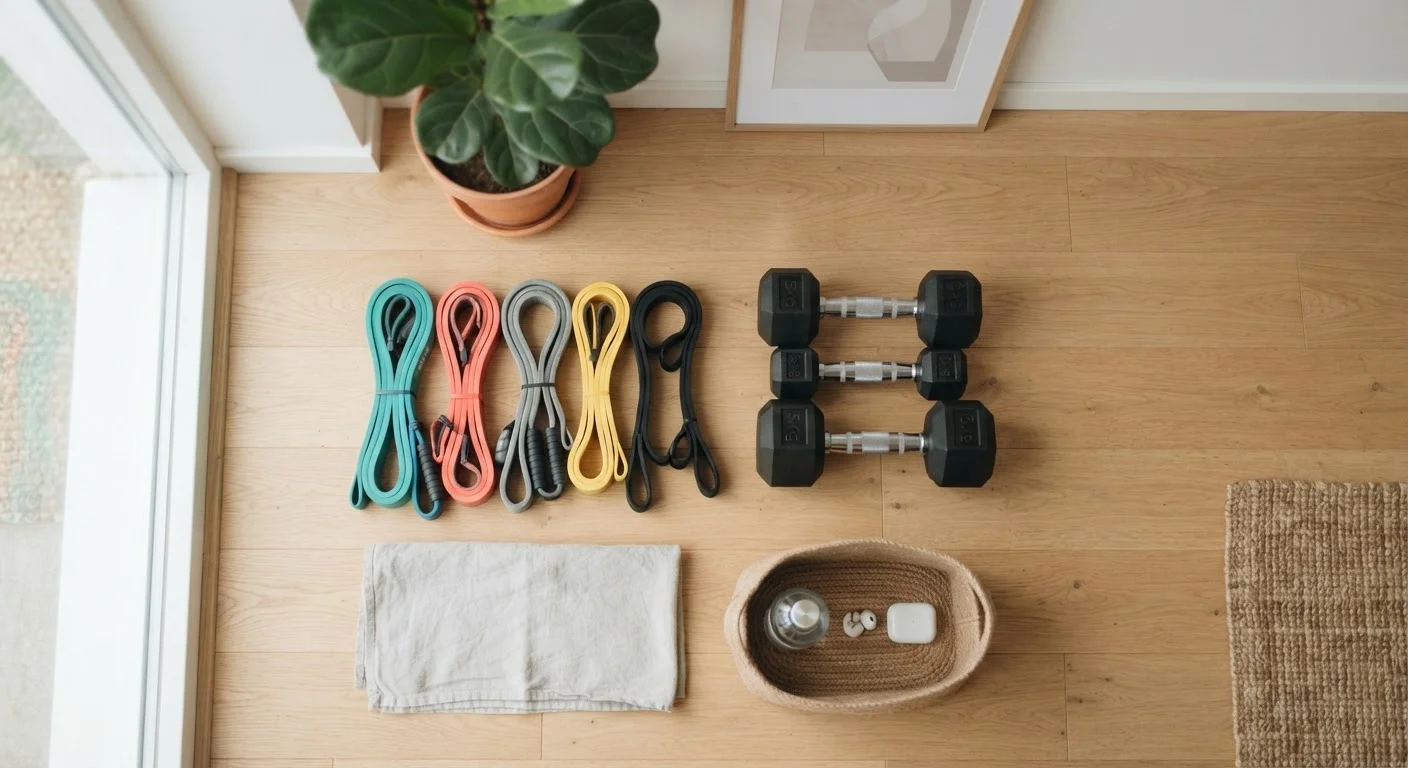
Option A
Resistance Bands
The portable, budget-friendly option for flexible strength training.
Best for: Families with limited storage, tight budgets, or beginners building foundational strength and mobility.
Option B
Dumbbells
The time-tested, precise tool for progressive strength development.
Best for: Households ready to invest in consistent, measurable strength gains across all fitness levels.
Cost and Storage: The Practical Realities
For most US families, the first question isn't about muscle fiber recruitment - it's about budget and square footage. Resistance bands win decisively on both counts. A set covering light to heavy resistance typically runs between $15 and $50 and fits into a small bag or drawer. A comparable dumbbell set - spanning enough weight to challenge beginners through intermediate lifters - can cost several hundred dollars and requires dedicated floor or rack space.
That said, dumbbells are a one-time purchase that rarely degrades. Quality bands, particularly loop-style latex bands, can snap with age or heavy use and need periodic replacement. If you're setting up a home workout space on a tight budget, bands offer a genuinely low barrier to entry. Adjustable dumbbells - which consolidate multiple weight settings into one compact unit - narrow the space gap considerably but typically carry a higher upfront cost.
| Criterion | Resistance Bands | Dumbbells |
|---|---|---|
| Typical entry cost | $15-$50 for a full set | $50-$300+ for a usable set |
| Storage space required | Minimal - fits in a bag | Moderate to significant floor space |
| Progressive overload precision | Approximate; hard to quantify | Precise fixed weight increments |
| Portability | Highly portable, travel-friendly | Heavy, not travel-friendly |
| Durability | Bands degrade and may snap over time | Long-lasting with minimal maintenance |
| Injury/rehabilitation suitability | Commonly used in rehab settings | Requires more caution for injuries |
| Suitability for experienced lifters | Limited at very high strength levels | Well-suited to advanced training |
Effectiveness for Building Strength
Both resistance bands and dumbbells can stimulate meaningful strength gains. The underlying principle - applying sufficient tension to muscles to drive adaptation - works with either tool. The difference lies in how resistance is delivered. Dumbbells provide constant, gravity-dependent load throughout a movement. Bands provide variable resistance: tension is lowest at the start of a movement and increases as the band stretches. This can make the peak contraction phase more challenging, which some research suggests may benefit certain muscle groups.
Where dumbbells hold a clear advantage is in progressive overload - the practice of gradually increasing training demand over time, which is foundational to long-term strength development. With dumbbells, moving from 15 lb to 20 lb is straightforward and measurable. With bands, resistance increments are less precise and harder to quantify. For a deeper look at how this plays out without any equipment at all, see why bodyweight training can be highly effective.
~$30
Average cost of a resistance band set
Consumer fitness product surveys consistently place entry-level resistance band sets well below $50, making them accessible for most household budgets.
2x
Approximate storage footprint difference
A full resistance band set can occupy as little as a single drawer, compared to the dedicated rack or floor space typically needed for an equivalent dumbbell range.
Similar
Strength gains vs. free weights (beginner level)
Exercise science literature broadly indicates that resistance bands can produce comparable strength adaptations to free weights for novice trainees when applied with consistent effort and progression.
Versatility, Safety, and Who Each Tool Suits
Resistance bands offer a wider functional range in some respects: they can be anchored to doors, used for mobility and stretching drills, and adapted for rehabilitation exercises. They're also inherently safer for unsupervised home use - there's no risk of dropping a heavy load on a foot or a floor. This matters when children are present or when training space is shared with living areas.
Dumbbells, by contrast, deliver reliable, sport-specific strength patterns and are straightforward to incorporate into well-established workout programming. They suit households where at least one adult has prior training experience and wants a structured, consistent routine. Families exploring home fitness for the first time may find common exercise misconceptions worth addressing before committing to either tool.
It's also worth noting that neither piece of equipment is inherently superior - consistent use with good technique matters far more than the tool itself. If you're new to strength training terminology, a quick reference to common home workout terms can help you navigate workout guides confidently.
This article is for general informational purposes only and does not constitute medical or fitness advice. Consult a qualified healthcare or fitness professional before beginning any new exercise program, particularly if you have existing health conditions or injuries.
The content provided on our blog site traverses numerous categories, offering readers valuable and practical information. Readers can use the editorial team’s research and data to gain more insights into their topics of interest. However, they are requested not to treat the articles as conclusive. The website team cannot be held responsible for differences in data or inaccuracies found across other platforms. Please also note that the site might also miss out on various schemes and offers available that the readers may find more beneficial than the ones we cover.