

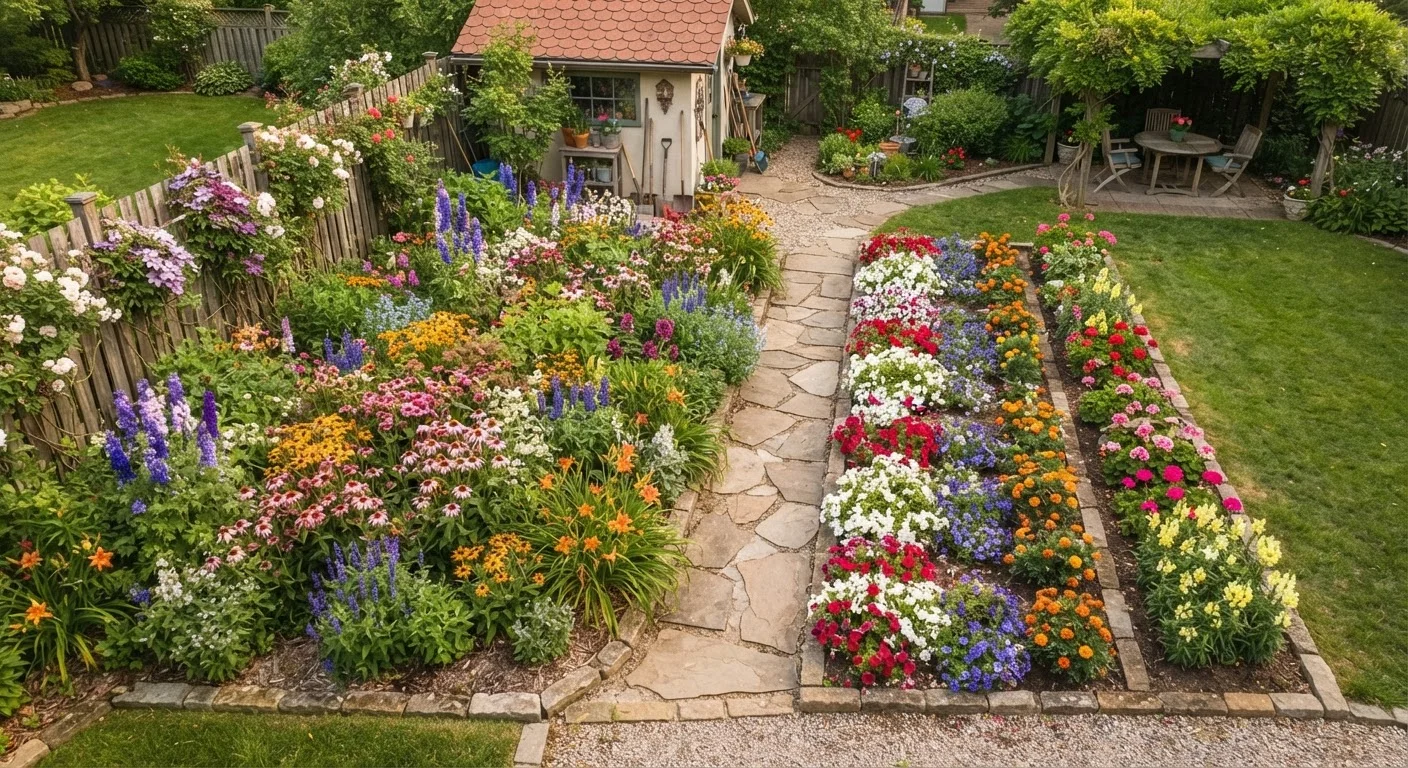
Option A
Perennials
The long-game investment that compounds over seasons.
Best for: Homeowners seeking a lower-maintenance, lower-cost-per-year garden that fills in and expands on its own over time.
Option B
Annuals
The flexible, high-impact choice that resets every year.
Best for: Gardeners who want bold, season-long color, enjoy experimenting with new varieties, or tend spaces like containers and rental properties.
Understanding the Core Difference
The simplest way to distinguish these two plant categories: perennials are plants whose roots survive winter and regrow each spring, while annuals complete their entire life cycle - germination, bloom, seed-set, and death - within a single growing season.
That biological distinction drives almost every practical difference in cost, maintenance, and garden design. Perennials are a multi-year commitment; annuals are a renewable seasonal decision. Neither is inherently superior - the right choice depends on your budget, property situation, and how much flexibility you want from year to year.
It's worth knowing that some plants sold as annuals in colder climates are actually perennials in their native warmer regions. Impatiens and petunias, for example, behave as annuals in most of the US but would persist in frost-free zones. Your USDA Hardiness Zone shapes which plants fall into each category for your specific garden.
What About Biennials?
A third, less-discussed category - biennials - completes its life cycle over two years, typically producing foliage in year one and flowers in year two before dying. Common examples include foxglove and hollyhock. Biennials are often treated as short-lived perennials in garden planning and can self-seed reliably enough to feel like permanent fixtures in a bed.
The Financial Picture: Upfront Cost vs. Long-Term Value
Annuals typically cost less per plant at purchase - seedling trays are often modestly priced - but those costs recur every single spring. Over a five-year span, a garden bed stocked entirely with annuals can cost two to three times more cumulatively than the same bed planted with perennials, once the perennials have filled in.
Perennials carry a higher initial price tag per plant, and most take two to three seasons to reach their full size and flowering potential. This is sometimes called the "sleep, creep, leap" rule among gardeners: year one the plant sleeps (establishes roots), year two it creeps (modest growth), and year three it leaps (full performance). Budget planning should account for this lag.
2-3×
Cumulative cost of all-annual beds over 5 years
Garden economists and extension programs generally estimate that annual-only beds cost significantly more over a multi-year period compared to perennial-dominant plantings once establishment is complete.
3 years
Typical perennial establishment window
Most perennial reference guides, including those from university cooperative extension services, describe a three-year arc before perennials reach their full size and flowering potential.
The compounding value of perennials also includes division - many varieties can be split every few years and replanted elsewhere in your garden or shared with neighbors, effectively multiplying your original investment for free. This is one of the more underappreciated financial upsides of going perennial-heavy.
For families watching household spending, building a garden budget that accounts for both the establishment phase and long-term maintenance costs is the clearest path to avoiding sticker shock in year one.
Head-to-Head: Comparing What Actually Matters
Both plant types reward you in different ways depending on what you prioritize. The comparison below covers the dimensions most relevant to home gardeners making a real-world planting decision.
| Criterion | Perennials | Annuals |
|---|---|---|
| Upfront cost per plant | Higher | Lower |
| Recurring seasonal cost | None after establishment | Repurchased every year |
| Time to peak performance | 2-3 seasons | Same season |
| Bloom duration per season | Typically 4-8 weeks | Often all season long |
| Design flexibility | Fixed placement, slow to move | Fully flexible each spring |
| Maintenance intensity | Low after establishment | Moderate; replanting required |
| Self-propagation potential | Divisible; expands over time | Self-seeds in some varieties |
| Best suited for | Owned, long-term properties | Rentals, containers, quick impact |
One area where both plant types are equally impacted: soil quality. Healthy, biologically active soil reduces fertilizer needs, improves water retention, and supports stronger root systems for both annuals and perennials. Investing in soil health is arguably the highest-return garden expense regardless of which plant strategy you choose.
Building a Blended Strategy That Works
The most cost-effective and visually satisfying gardens typically don't choose sides. A practical approach: use perennials as the structural backbone of your beds - plants that define the space, return reliably, and expand over time - then use annuals to fill gaps, extend color into periods when perennials aren't blooming, and add design variety from season to season.
For example, a border of coneflowers (Echinacea) and black-eyed Susans provides mid-summer color that returns reliably. Filling early-season gaps with cool-weather annuals like pansies, and late-season gaps with marigolds, gives you near-continuous visual interest without the full cost of annual-only planting.
If you're working with containers or a balcony garden, annuals tend to be more practical since container perennials require winter protection to survive. Small-space gardeners in particular often find annuals the more sensible default in confined or portable setups.
As the growing season ends, protecting your perennial investment is just as important as the initial planting. See our fall garden closedown checklist for steps to winterize roots, amend soil, and set your beds up for a strong spring return.
The content provided on our blog site traverses numerous categories, offering readers valuable and practical information. Readers can use the editorial team’s research and data to gain more insights into their topics of interest. However, they are requested not to treat the articles as conclusive. The website team cannot be held responsible for differences in data or inaccuracies found across other platforms. Please also note that the site might also miss out on various schemes and offers available that the readers may find more beneficial than the ones we cover.