

Option A
Fiberglass Batt Insulation
The accessible, time-tested workhorse of residential insulation.
Best for: Homeowners insulating standard stud-framed walls, attic floors, or crawl spaces on a tighter budget.
Option B
Spray Foam Insulation
The high-performance, air-sealing solution for complex or demanding spaces.
Best for: Homes with irregular cavities, significant air leakage problems, or areas where moisture control is a priority.
How Each Material Actually Works
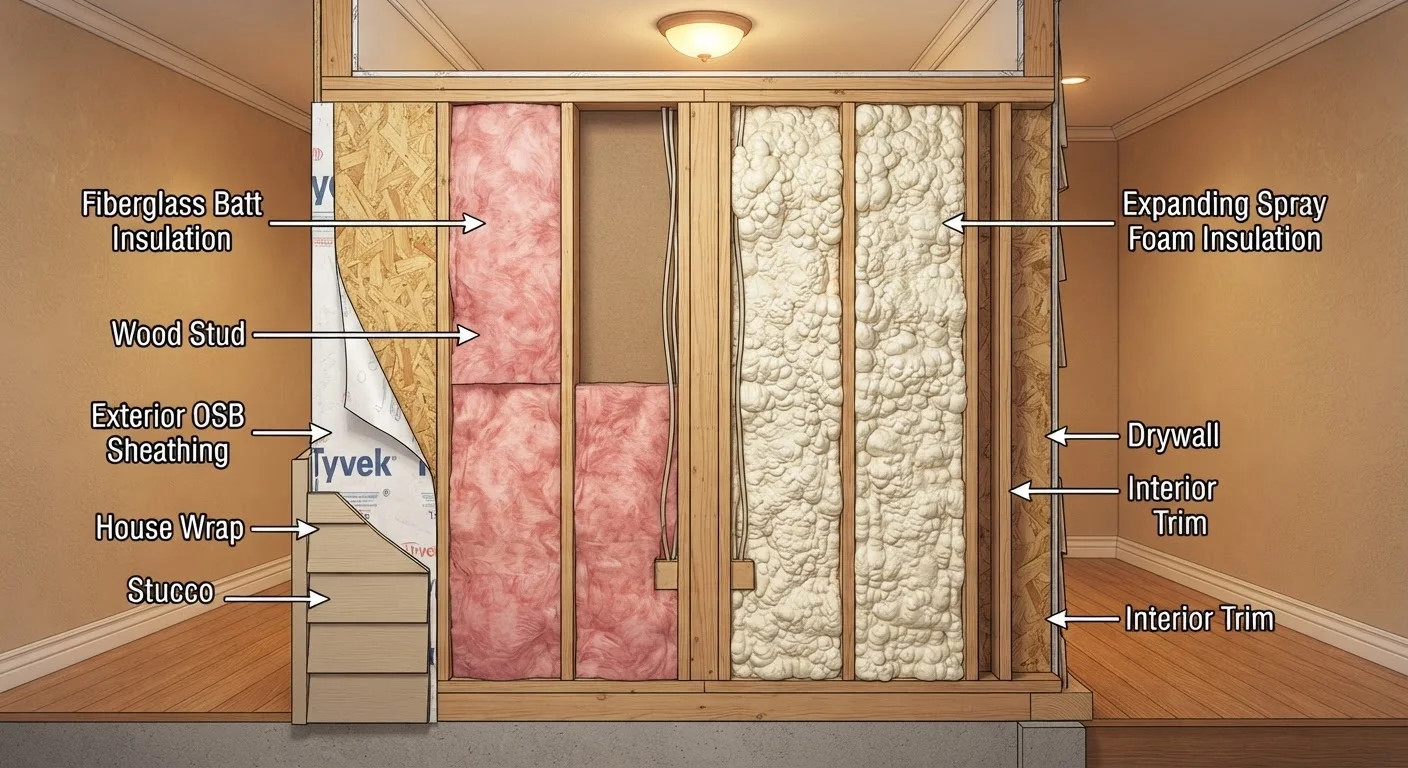
Understanding what separates these two insulation types starts with how they slow heat transfer. Fiberglass batt insulation is composed of tightly woven glass fibers that trap pockets of still air. That trapped air resists the movement of heat - a process called conductive and convective heat transfer. Batts are manufactured in standard widths to fit snugly between wall studs or floor joists.
Spray foam insulation works differently. A two-part chemical mixture is applied as a liquid that expands rapidly and hardens in place. It comes in two main varieties: open-cell foam, which is softer and more vapor-permeable, and closed-cell foam, which is rigid, denser, and far more resistant to moisture and air movement.
The key distinction is that fiberglass resists heat transfer through the material itself but does not stop air from moving around or through it if improperly installed. Spray foam, particularly closed-cell, functions as both an insulator and an air barrier simultaneously. For homes where air leakage is a major energy drain, that dual function matters considerably. See our guide to sealing gaps to understand how insulation fits within a broader air-sealing strategy.
| Criterion | Fiberglass Batt | Spray Foam |
|---|---|---|
| Typical R-value per inch | ~R-3.1 to R-3.8 | Open-cell ~R-3.7; Closed-cell ~R-6.0-6.5 |
| Air sealing capability | None on its own | Excellent (especially closed-cell) |
| Relative upfront cost | Lower | Significantly higher |
| DIY-friendliness | Accessible with basic PPE | Typically requires professional installer |
| Moisture resistance | Can absorb moisture if exposed | Closed-cell resists moisture well |
| Best application | Standard framed cavities, attic floors | Rim joists, irregular cavities, air-leaky areas |
| Environmental considerations | Recycled glass content; lower embodied energy | Blowing agents have climate impact (varies by product) |
Cost, Installation, and Practical Realities
Fiberglass batts are among the most affordable insulation materials available. Material costs are relatively low, and installation is within reach of careful DIYers comfortable working in confined spaces. Safety precautions - gloves, eye protection, and an N95 respirator - are essential since glass fibers are irritating to skin and lungs. That said, improper installation, such as compressing the batts or leaving gaps around obstructions, meaningfully reduces performance.
Spray foam carries a substantially higher price tag, both for materials and labor. Because the two-part chemical components require precise mixing ratios, temperature controls, and appropriate protective equipment, professional installation is strongly recommended and often required by local codes for certain applications. Homeowners should obtain multiple quotes and verify that installers are licensed and experienced. The higher upfront cost can offset over time through energy savings, but this outcome varies by home, climate, and how well the rest of the building envelope performs.
15-25%
Estimated heating/cooling energy lost to air leakage
The U.S. Department of Energy estimates that air infiltration accounts for roughly 15-25% of heating and cooling energy loss in typical homes.
~3×
Cost difference: spray foam vs. fiberglass per square foot
Industry cost guides generally show spray foam installation running two to three times more per square foot than fiberglass batts, though regional labor rates vary widely.
For a full picture of what an attic insulation project typically involves - including permits and ventilation considerations - the attic insulation process overview lays out the scope clearly.
Choosing Based on Location and Climate
No single insulation material is the right answer for every part of a home or every climate zone. Fiberglass batts perform reliably in attic floors, interior walls, and floor assemblies over unconditioned crawl spaces - provided the surrounding framing creates a well-defined cavity. They are less suited to irregular spaces, around pipes or wiring, or in locations where air movement is difficult to control with separate sealing measures.
Spray foam excels in areas where batts struggle: rim joists (the framing member at the top of your foundation wall), cathedral ceilings with limited rafter depth, and any cavity with unusual geometry. Closed-cell foam also adds structural rigidity, which some contractors note as a benefit in storm-prone regions, though this should be discussed with a licensed structural professional before relying on it as a design factor.
In very cold climates, vapor management becomes critical. Closed-cell spray foam acts as a vapor retarder, which can be advantageous - but the placement within a wall assembly must account for your climate zone's moisture dynamics. Installing the wrong vapor profile can trap moisture and encourage mold growth. Local building codes exist for exactly this reason; always verify what your jurisdiction requires before starting any insulation project.
Families looking for lower-lift ways to improve energy performance alongside insulation decisions may find practical starting points in weekend energy-saving fixes worth reviewing first. And if assumptions about insulation are shaping your decision, it's worth reading about common insulation myths before committing to a plan.
The content provided on our blog site traverses numerous categories, offering readers valuable and practical information. Readers can use the editorial team’s research and data to gain more insights into their topics of interest. However, they are requested not to treat the articles as conclusive. The website team cannot be held responsible for differences in data or inaccuracies found across other platforms. Please also note that the site might also miss out on various schemes and offers available that the readers may find more beneficial than the ones we cover.