

Our Verdict
Caulk excels at sealing fixed, static joints along baseboards, window frames, and where walls meet ceilings. Weatherstripping is the right tool for any gap that opens and closes with a door or operable window. For larger voids or complex penetrations, expanding foam or backer rods bridge the gap. Matching the right product to the right location makes the repair last and genuinely reduces energy loss.
| Best for | Recommended |
|---|---|
| Static cracks around window frames, baseboards, and trim | Caulk |
| Drafts around doors and operable windows | Weatherstripping |
| Large gaps around pipes, vents, or framing | Expanding foam or backer rod |
| Gaps near gas lines, load-bearing areas, or complex penetrations | Licensed professional |
Why the Right Product Matters More Than You'd Think
Every home has gaps - around window frames, under doors, along baseboards, and where pipes enter walls. Each one is a potential pathway for conditioned air to escape and outdoor air to infiltrate. But plugging every gap with the same tube of caulk is a common and costly mistake. The wrong product either fails prematurely, traps moisture, or simply doesn't address the mechanics of why a draft forms in the first place.
The good news: once you understand what each type of gap is doing - whether it's static or moves with use - the right fix becomes obvious. This guide walks through caulk, weatherstripping, and foam sealing so you can tackle repairs confidently and make them stick. For a broader look at energy-saving weekend projects, see small fixes that cut energy bills.
Caulk: Built for Static Joints
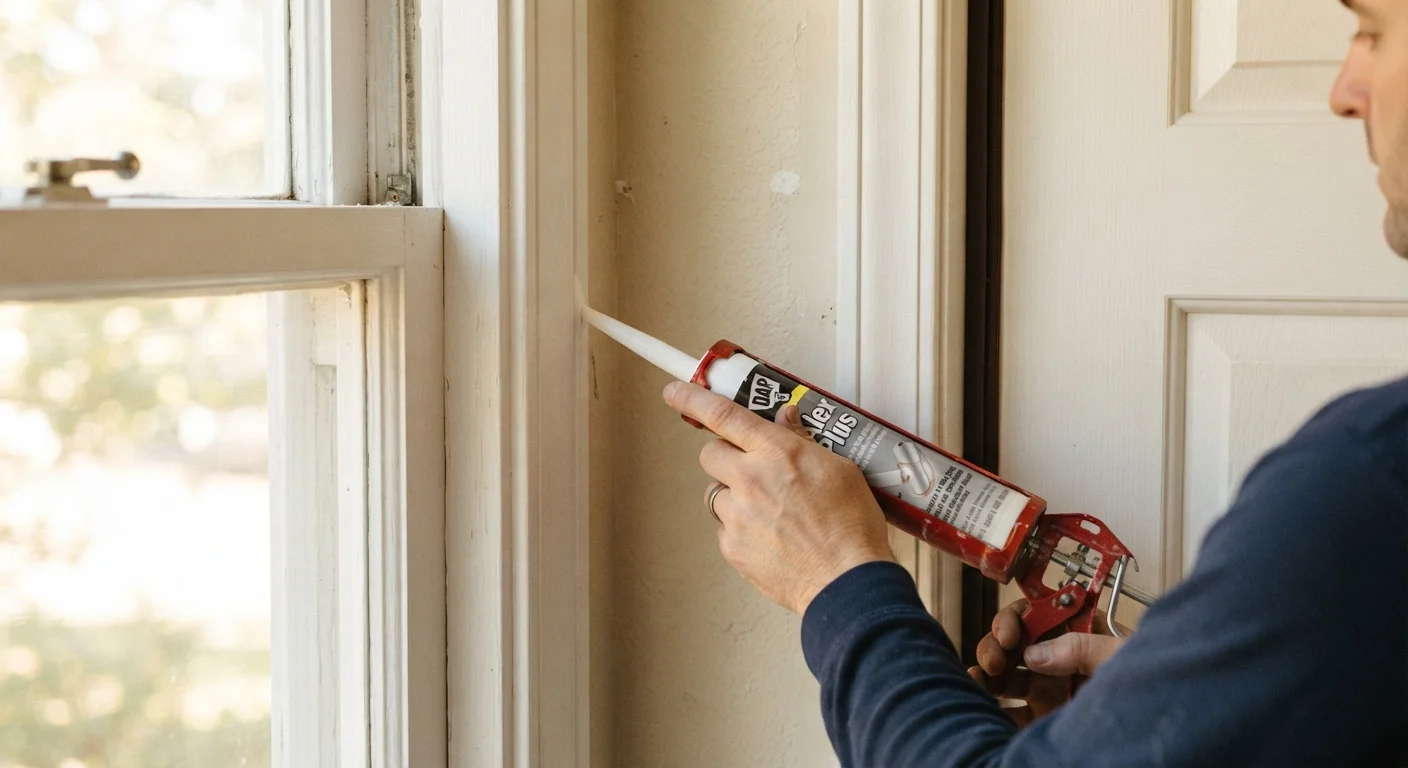
Caulk is a flexible sealant designed for gaps between two surfaces that do not move relative to each other. Think of the joint where a window frame meets drywall, where a baseboard meets the floor, or where exterior siding meets a window casing. These surfaces expand and contract slightly with temperature changes, but they don't repeatedly open and close - and that's exactly what caulk handles well.
Common caulk types
- Latex (acrylic) caulk: Easy to apply, paintable, and ideal for interior gaps. Cleans up with water before it cures.
- Silicone caulk: Highly durable and water-resistant; best for kitchens, bathrooms, and exterior use where moisture exposure is high. Harder to paint over.
- Siliconized latex: A hybrid combining paintability with added moisture resistance - a versatile choice for interior window and door frames.
Where caulk fails: applying it to a surface that flexes repeatedly - like the bottom of a door threshold - causes it to crack within weeks. For those locations, you need weatherstripping. For related bathroom sealing questions, see what bathroom maintenance actually requires.
Prep the Surface Before You Caulk
Old, cracked caulk should be fully removed before applying a new bead - caulking over failed sealant rarely lasts. Use a caulk removal tool or utility knife to scrape the joint clean, then wipe with isopropyl alcohol to remove oils and dust. Applying to a dry, clean surface dramatically improves adhesion and longevity.
Weatherstripping: Built for Moving Parts
Weatherstripping is the correct solution wherever a gap opens and closes repeatedly - along the top and sides of a door, around an operable casement window, or at a sliding door's rail. Unlike caulk, weatherstripping is a physical barrier (foam tape, V-strip, door sweeps, or bulb gaskets) that compresses when the door or window closes and springs back when it opens.
Matching type to location
- Foam tape: Inexpensive and easy to install; works well on window sashes and door stops where compression is modest. Typically needs replacement every one to three years.
- V-strip (tension seal): A durable plastic or metal strip that fits into the channel of a door or window; handles heavier use and lasts longer than foam tape.
- Door sweeps: Attach to the bottom of a door to seal the gap against the threshold; available in aluminum with a rubber seal.
- Bulb or Q-lon gaskets: Compressible rubber profiles used in high-quality exterior door frames; provide an excellent seal with proper door alignment.
Key diagnostic: if you can see daylight under or around a closed door, weatherstripping - not caulk - is your answer.
Foam and Backer Rod: Handling Larger Voids
Some gaps are simply too wide for caulk to bridge effectively. Gaps wider than roughly a quarter inch - around pipes passing through walls, behind electrical outlets on exterior walls, or in large framing voids - call for a different approach.
- Backer rod: A foam cord pressed into wide gaps before caulking. It fills the void inexpensively so caulk bonds properly at the surface rather than spanning the full depth, which prevents cracking.
- Expanding spray foam: Fills irregular voids around pipes, rim joists, and penetrations. Available in low-expansion formulas (preferred around window and door frames to avoid warping) and high-expansion versions for open cavities.
Don't Use High-Expansion Foam Near Window Frames
Standard high-expansion spray foam can exert enough pressure to bow or warp window frames as it cures, making windows difficult or impossible to open. Always use a low-expansion or 'window and door' formulation when sealing around any framed opening. Read the label carefully before you apply - the two product types look similar on the shelf.
For larger-scale insulation decisions that pair with sealing work - such as whether to add batting or spray foam in wall cavities - fiberglass vs. spray foam insulation covers the trade-offs in detail.
Side-by-Side: Choosing the Right Fix
The table below summarises when to reach for each solution based on gap location and movement.
| Caulk | Weatherstripping | Expanding Foam / Backer Rod | |
|---|---|---|---|
| Best gap type | Static, non-moving joints | Gaps that open and close | Large or irregular voids |
| Typical locations | Window frames, baseboards, trim | Doors, operable windows | Pipe penetrations, rim joists, framing gaps |
| DIY difficulty | Low - gun and steady hand | Low to moderate | Low to moderate |
| Durability | 5-20 years depending on type | 1-10 years by material | Foam: permanent; backer rod: lasting |
| Main failure mode | Cracking if applied to moving surfaces | Compression fatigue over time | Over-expansion can warp frames |
| Paintable | Latex yes; silicone generally no | Usually not | Paintable after cure (check label) |
If you're unsure whether a gap is truly static, watch it across a few door or window cycles. Movement you can see or feel means weatherstripping belongs in the equation.
When to Call a Professional
Most caulking and weatherstripping tasks are well within DIY reach. However, some gaps signal problems that go beyond a tube of sealant:
- Gaps near gas lines or HVAC flues: Sealing around combustion appliances requires knowledge of clearance requirements and building codes. Incorrect sealing can restrict airflow or create carbon monoxide hazards. Always consult a licensed HVAC technician or plumber.
- Structural cracks: A crack that runs through masonry, a foundation wall, or a load-bearing framing member is not a caulking issue - it may indicate settling or structural movement that needs professional evaluation.
- Persistent moisture intrusion: If a gap is allowing water to enter and you've caulked it before without lasting success, the source may be flashing failure, roof issues, or a drainage problem rather than a simple surface gap.
Understanding your home's plumbing layout can also help you identify where pipe penetrations create hidden drafts - plumbing basics every homeowner should know provides a useful foundation.
The content provided on our blog site traverses numerous categories, offering readers valuable and practical information. Readers can use the editorial team’s research and data to gain more insights into their topics of interest. However, they are requested not to treat the articles as conclusive. The website team cannot be held responsible for differences in data or inaccuracies found across other platforms. Please also note that the site might also miss out on various schemes and offers available that the readers may find more beneficial than the ones we cover.