

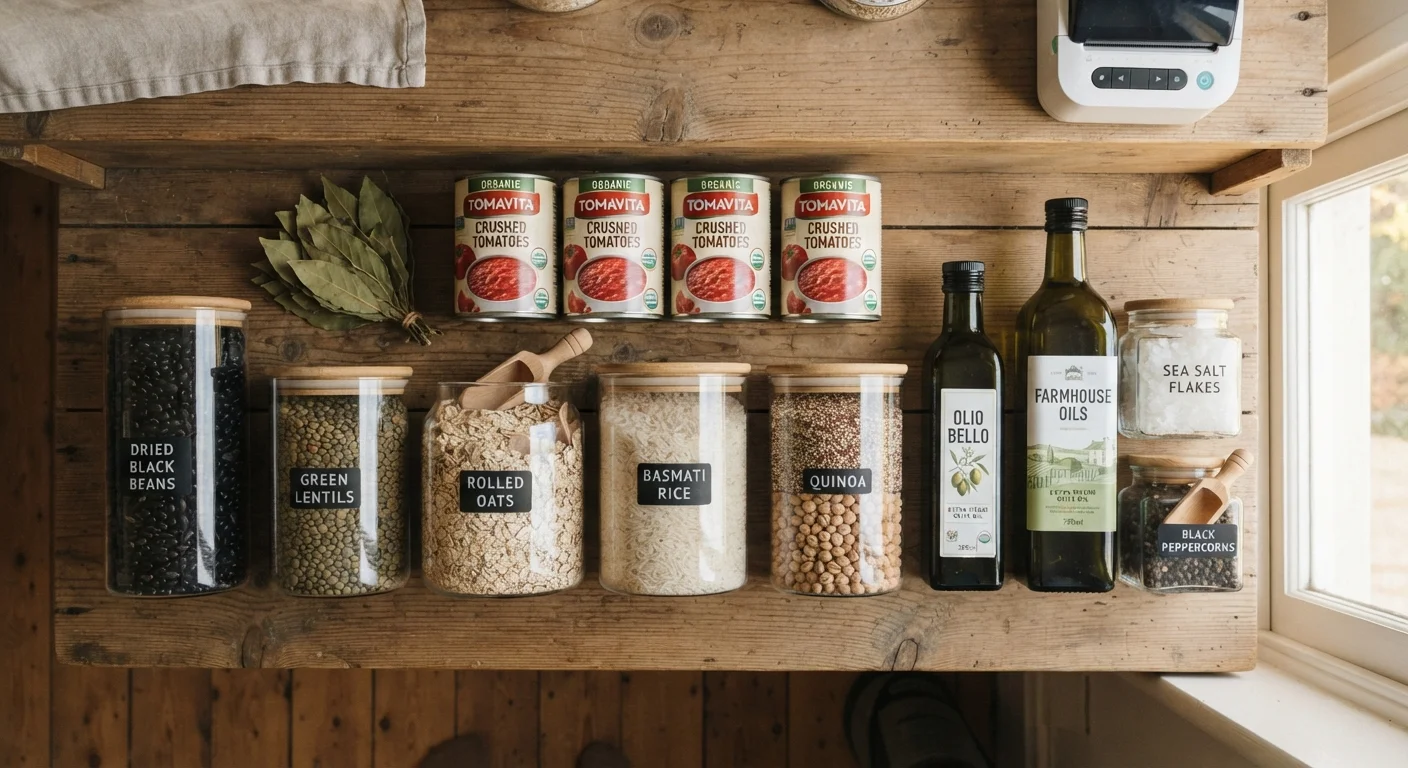
Why Pantry Staples Change the Budget Math
For most US families, food is one of the largest flexible line items in a monthly budget. Unlike fixed costs, grocery spending responds directly to purchasing decisions - and few decisions have more consistent impact than what lives in the pantry. See how grocery spending fits inside a family budget for a fuller picture of where food dollars tend to go.
The logic is straightforward: when a pantry contains versatile, shelf-stable ingredients, families have a low-cost foundation for meals at any point in the week. That reduces dependence on expensive convenience foods, takeout, and unplanned grocery runs - which are among the most reliable sources of budget overruns, as explored in our look at grocery shopping habits that quietly drain family budgets.
The staples below were selected based on three criteria: low cost per serving, high versatility across meal types, and long shelf life that minimizes waste. They aren't exotic - most are already familiar. What changes is understanding why they earn their place.
Dried beans and lentils
Dried legumes consistently rank among the most affordable sources of protein and fiber available in US grocery stores. A one-pound bag of dried lentils or black beans typically yields six to eight servings at a cost that compares favorably to nearly any protein alternative. Lentils require no soaking and cook in under 30 minutes, making them accessible even on busy evenings.
Their culinary range is broad: soups, tacos, grain bowls, stews, patties, and curries all accommodate legumes without adjustment. Families who rotate beans across different preparations rarely exhaust the format. Canned versions cost more per serving but remain a reasonable convenience option - the unit price difference is real but modest.
Dried lentils and beans deliver more protein per dollar than nearly any other grocery store option.
Rolled oats
Rolled oats are among the lowest cost-per-serving breakfast foods available, and they extend well beyond oatmeal. Oats are used in overnight preparations, baked goods, granola, and as a binder in meatballs or veggie burgers. A 42-ounce canister provides dozens of servings, and oats store reliably for 12-18 months when kept in a sealed container away from moisture.
For families trying to reduce reliance on packaged breakfast cereals - which carry a significant price premium - oats are a practical substitute. The fiber content also supports satiety, which matters when managing per-meal food volume.
A single canister of oats provides weeks of breakfasts at a fraction of the cost of boxed cereal.
White and brown rice
Rice is a caloric and budget anchor for a large share of the world's cuisines, and it earns that role in family pantries through sheer versatility and low unit cost. A five-pound bag of long-grain white rice provides around 30 half-cup dry servings. Brown rice adds fiber and nutrients with a slightly shorter shelf life due to its bran layer, but both are valuable pantry holdings.
Rice absorbs flavors from broths, spices, and sauces, which means it adapts to whatever protein or vegetable is on hand. It also scales up easily for larger households without proportional cost increases.
Rice scales effortlessly across household sizes and adapts to nearly any cuisine with minimal added cost.
Canned tomatoes
Few ingredients contribute more flavor per dollar than canned tomatoes. Crushed, diced, and whole varieties all function as a base for pasta sauces, chilis, soups, braises, and shakshuka. They eliminate the need for fresh tomatoes out of season - when fresh tomatoes are expensive and often poor quality - and store for well over a year.
Canned tomatoes also reduce the need for jarred sauces, which carry a notable markup for essentially the same core ingredient. Families who cook three to four tomato-based meals per week typically find canned tomatoes among their highest-leverage pantry items on a per-use basis.
Canned tomatoes replace expensive jarred sauces at a fraction of the cost with no real trade-off in flavor.
Dried pasta
Pasta is one of the most cost-efficient carbohydrates in the US grocery store, and its shelf life of two or more years makes it a reliable pantry buffer. A one-pound box serves four people as a main course and pairs with pantry-based sauces built from canned tomatoes, olive oil, garlic, and dried herbs - no expensive additions required.
Different pasta shapes aren't interchangeable in every recipe, but most family meals benefit from keeping two or three varieties on hand. Spaghetti, penne, and a small shape like ditalini or elbows cover most use cases.
Pasta paired with pantry sauces produces some of the lowest per-serving meal costs in home cooking.
Chicken or vegetable broth (low-sodium)
Broth functions as a cooking liquid that adds depth to rice, grains, soups, and braises without requiring fresh aromatics every time. Carton-style broth stores for months unopened and extends the flavor of simple pantry meals significantly. Low-sodium varieties are broadly recommended by nutrition professionals because they allow seasoning control at the household level.
Families who make soups regularly often find broth one of the highest-use pantry items. It also reduces the need for recipe-specific sauces or flavor packets that carry ingredient costs well above what broth provides.
Broth turns simple pantry grains and legumes into flavorful meals without adding meaningful cost per serving.
Cooking oil (neutral and olive)
Cooking fat is a fundamental input for most home cooking, and the choice of oil has both flavor and cost implications. A neutral oil - such as canola or vegetable - handles high-heat applications like sautéing and roasting at low cost. Olive oil contributes flavor at medium heat and in dressings. Keeping one of each covers most cooking needs without specialty purchases.
Larger bottles reduce unit cost meaningfully on both types, and because cooking oils store well at room temperature, larger sizes represent a straightforward unit-price win for families who cook frequently. Our primer on unit price math explains how to verify this at the shelf.
Two cooking oils - one neutral, one olive - cover virtually every home cooking need without specialty additions.
Dried spices and herbs
Spices are the variable that determines whether a pantry meal tastes intentional or improvised. A core set - garlic powder, cumin, smoked paprika, chili flakes, oregano, and black pepper - covers a wide range of cuisines and requires minimal investment. Dried spices store for 12-24 months when kept away from heat and light, making them durable pantry assets.
Buying spices in bulk bins or in larger containers (where available) substantially reduces cost per use compared to small single-use jars. The difference in flavor impact between a well-seasoned pantry meal and an unseasoned one is significant enough that spices often represent the best return on investment of any pantry category.
A core set of dried spices transforms inexpensive base ingredients into meals worth repeating.
Building the Habit Around What You Stock
Stocking these ingredients is only half the equation. The other half is rotating them consistently so nothing sits unused until it expires. A practical approach is building weekly meals backward from what's already in the pantry, then filling gaps with fresh or frozen items - a strategy detailed in our guide on meal planning on a budget.
Pantry Rotation Prevents Waste
Place newly purchased pantry items behind existing stock so older items get used first. Check expiration dates during monthly restocking rather than waiting until items are needed mid-recipe. Most dried grains and legumes remain safe and usable well past their printed date if stored in sealed containers, but quality does gradually decline - rotating regularly keeps your pantry at its most useful.
It's also worth checking unit prices when restocking. Larger package sizes often reduce cost-per-unit on staples like oats, rice, and dried beans - but as our analysis of bulk buying shows, this only holds when storage capacity and usage rates support it. On shelf-stable staples with a two-year horizon, the calculus usually does favor larger sizes.
For families working on nutrition alongside budget goals, these same ingredients form the backbone of affordable, balanced eating. The guide to feeding a family on a tight budget without sacrificing nutrition covers how to build complete meals around them. Taken together, a well-planned pantry doesn't just cut costs - it makes consistent, healthy cooking more achievable on ordinary weeknights.
The content provided on our blog site traverses numerous categories, offering readers valuable and practical information. Readers can use the editorial team’s research and data to gain more insights into their topics of interest. However, they are requested not to treat the articles as conclusive. The website team cannot be held responsible for differences in data or inaccuracies found across other platforms. Please also note that the site might also miss out on various schemes and offers available that the readers may find more beneficial than the ones we cover.