

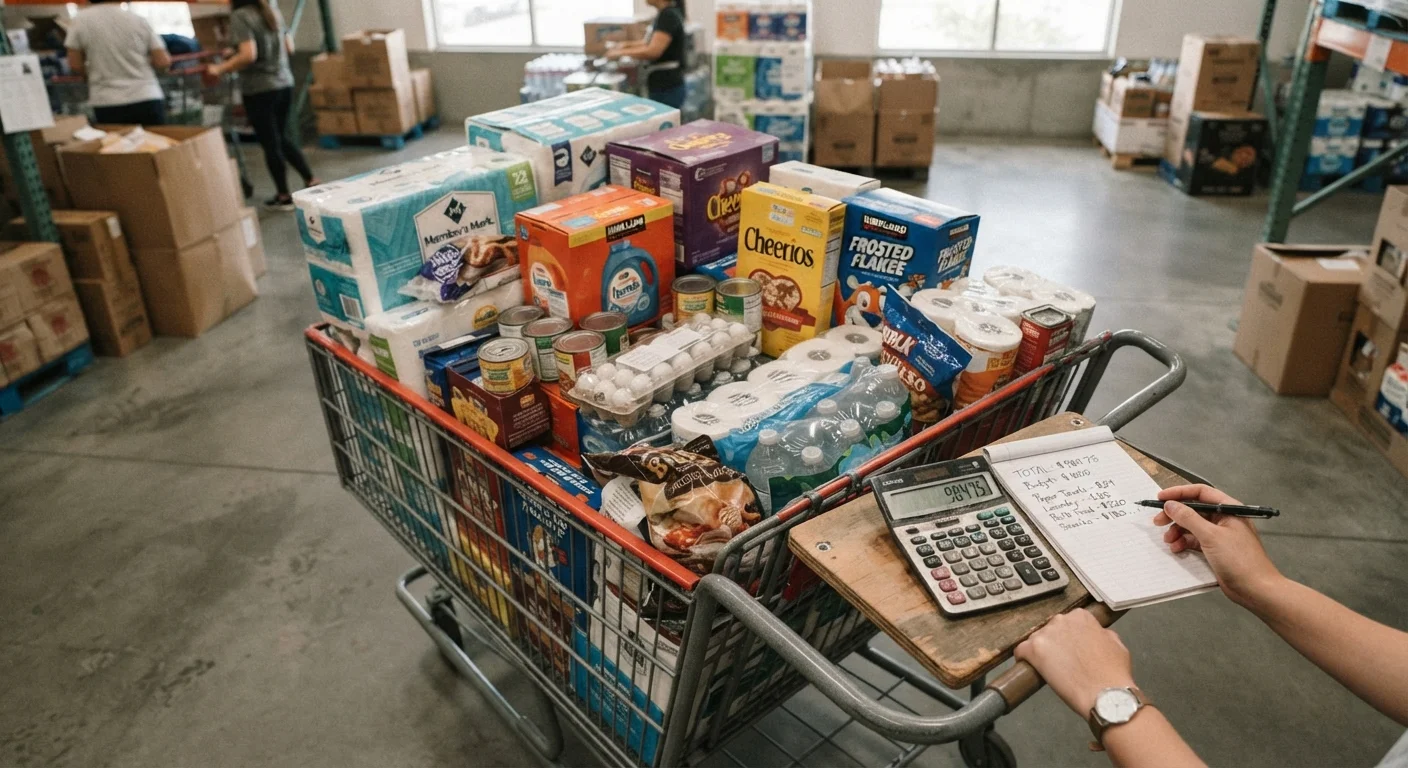
The Bulk-Buying Promise vs. the Reality
Walk into any warehouse club and the logic feels airtight: pay less per ounce, buy more at once, repeat less often. For millions of US families, bulk shopping has become a default strategy for trimming the grocery bill. The problem is that the per-unit price - the number printed on the shelf tag - is only one part of a much larger equation.
Whether bulk buying actually saves a household money depends on at least four variables: consumption rate, spoilage risk, storage capacity, and opportunity cost of the upfront spend. When those factors line up, buying in volume is genuinely smart. When they don't, it quietly inflates costs instead of cutting them. Understanding when unit pricing saves money and when it's a distraction is the foundation of any honest bulk-buying analysis.
Myth
Buying in bulk always costs less per unit, so it always saves money.
Fact
A lower unit price only saves money if the entire quantity is used - spoilage and waste can push the real cost higher than the regular-size alternative.
Unit price is a useful comparison tool, but it's a starting point, not a conclusion. If a family buys a 64-ounce jar of salsa at a 30% lower unit cost but uses only half before it molds, the effective price per ounce consumed is 40% higher than the smaller jar. The savings calculation must account for what actually gets used, not what gets purchased.
Myth
Warehouse club membership fees are worth it for any family that shops there regularly.
Fact
Membership fees are a fixed annual cost that must be recovered through actual savings - families who shop infrequently or primarily buy perishables may not break even.
A $65-$120 annual membership requires a household to generate that much in genuine savings just to reach zero. Families who visit monthly and purchase high-turnover non-perishables can realistically achieve this. Those who go occasionally or fill their cart mainly with fresh produce and bakery items often don't. Running a simple tally of one year's purchases is the only honest way to know.
Myth
Buying more at once means fewer trips, which means less total spending.
Fact
Fewer trips reduce impulse purchases at the regular store, but warehouse clubs are specifically designed to encourage large unplanned purchases - offsetting that advantage.
The store-trip savings argument has some logic: fewer visits to a regular grocery store can reduce impulse buys. But warehouse clubs use wide aisles, oversized displays, and end-cap sampling stations specifically to increase basket size beyond what shoppers planned. Research on consumer behavior consistently finds that shoppers in large-format stores exceed their intended spend more often than those in standard grocery environments. Common shopping patterns that lead to higher spending are worth recognising before assuming fewer trips always mean lower costs.
Myth
If a bulk item is on sale, it's definitely a better deal than the regular grocery store price.
Fact
Sale prices at warehouse clubs and grocery stores are often set relative to different baselines - without comparing unit prices across stores, the 'sale' may not be the lowest available price.
Sale pricing mechanics are more complex than they appear. A promotional price at a warehouse club may still be higher per unit than an everyday price at a standard grocery store, particularly for store-brand equivalents. Understanding what sale price really means at major grocery chains - and checking unit prices across formats - is the only reliable way to verify a genuine discount. It's also worth comparing against store-brand alternatives: store brand vs. name brand differences often reveal overlooked savings.
Myth
Bulk buying perishables is fine if you have a large family.
Fact
Household size helps, but consumption rate relative to spoilage timelines - not headcount alone - determines whether bulk perishables are a sound choice.
A four-person household may still waste a significant portion of a 3-pound container of strawberries if the family's eating habits, schedule, or preferences vary week to week. Realistic consumption patterns, not idealized ones, should drive the decision. Families who notice consistent food waste may benefit from reviewing grocery shopping habits that quietly undermine food budgets for patterns that compound the problem.
Where the Math Actually Breaks Down
Spoilage is the most underestimated cost in bulk shopping. A family that buys a 5-pound tub of mixed greens at a lower per-ounce price but discards half of it hasn't saved anything - they've paid more for the portion they used than they would have at a regular grocery store. The USDA estimates that US households waste roughly 30-40% of their food supply, and oversized packages are a documented contributor to that pattern.
Perishables Bought in Bulk Carry Real Waste Risk
Fresh produce, dairy, and proteins have fixed spoilage windows that don't adjust to how much you purchased. Before buying a bulk perishable, calculate whether your household can realistically consume the full quantity within that window - not in theory, but based on actual recent eating patterns. When in doubt, a smaller quantity at a slightly higher unit cost produces less waste and a lower effective price per usable portion.
Storage is a second hidden cost. Refrigerator and freezer space is finite, and bulk perishables that displace other food can lead to secondary waste elsewhere. For dry goods, extra shelving or dedicated pantry space has a real cost - particularly in smaller homes or apartments.
The upfront cash requirement matters too, especially for budget-constrained families. Tying up $60 in a single bulk purchase may mean less flexibility for other grocery needs that week, even if the long-run unit economics look favorable. This pattern is covered in more depth in our look at where grocery spending actually goes inside a family budget.
30-40%
US household food wasted annually
According to USDA estimates, American households discard between 30 and 40 percent of the food supply, with oversized package sizes identified as a contributing factor.
$1,500+
Average annual household food waste cost
The Natural Resources Defense Council has estimated that the average US family of four loses over $1,500 per year to food that is purchased but not consumed.
$65-$120
Typical annual warehouse club membership fee
Major warehouse club memberships carry annual fees in this range, a fixed cost that must be offset by verifiable savings on purchases to provide a net benefit.
What Bulk Buying Gets Right - and When to Use It
None of this means bulk buying is a bad strategy. For the right products and the right households, it delivers genuine savings. The key is being selective rather than treating every bulk option as an automatic win.
Shelf-stable, high-turnover staples are the strongest candidates: dried beans, rice, pasta, cooking oil, canned goods, dish soap, paper products, and laundry detergent. These don't spoil on a household timeline, they're used consistently, and they don't require unusual storage. If a family reliably goes through a product within its usable lifespan, the lower unit price translates directly into savings.
Perishables are where caution is warranted. Produce, dairy, bread, and fresh proteins carry a real spoilage window. Unless a household is large enough - or disciplined enough - to consume bulk quantities within that window, the effective cost per usable unit often exceeds the regular-size price. Certain shelf-stable ingredients consistently lower per-meal costs - and those are exactly the categories where bulk purchasing delivers the clearest return.
Membership fees also deserve honest accounting. A warehouse club annual fee, typically ranging from $65 to over $120, is a fixed cost that only pays off if total savings on purchases exceed that amount. Families who shop infrequently or buy primarily fresh food may not cross that threshold. For a broader look at habits that inflate grocery costs without obvious signs, see grocery shopping habits that quietly drain family budgets.
This article is for general informational purposes only and does not constitute personalised financial advice. Readers should assess their own household needs and consult relevant resources when making budgeting decisions.
The content provided on our blog site traverses numerous categories, offering readers valuable and practical information. Readers can use the editorial team’s research and data to gain more insights into their topics of interest. However, they are requested not to treat the articles as conclusive. The website team cannot be held responsible for differences in data or inaccuracies found across other platforms. Please also note that the site might also miss out on various schemes and offers available that the readers may find more beneficial than the ones we cover.