

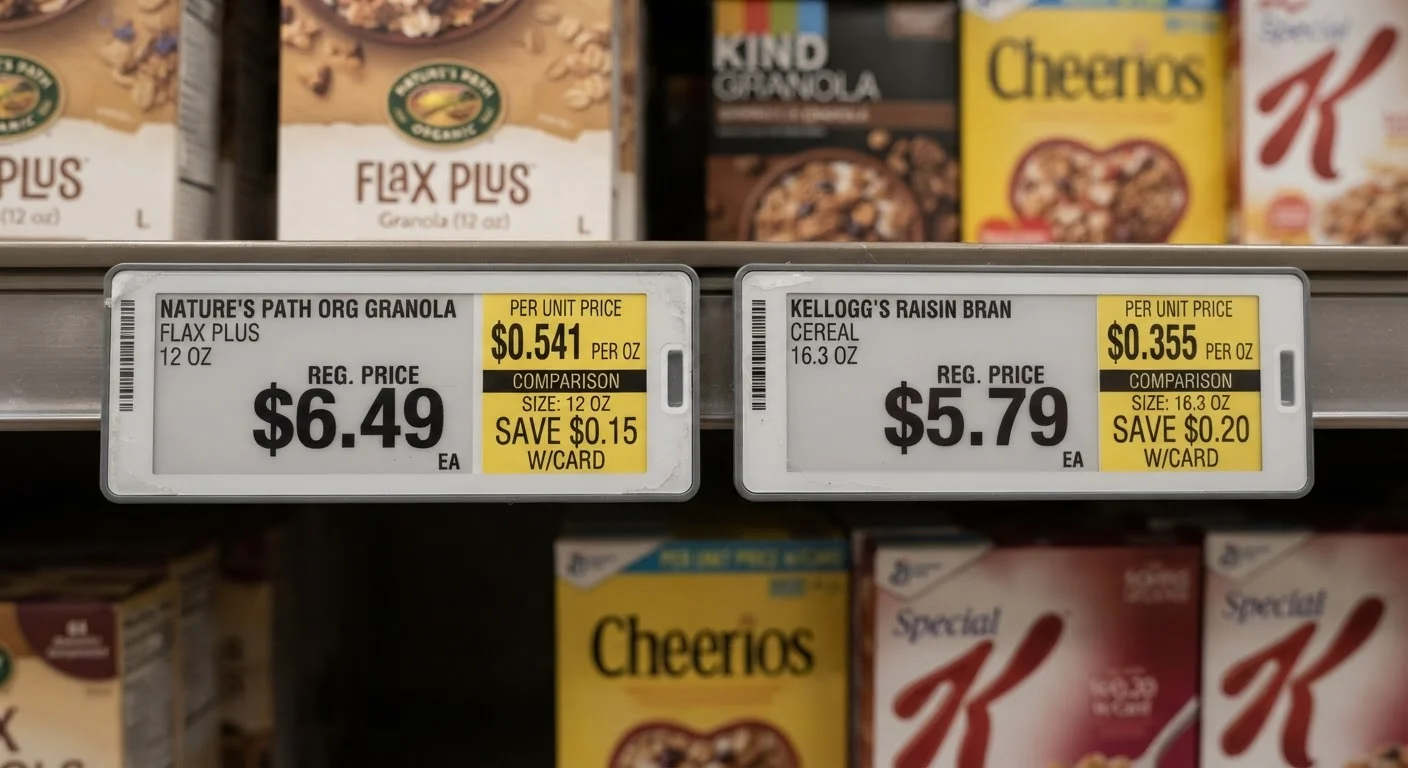
Option A
Sticker Price
The upfront number that dominates our attention.
Best for: Quick budget checks when comparing items of identical size, format, or quantity.
Option B
Price Per Unit
The standardized metric that levels the playing field.
Best for: Comparing products across different package sizes, brands, or quantities to find true value.
Why the Number on the Tag Can Mislead You
Sticker price is the number retailers design you to see first. It anchors your perception of a product before you've thought about quantity, concentration, or usage rate. A $4.99 bottle of dish soap feels cheaper than an $8.49 bottle - until you notice the first is 16 oz and the second is 48 oz.
This is why sticker price, as a standalone metric, is often a distraction rather than a guide. It answers only one question: what does this cost to put in my cart today? It does not answer: what am I actually getting for that money?
Price per unit - typically expressed as cost per ounce, per count, per square foot, or per serving - reframes the question. Instead of comparing total package prices, you're comparing the cost of a consistent, standardized unit across products. That's the number that reflects real-world value for anything you consume, refill, or replace regularly.
For a deeper look at how sticker-anchored thinking extends to bigger purchases, see our piece on the true cost of owning a car - where the window sticker is rarely the whole story.
How to Read and Use Unit Pricing
In most US states, retailers are required to display unit prices on shelf tags for grocery and household goods. The format is usually printed in smaller font than the sticker price - a design reality that requires you to actively look for it. The unit shown (per oz, per 100 sheets, per load) varies by product category, so you can only compare unit prices when they use the same unit.
| Criterion | Sticker Price | Price Per Unit |
|---|---|---|
| What it measures | Total package cost | Cost per standardized unit |
| Best for | Budget ceiling checks | Cross-size value comparisons |
| Misleading when | Package sizes differ | Spoilage or storage limits apply |
| Displayed prominently? | Always - large font | Usually smaller, easy to miss |
| Applies to durable goods? | Yes, as a starting figure | Rarely useful |
| Applies to consumables? | Partially | Yes - most reliable metric |
A few important caveats apply. Unit price calculations assume you'll use the entire product before it expires or loses quality. For perishables, a lower unit price on a larger package isn't a savings if a portion ends up discarded. Buying in bulk doesn't always save money once spoilage, storage cost, and cash flow are factored in.
Also worth noting: sale tags can complicate unit price comparisons. A "sale" sticker doesn't guarantee a lower unit price than the competing shelf brand. Our coverage of what sale price really means at major grocery chains breaks down the tactics that make this easy to miss.
When Sticker Price Still Matters
Unit pricing isn't universally superior. There are clear situations where the sticker price should govern your decision:
- Hard budget limits: If your weekly grocery budget has a firm ceiling, the sticker price determines whether an item fits. A lower unit price on a large package may save money over time but blow your immediate cash flow.
- One-time or durable purchases: For appliances, tools, or furniture, unit-price logic doesn't apply. Here, the relevant framework is total cost of ownership - purchase price, maintenance, energy use, and lifespan combined.
- Fixed-quantity needs: If you need exactly one item in a standard size - a single greeting card, a specific medication dose - comparing unit prices across sizes is irrelevant.
~30+
US states with unit pricing laws for groceries
Many US states require unit prices on shelf labels for packaged grocery and household goods, though enforcement and format vary by jurisdiction.
Up to 40%
Potential per-unit cost difference across package sizes
Consumer research consistently finds wide per-unit price variation between small and large package sizes of the same product within a single store.
The practical skill is knowing which number to reach for given the specific purchase. Most everyday consumable shopping benefits from unit price scrutiny. Most one-time or large-ticket purchases benefit from a broader cost framework instead. And for the full breakdown of unit price mechanics at the shelf level, our unit price math guide walks through exactly how to read those shelf tags efficiently.
The content provided on our blog site traverses numerous categories, offering readers valuable and practical information. Readers can use the editorial team’s research and data to gain more insights into their topics of interest. However, they are requested not to treat the articles as conclusive. The website team cannot be held responsible for differences in data or inaccuracies found across other platforms. Please also note that the site might also miss out on various schemes and offers available that the readers may find more beneficial than the ones we cover.