

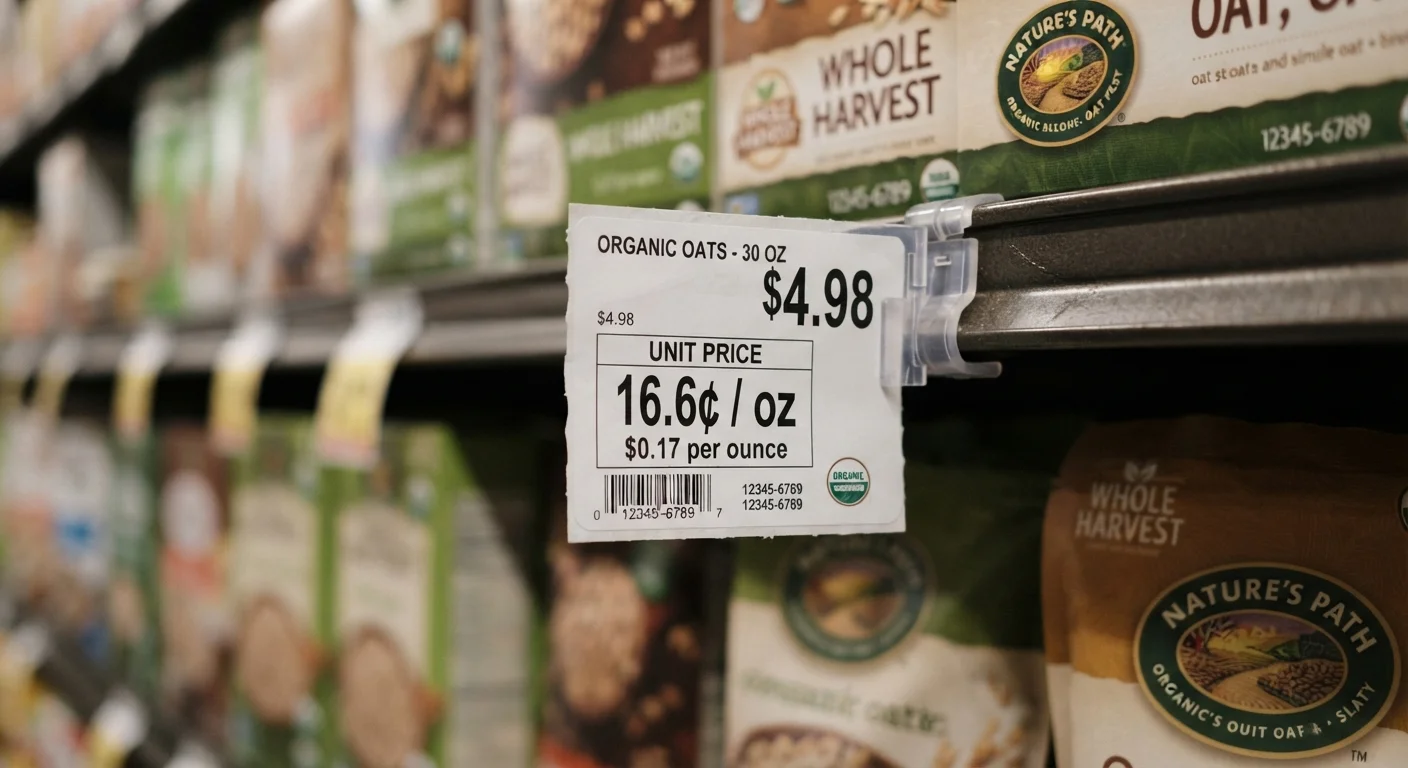
Why the Sticker Price Is the Wrong Number to Compare
Grocery stores stock thousands of products in dozens of package sizes. A 28-oz jar of pasta sauce and a 45-oz jar of the same sauce from the same brand aren't easily compared by their sticker prices alone - one is simply larger. Yet most shoppers instinctively reach for the item with the lower price on the tag, without stopping to run the math.
This is exactly the problem unit pricing solves. By expressing cost in a consistent unit - per ounce, per pound, per 100 sheets - it collapses the packaging variable and surfaces the actual cost of what you're buying. Sticker price is rarely the whole story, particularly when sizes, brands, or promotional tags are in the mix.
The sticker price answers "how much do I pay at the register for this specific item?" Unit price answers the more useful question: "how much am I actually paying for the product itself?"
How to Read and Calculate a Unit Price
On most shelf labels, the unit price appears as a smaller figure - often in the top corner - labeled something like $0.18/oz or $2.14/lb. The sticker price (the larger number) is what you'll pay; the unit price is what you should compare.
If a label is missing or unclear, the math is straightforward:
- Find the total price and the package quantity (weight, volume, or count).
- Divide the price by the quantity.
- The result is your unit price.
For example: a 32-oz bottle of dish soap at $4.48 works out to $0.14 per ounce. A 20-oz bottle at $3.20 is $0.16 per ounce. The larger bottle costs less per ounce even though its sticker price is higher.
~30%
Potential unit price gap between sizes
Consumer research has documented unit price differences of 20-30% or more between the smallest and largest available sizes of the same product in common grocery categories.
32 states
US states with unit pricing regulations
According to the National Conference of State Legislatures, roughly 32 US states have statutes or regulations addressing unit price disclosure in retail settings, though scope and enforcement vary.
~$1,500
Estimated annual grocery overspend per household
Consumer advocacy research suggests US households that don't actively compare unit prices may routinely overpay by hundreds to over a thousand dollars annually across grocery categories.
One complication: stores don't always use the same unit across competing products. If one label shows cost per ounce and another shows cost per pound, you'll need to convert. Divide the per-pound figure by 16 to get per-ounce - a step that takes seconds on a phone calculator but trips up many shoppers.
Where Stores Obscure the Unit Price
Retailers have an incentive to make premium or higher-margin products look attractive, and shelf layout can subtly work against the consumer. A few patterns worth knowing:
- Inconsistent units: Competing products on the same shelf may have unit prices listed in different measurements, making direct comparison harder than it should be.
- Sale tags that omit unit price: Promotional labels sometimes display only the sale sticker price, dropping the unit price that appears on the standard label.
- Small print placement: Unit prices are often printed in the smallest font on the label, positioned where the eye doesn't naturally land.
- End-cap displays: Products featured on aisle end caps frequently carry the implication of being a deal - but their unit prices are often no better than shelf alternatives.
Sale tags use several pricing tactics that aren't always discounts. A "sale" item with a higher unit price than a non-sale competitor isn't actually saving you money on the product itself.
Keep a Notes App Price Log
After a few shopping trips, jot down the unit prices you pay for your five most frequently purchased staples. This takes under two minutes and gives you a personal benchmark you can verify against instantly at the shelf. When a unit price is noticeably higher than your baseline, that's a signal to look at alternatives before adding the item to your cart.
Applying Unit Pricing to Build Smarter Habits
Unit pricing is most powerful when it becomes a habit rather than an occasional check. A few practical ways families use it consistently:
- Build a mental benchmark: Over a few shopping trips, note your household's typical unit price for staples like oats, olive oil, or canned tomatoes. When a price deviates significantly, you'll notice. A practical reference covering how prices typically range across common grocery categories can serve as a useful starting point.
- Buy bulk only when it makes sense: Bulk sizes are worth their lower unit price only if you'll use the product before it expires or degrades. A better unit price on a product you waste isn't a saving.
- Cross the brand line: Unit pricing neutralizes the visual influence of packaging. Store brands frequently carry materially lower unit prices in categories like canned goods, grains, and cleaning products - certain shelf-stable ingredients consistently lower per-meal costs.
- Check before stocking up on a sale: If a sale item has a higher unit price than the shelf alternative, buying ten of them amplifies the overpay rather than preventing it. Several common shopping patterns consistently lead to higher spending - stocking up on poorly priced sale items is one of them.
Frequently Asked Questions
Most stores print the unit price in small text on the shelf label directly below or beside the sticker price. It typically appears as a cost per ounce, pound, liter, or count. Some stores use a different measurement unit than the package label, so read carefully before comparing.
Not always. While bulk sizes often offer lower unit prices, this isn't guaranteed - especially for store-brand versus name-brand comparisons, or during promotional pricing. Always calculate or read the unit price rather than assuming size equals savings.
This is a common hurdle. If one label shows cost per ounce and another shows cost per pound, divide the per-pound price by 16 to convert to per-ounce for a fair comparison. Most smartphones have a calculator app that makes this quick work at the shelf.
Requirements vary by state. Some states mandate unit pricing for covered categories like food and cleaning products; others do not. Where it isn't required, some retailers still display it voluntarily. When a label is missing, you can calculate it yourself using the package weight and sticker price.
Yes. For products like paper towels, batteries, or snack pouches, cost per count (per sheet, per cell, per pouch) is the relevant metric. Sheet count and absorbency can also affect true value, so unit price is a starting point rather than the whole picture.
Absolutely. Unit pricing removes packaging bias and lets you see the actual price gap between a store brand and a name brand in the same category. The decision still involves quality preferences, but the math gives you a clear baseline.
The content provided on our blog site traverses numerous categories, offering readers valuable and practical information. Readers can use the editorial team’s research and data to gain more insights into their topics of interest. However, they are requested not to treat the articles as conclusive. The website team cannot be held responsible for differences in data or inaccuracies found across other platforms. Please also note that the site might also miss out on various schemes and offers available that the readers may find more beneficial than the ones we cover.