

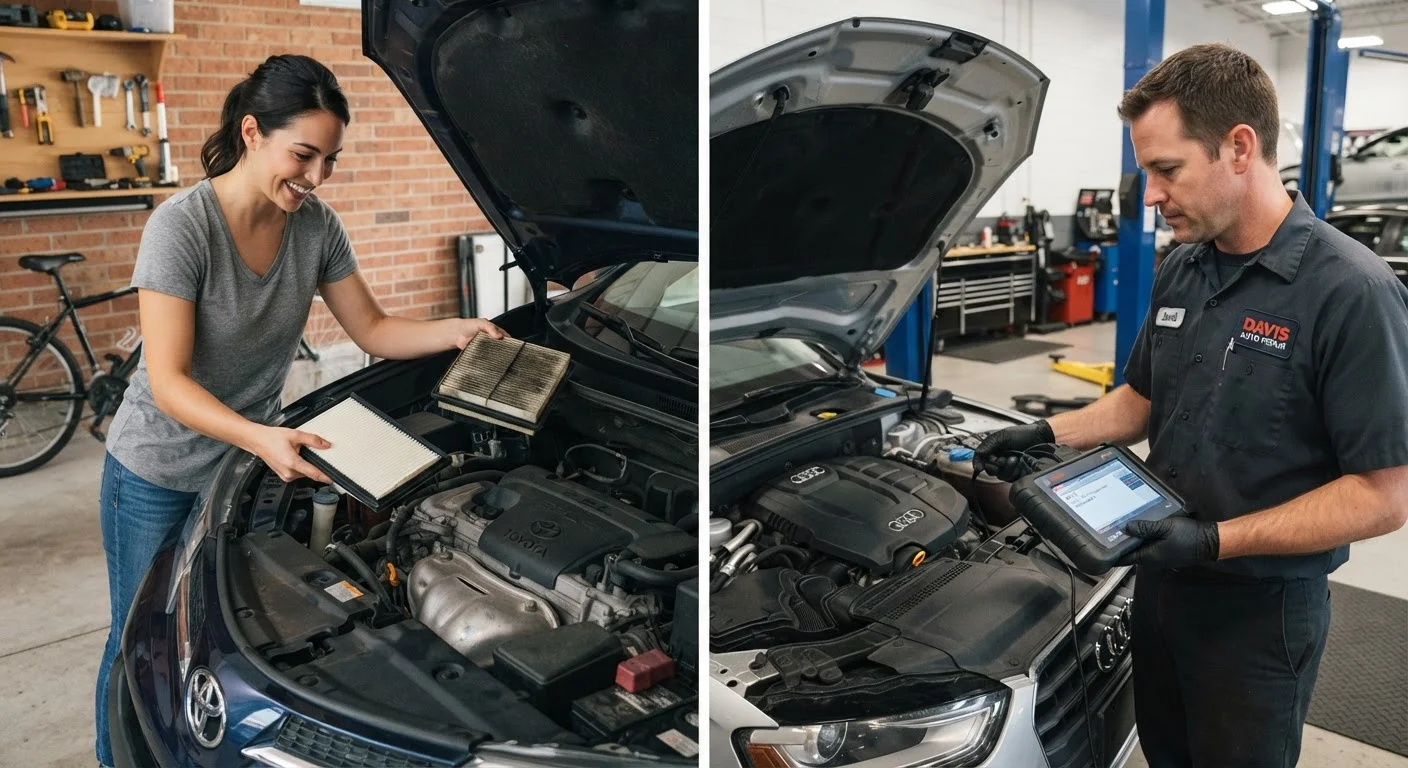
Our Verdict
Neither DIY nor professional service wins outright - the right choice depends entirely on the specific task, your comfort level, and the tools you have available. For routine, accessible maintenance, doing it yourself can deliver meaningful savings. For anything touching safety systems, emissions controls, or complex electronics, a qualified mechanic is worth the cost.
| Best for | Recommended |
|---|---|
| Families looking to cut routine maintenance costs | DIY maintenance for simple tasks |
| Anyone dealing with brakes, suspension, or warning lights | Professional shop service |
| First-time owners building confidence gradually | DIY for basic checks, shop for anything unfamiliar |
| Vehicles still under manufacturer warranty | Professional shop service to protect coverage |
The Real Question: Task Complexity, Not Just Cost
The DIY-vs-shop debate is rarely about pride - it's about matching the job to the right level of skill, tools, and risk tolerance. Some maintenance tasks require nothing more than a screwdriver and a YouTube tutorial. Others involve pressurized systems, precision torque specs, or onboard computer resets that genuinely require professional equipment.
Before picking up a wrench, ask three questions: Do I have the right tools? Could a mistake create a safety hazard? Will doing this myself void my warranty? If the answer to any of those is uncertain, that's useful information - not a failure.
For a broader look at what your vehicle actually needs and when, see your family car's maintenance schedule, decoded.
| DIY at Home | Professional Shop | |
|---|---|---|
| Air & cabin filter replacement | Easy, low risk, saves $20-$50 | Convenient but unnecessary markup |
| Oil change | Feasible; requires disposal planning | Fast, includes inspection, moderate cost |
| Wiper blade swap | Minutes, no tools needed | Quick but rarely worth the service fee |
| Brake pad replacement | High risk if done incorrectly | Recommended; safety-critical system |
| Check engine light diagnosis | Code reading only; easy to misinterpret | Full diagnostic with proper equipment |
| Timing belt service | High error risk; special tools needed | Essential professional job |
| Tire pressure check | Cheap gauge, takes two minutes | Free at most shops but DIY is easier |
What Most Drivers Can Handle at Home
Several routine tasks are well within reach for anyone willing to read the owner's manual and take basic precautions.
- Engine air filter replacement: Typically a no-tool job on most vehicles. A clogged filter reduces fuel efficiency, and swapping it takes minutes.
- Cabin air filter: Usually tucked behind the glove box. Minor components like this are often overlooked but easy and cheap to replace yourself.
- Windshield wiper blades: Most blade sets include fitting instructions and snap on without tools.
- Battery terminal cleaning: A mixture of baking soda and water, a wire brush, and basic safety gloves is all it takes to clean corrosion from terminals.
- Fluid top-offs: Checking and topping up washer fluid, coolant reservoir, and power steering fluid (where applicable) is straightforward. Note: Never open a hot radiator cap.
- Tire pressure checks: A $10-$15 gauge is accurate enough for routine monitoring.
New owners can find a solid starting framework for exactly these beginner-friendly tasks.
Start With Your Owner's Manual
Your vehicle's owner's manual specifies the correct fluid types, torque values, and service intervals for your exact model. Before attempting any DIY task, confirm the procedure and specs there first. Manufacturer-approved procedures help protect your warranty and prevent mismatched parts or fluids.
When a Professional Shop Is the Smarter Call
Other jobs carry consequences that make the cost of professional service a reasonable investment.
- Brake pad and rotor work: Brake failure is one of the leading causes of collision. Improper installation - wrong torque, uneven wear, missed caliper issues - creates serious hazards. This is one area where professional service is strongly advisable.
- Suspension and steering components: These systems interact in ways that require alignment equipment to verify. A mistake here affects handling at highway speeds.
- Timing belt or timing chain: These require precise reinstallation and often special locking tools. An error can cause catastrophic engine damage.
- Check engine light diagnostics: Reading a code with a basic scanner tells you a fault category, not a root cause. Misinterpreting the data and replacing the wrong part is a common and costly mistake.
- Transmission service: Fluid type, fill level, and procedure vary widely by vehicle and are easy to get wrong without proper training.
Deferred professional service on these items is one of the patterns covered in the maintenance tasks families most often put off.
Don't Guess on Safety-Critical Systems
Brakes, steering, and suspension directly affect your ability to control the vehicle. If you're uncertain about any step in a repair involving these systems, stop and consult a qualified mechanic. A partial or incorrect repair on a safety-critical component is more dangerous than leaving the job undone while you arrange professional service.
Calculating the Real Cost Difference
DIY savings are real but not always as large as they first appear. Parts markups at shops are genuine - a professional oil change may cost twice what the oil and filter cost at a parts store. For simple, repeatable tasks, those savings accumulate meaningfully over years of ownership.
But factor in the other side: specialty tools (torque wrenches, oil filter pliers, brake bleeders) can cost $50-$200 or more and may only be used once. Disposal fees for used oil are sometimes overlooked. And if a DIY mistake requires a shop visit to correct, you've paid twice.
For families working to reduce overall car ownership costs, the practical approach is a tiered one: build DIY competence on low-risk, repeatable tasks while budgeting professionally for anything safety-critical. Staying current on the right maintenance tasks is the larger savings lever regardless of who does the work.
For a broader household lens, the same logic applies across other domains - see which home tasks are genuinely DIY-friendly for a parallel framework.
The content provided on our blog site traverses numerous categories, offering readers valuable and practical information. Readers can use the editorial team’s research and data to gain more insights into their topics of interest. However, they are requested not to treat the articles as conclusive. The website team cannot be held responsible for differences in data or inaccuracies found across other platforms. Please also note that the site might also miss out on various schemes and offers available that the readers may find more beneficial than the ones we cover.